KHABAT, Iraq — On a dirt road strewn with shattered concrete, Jalal Rashidi bent to pick up a shard of jagged debris. A piece of a drone, he said, that crashed into a compound of exiled Iranian Kurds soon after the United States and Israel launched their war on Iran.
About 40 families were preparing to break the Ramadan fast here in northern Iraq on March 5 when drones struck, Rashidi said. They blew out windows, peppered walls with shrapnel and tore open a courtyard.
Rashidi’s pregnant wife, he said, lost their baby. He blamed Iranian-backed militias in Iraq.
Rashidi, 51, who left Iran as a child in the 1980s, was now hopeful, he said, that the war would bring the collapse of the Islamic republic in Tehran — and he was prepared to return to his homeland to help.
“This is a war of existence: To be or not to be,” he said. But “we need support. We cannot do it by ourselves.”
In the holy city of Najaf, some 370 miles to the south, the view of the war was sharply different. Home to the Shrine of Ali, the prophet Muhammad’s son-in-law and, for Shiite Muslims, successor, Najaf hosts Iraq’s clerical hierarchy and many seminaries.
Ali Reza, a 28-year-old seminarian from central Iran who has studied here for eight years, has watched the war with concern. His home city, Khomein, hides an underground missile base that has been targeted repeatedly. His parents and sister have fled for the relative safety of a village nearby, he said, but believe it’s their “national duty” to stay in Iran.
The killing of Iran’s supreme leader, Ayatollah Ali Khamenei, on the first day of the war struck him deeply, he said. He went to the Shrine of Ali, where he found mourners crying and shouting.
Although he was a disciple of Grand Ayatollah Ali al-Sistani, Iraq’s top Shiite critic, not Khamenei, he said, he “began to cry as if I had lost my father.”
“When someone is killed like this by a foreign power, it is clear to people that he is a martyr for the homeland,” he said. “If there is a land invasion, I will return to Iran to fight.”
“Not just me,” he added. “All Iranians, inside and outside.”
Iraq, long a regional magnet for exiles, foreign students and pilgrims, is home to hundreds of thousands of Iranians and people of Iranian descent. Members of the diaspora, from Sunni Muslim Kurds in the north to Shiite Persians in the south, are as divided over the war as they are back home.
“If we are called to defend the country, I will return immediately,” said Hassan Mousawi, a 32-year-old seminarian who has studied in Najaf for a decade. “This is a test of history. Iran will not fall — it will emerge from this war victorious, with its head held high.”
In Sulaymaniyah, Amir, too, dreamed of going back — to topple the regime.
“There are many armed fighters inside Iran,” the 34-year-old said. “We are waiting for the right moment. … All we need is air support. We can do the rest on the ground.”
His wife, Zahraa, expressed caution. Both spoke on the condition that their last names be withheld for fear of retaliation.
“I’m afraid the world will not finish what it starts,” said Zahraa, 30. “We have seen this before.”
The couple, from Kermanshah in western Iran, participated in the antigovernment protests that erupted in Tehran in December and quickly spread nationwide. The regime, facing the greatest challenge to its authority since its founding, cracked down hard, killing as many as tens of thousands of people.
Amir believed the country’s Kurdish regions, where there is significant support for an autonomous state, were targeted disproportionately.
“All groups protested,” he said, “but Kurds paid the highest price.” The couple escaped to the mountains and, with the help of contacts linked to Kurdish opposition groups, made their way to Iraq.
“Now we are wanted,” Amir said. “If we are arrested, we will be executed.”
Zahraa worried about the loved ones they left behind.
“I don’t know what will happen to them,” she said. “I escaped to save my life — but I don’t know if they will take revenge on my family.”
Reza, in Najaf, acknowledged the protests. But he believed they went too far.
“Some people began asking Trump and Netanyahu to bomb Iran,” he said. “I cannot understand this at all. Even if you have problems with your government, you don’t invite foreign powers to destroy your country.”
When Khamenei was killed on Feb. 28, Reza said, he “feared internal unrest.”
“Internal conflict is more dangerous than external attack,” he said. “But the opposite happened”: People took to the streets to support the government.
“They united against external enemies,” he said. “That’s when I realized the regime will not fall.”
Not everybody united. There were also spontaneous celebrations, and not only in Kurdish areas.
Since the start of the war, militias backed by Tehran and funded by Baghdad have launched hundreds of attacks on U.S. diplomatic and military sites in Iraq. In March, the U.S. Embassy and the Baghdad Diplomatic Support Center were targeted with drones and projectiles, the State Department said. In April, U.S. diplomats in Baghdad were ambushed by drones.
Washington has pushed the Iraqi government hard to disarm and remove these groups from state institutions and payrolls, blocking the return of former prime minister Nouri al-Maliki and reportedly threatening to withhold full financial and security support unless new Prime Minister Ali al-Zaidi reins the groups in.
Rashidi, in Khabat, described himself as part of a broader Kurdish opposition movement. Affiliated fighters remain active and in contact with networks inside Iran, he said, even as communication has become more challenging, ready to take on the regime.
“When communication is cut,” he said, “people cross the border illegally to carry messages.”
At the Haji Omran border crossing, high in the mountains that rise along the countries’ 1,000-mile frontier, Azad had just returned from a visit with family in Mahabad, a Kurdish center in Iran.
It was days into the war. He visited his hometown regularly, he said, but this time felt different: “People are preparing for the fall of the regime.”
The state’s visible presence had receded, he said. Security forces no longer appeared in uniform on the streets but were instead blending into civilian areas, mosques, hospitals and residential neighborhoods. “At checkpoints, there used to be many officers,” he said. “Now there is no one.”
Prices had risen, the banking system was barely functioning, and shortages of food and medicine were growing more common. Still, he said, people were choosing to remain in Iran, hoping to play a role in what they believe could be a decisive moment.
“They don’t want to leave now,” he said. “They want to be there if something happens.”
Mousawi, in Najaf, said the moment demands unity — in his view, unity under Mojtaba Hosseini Khamenei, Khamenei’s son and successor.
“In times of crisis, societies need a guiding authority,” he said. “Without it, there is a vacuum, chaos and foreign interference.”
Nor is it time to address the Kurds’ concerns, he said. “Yes, there are legitimate demands, but there are also political projects,” he said. Some groups, he suggested, are seeking independence. Some, he argued, have links to foreigners.
“It is not only about rights, but also about the unity of the state,” he said. “We cannot allow separatist groups to undermine and divide our country under the pretext of rights.”
In Baghdad, there was yet another view of the conflict. The Iraqi capital has grown more hospitable to Shiite Muslims since the 2003 ouster of Saddam Hussein. Portraits of Iran’s supreme leader hang in public squares. Iranian-backed militias fire rockets toward U.S. positions and opposition sites in northern Iraq.
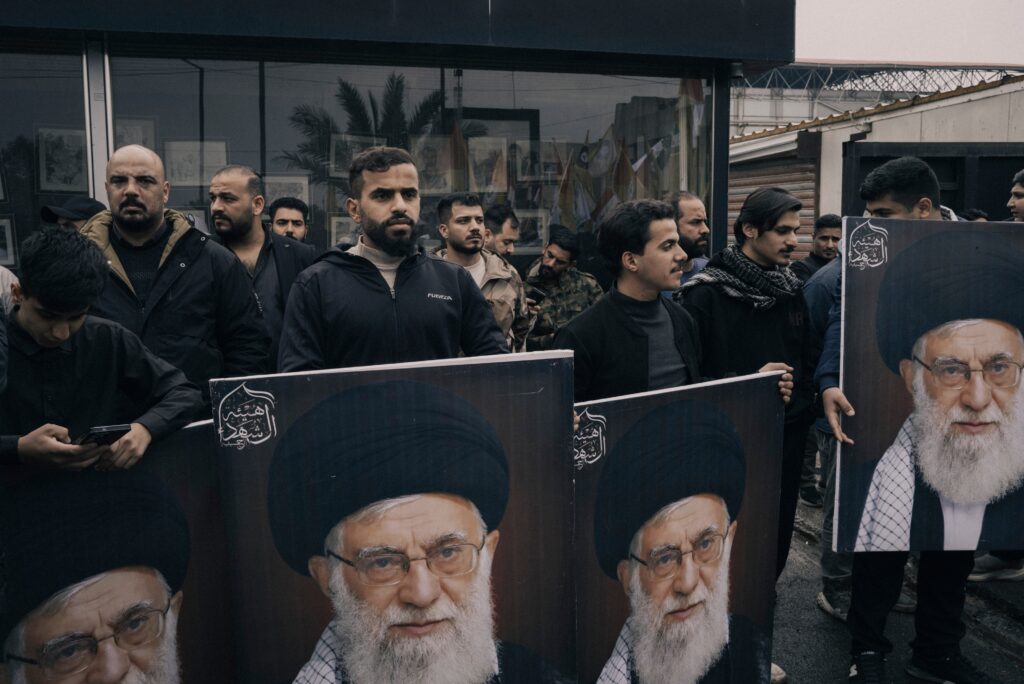
Mourners at funerals here for militia commanders killed by U.S. strikes raised posters of Khamenei and chanted: “Death to America! Death to Israel!” At one such funeral, Abu Zeinab, a 38-year-old member of the Iranian-backed Popular Mobilization Forces, said confrontation was inevitable.
“The war has been imposed on us,” he said. “If Iran falls, we will be next. The battle is one, and the arenas are interconnected. …
“Backing down now will only lead to greater weakness.”
At a cafe in Baghdad’s tony Karrada neighborhood, Ali al-Kaabi, a 41-year-old government employee, scrolled through news updates on his phone and shook his head. He feared Iraq was getting caught in a regional conflict beyond its capacity to handle.
“Iraq cannot handle another war,” he said. “We have barely emerged from years of conflict, and the country is still fragile. …
“I do not support America or Iran in the war. I support Iraq,” he said. “We need stability, not another front.”
The post Some Iranians abroad say they’d fight for the regime. Others want to topple it. appeared first on Washington Post.