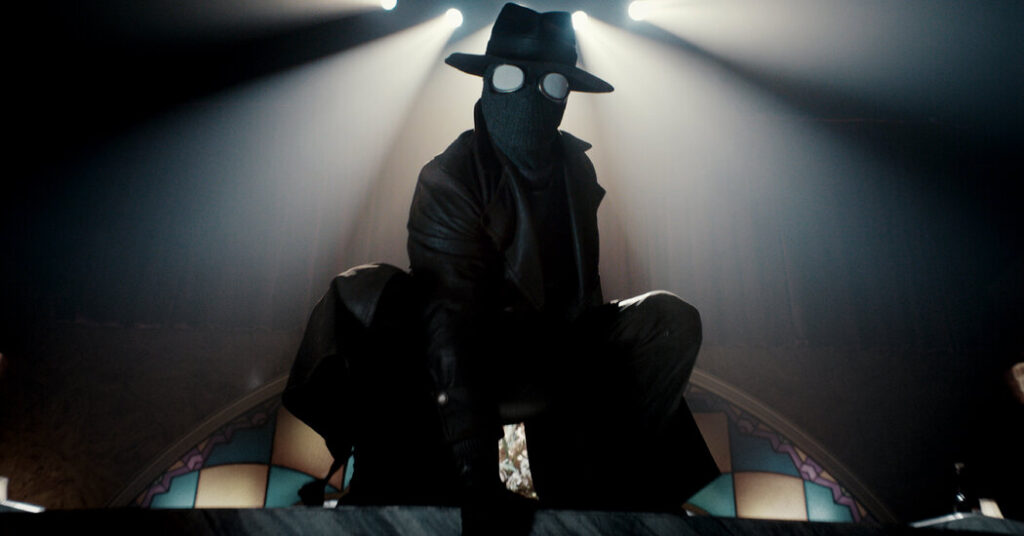
What do triumphal comic-book heroes have in common with fatalistic film-noir gumshoes? Beyond fighting the bad guys, not much. One is superhuman, the other extra human, lacking special powers, unless you count idealism. But the two character types often share an equal hold on the imaginations of young people, and those young people sometimes grow up to be artists and think, what if …?
Sometimes superheroes do begin life as film-noir mash-ups: the Spirit, Daredevil, Jessica Jones. But sometimes noir is thrust upon them. Such is the case with Spider-Man, who had been around for nearly a half century when an older, more hard-edged, Depression-era version of his character was created in 2008 as the web-slinging hero of an alternate Earth.
When that dark Spidey appeared in the animated film “Spider-Man: Into the Spider-Verse” (2018), Nicolas Cage provided his voice, and Cage now supplies the face and body as well in the live-action series “Spider-Noir” on Amazon Prime Video. But it is still the voice you notice first. An admitted blend of the noir stalwarts Bogart, Cagney and Edward G. Robinson — particularly heavy on Robinson’s guttural bray — it is a good emblem for a series that takes loving Hollywood pastiche to new heights.
“Spider-Noir” takes place in a 1930s New York that is pleasantly, if blandly, woven together from soundstages, special effects and the occasional Los Angeles location. The look, which is crucial to the show’s mild appeal, is more patently artificial than those of similar series like “The Penguin” or “Daredevil: Reborn,” and that’s appropriate for a superhero story dressed up in classic-Hollywood drag: gangster violence, smoky musical numbers, screwball patter, mad-doctor horror.
(One gimmick that doesn’t pay dividends is the option to watch the show in “True-Hue Color” or “Authentic Black and White.” After switching back and forth in the first episode, I watched the rest in True-Hue. When you don’t have a John Alton or a James Wong Howe lighting scenes specifically for black-and-white, it ends up looking like someone just forgot to turn on the color.)
The angsty teenager Peter Parker does not exist in the world of the series, where Cage plays Ben Reilly, a weary, sardonic private detective who seems almost surgically attached to his fedora and trench coat. Reilly’s origin story involves a spider bite of sorts, and he had a career as a crime fighter named the Spider that has ended by the time the show starts.
Reilly is surrounded by other noir types, beginning with his feisty receptionist, Janet (Karen Rodriguez). She runs interference as a succession of other achingly familiar characters — a femme-fatale nightclub singer (Li Jun Li), a larger-than-life crime boss (Brendan Gleeson), an eager reporter (Lamorne Morris) — circulate through Reilly’s office. Eventually they force him to unpack the Spider suit, a stylish black leather number with opalescent white goggles.
The troubles they bring to Reilly’s door involve biological experimentation and abuse of superpowers, from the comic book side, and doomed romance and noble suffering, from the noir side. The story it all adds up to is numbingly free of surprise or real excitement; its one bid for honest emotion, the inevitable attraction between Reilly and the chanteuse, is a washout. (To put it in noir terms, it’s D.O.A.)
“Spider-Noir” does have the advantage of being easygoing and in on its own jokes; that, along with the production design, can lull you into submission. Its evocation of film noir is barely skin deep — and in its visual quotations from films like “The Night of the Hunter” and “The Lady From Shanghai,” it’s exactly skin deep — but it’s not off-putting.
The show has one real source of suspense: waiting to see what Cage will do, given the opportunity to play a human with insect genes. Cage and the writers, fully aware of his wild-man reputation, toy with our expectations — he plays Reilly straight, for the most part, but on a few occasions the inner spider breaks out, and Cage delivers the twitching, prancing, grimacing display that we might, against our better natures, hope for.
Cage’s Reilly is less of a cynic or romantic than he is a ham, and the script plays this up. When Reilly goes on a drunken, Eugene O’Neill-style rant in a saloon, there is a moment of silence before the barflies laugh in his face. Cage’s own preparation for the role is satirized when Reilly practices his Cagney while watching the noir “Great Guy.”
It’s all fun, in a minor way, but it doesn’t have much to do with film noir. Bogart, Cagney and Robinson were stylized performers; so is Cage, but in a modern, more self-aware and self-mocking fashion. Putting himself in their surroundings is more of a stunt, or a thought experiment, than a dramatic exercise.
What does come through, because of the relative restraint of the performance, is Cage’s inherent likability — the quality he sometimes seems to be running away from. Overall, it’s a pleasure spending eight episodes in his company.
Mike Hale is a television critic for The Times. He also writes about online video, film and media.
The post ‘Spider-Noir’ Review: Your Friendly Neighborhood Nicolas Cage appeared first on New York Times.