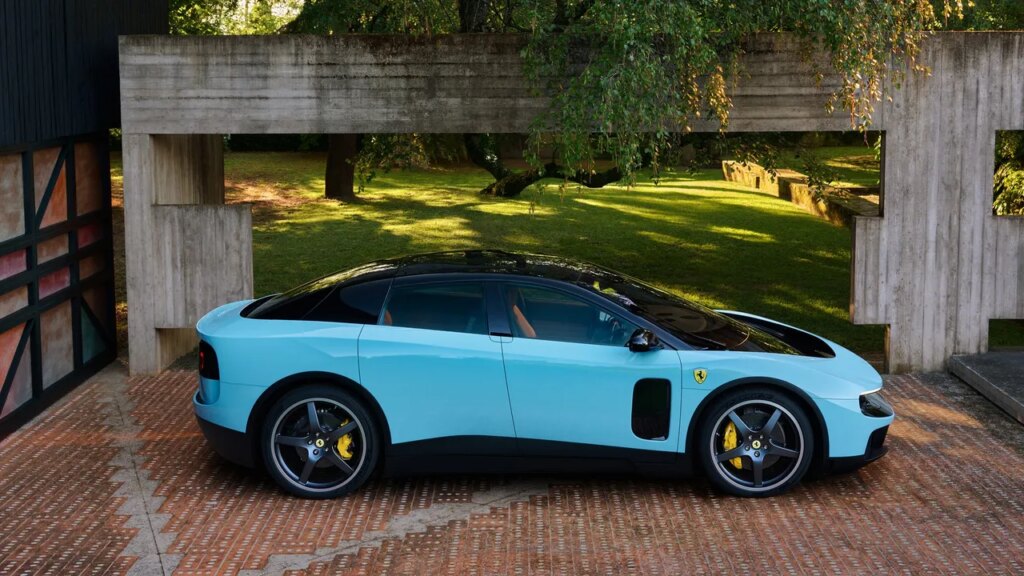
The Ferrari Luce, the first electric vehicle in the brand’s history, has generated heated discussion online, as comments and opinions about the design continue to bounce around the web.
The Luce, an electric sedan with a $650,000 price tag that Ferrari presented with pomp and circumstance at the Quirinale in Rome on Monday, has paid dearly for its coming out from behind the curtain. Since Monday, the automaker has been suffering an avalanche of complaints and skepticism about the Luce. It’s not just the price—which is high even for a Ferrari—but what the car represents and how it fits into the brand’s long and storied legacy. The day after the EV’s debut, Ferrari stock dipped 8 percent.
Luca Cordero di Montezemolo, Ferrari’s former chairman, said, “We risk the destruction of a myth.” Carlo Calenda, an Italian senator and the country’s former economic minister, called the release an “aesthetic and technological insult,” and took the opportunity to attack John Elkann—the leader of the Agnelli family, which owns a controlling stake in Ferrari—and his management of the family’s assets. Closing the circle was Matteo Salvini, who as Italy’s minister of transport felt compelled to intervene. His negative assessment, accompanied by an invocation of Enzo Ferrari, demonstrates that anything can be said about the Luce.
Beyond anything one might think, the Luce is a radically different car from its predecessors. It weighs roughly a ton more than a hybrid, uses four electric motors (one per wheel), and is built to seat five people. Its ability to sprint from zero to 100 kilometers per hour in 2.5 seconds is impressive; the instantaneous acceleration even required Ferrari to consult with NASA in order to keep the sensations of such an acceleration from being physically unpleasant. The “engine note” inside the car uses electronically treated mechanical sounds.
“It’s clear that this is a product designed not by a car designer but by a product designer.”Automotive designer Maurizio Corbi
We discussed the disruptive and divisive Luce with Maurizio Corbi, a car designer with more than 30 years of experience. Corbi, who trained at the industrial design firm Bertone and later at the car designer Pininfarina, explains why the Ferrari Luce has triggered such polarized reactions, both among insiders and the general public.
“I suspect it’s a powerful marketing ploy,” Corbi says. “They literally threw a boulder in a pond, and that’s all people are talking about. I can’t recall anything similar.”
“The world of cars, and design in particular, follows a fine line. It’s constantly evolving, but there’s always a need for a culture rooted in time. Ferrari, when it comes to road cars, means Pininfarina. The brand’s greatest masterpieces bear that signature. [Ferrari’s] current design director, Flavio Manzoni, has been able to innovate while still keeping a close eye on that tradition. I fear that he too has been affected by this project, because he is too detached from the path Ferrari has taken in recent years.”
As for the formal criticisms of the Luce’s flat surfaces and lack of emotion, Corbi says, “It’s clear that this is a product designed not by a car designer but by a product designer.”
Ferrari enlisted Marc Newson and ex-Apple designer Jony Ive from the agency LoveFrom to work on the interior and exterior of the Luce. “This gentleman came from Apple and is used to designing objects of that type. The car is something else, it’s not industrial design,” Corbi says. “A good industrial designer isn’t capable of designing a car; it’s another profession.”
“The involvement of Jony Ive and Marc Newson almost seems like a choice of boundless arrogance, as if to say, let’s not care about what our customers love and just sell this to them. The stock price has lost 8 percent. I have American friends, Ferrari owners who are members of the Ferrari Club of America, people in love with the brand, who are shocked. As is [former Ferrari chairman] Montezemolo, who yesterday publicly expressed his disappointment.”
Corbi says the design of the car lacks innovation. “From the standpoint of volume, Ferrari has designed a family soap bar: It’s the negation of everything that is a Ferrari. Then there are those little wheels. We car designers had the desire to make ever larger wheels, ever sharper, more aerodynamic shapes. Here we have returned to our grandfather’s car, without any stylistic features that hark back to the Ferrari tradition.”
On whether this change in visual language heralds a new direction for the entire Ferrari lineup, Corbi does not rule it out. “Since the language is so different, they probably intend to create a line of electric cars with their own independent philosophy.”
“People were already worried when they previewed the interiors,” Corbi says. “They aren’t exactly Ferrari-like in style, even if they appreciated the innovation, attention to detail, and materials. It’s also true that those who buy a car look at the exterior first. And those who buy a Ferrari are loyal customers, financially sound, who move from one model to another while remaining loyal to the brand.”
Corbi concedes that his judgment is probably influenced by a more traditional culture. “But those who buy a Ferrari aren’t 20-year-olds,” he says. “They’re mature people with significant financial resources. That’s their target; it’s pointless to pretend that a customer’s expectations can change just because there’s a prancing horse on the front. If I want a Ferrari, it has to meet certain precise requirements. It’s an iconic object, and there’s little to discuss.”
He also questions the very idea of an electric Ferrari. “A Ferrari is a combustion engine with a body. If you remove the engine, you’re left with an empty container. Just look at Porsche’s experience, which has bet everything on electric and is finding itself in serious difficulty.”
“The exterior is well designed. Clean, proportioned, refined. But it’s not a Ferrari.”Automotive designer Alessandro Cipolli
Alessandro Cipolli is a car designer with more than 20 years of experience in the automotive industry who specializes in interior design, exterior design, and 3D modeling. He suggested another point of view, namely that the sore point is not so much about execution but about feeling.
“It was right and inevitable that Ferrari would enter the electric world,” Cipolli says. “The technology is simply a masterpiece, it shows that they are ahead of everyone else.”
The design situation, Cipolli says, is more complicated. “The exterior is well designed. Clean, proportioned, refined. But it’s not a Ferrari. It lacks that tension, that strength, that character that strikes you before you even have time to analyze. The interior is even more eloquent. The collaboration with Jony Ive is evident: high-quality execution, meticulous detailing, precise interfaces. But it’s an interior that speaks Apple, not Ferrari. Take away the logo and you don’t know where you are.”
Cipolli says the Luce lacks emotional appeal. “The car is very well designed. The details have been taken care of, the surfaces are flawless, the materials chosen are of high quality, the division of the passenger compartment from the bodywork is very beautiful. But here we go beyond the execution to talk about emotions. Beyond the function, a car designer takes emotions into account. Transferring emotions into a car is not easy, but in this case it was not taken into account. This car does not excite.”
“Making a car, like making any object, is complex work. It’s a philosophical endeavor that then emerges from its forms.”Designer Carlo Gaino
Finally we spoke to Carlo Gaino, who had a completely different opinion. Gaino is a designer, the founder of Synthesis design, and a professor at the Polytechnic University of Turin. He bluntly dismantles the aesthetic choices of the new Ferrari.
“It’s a classic example of what happens when you call on profoundly ignorant people—in the sense that they ignore the history of the automobile—to design one of the most iconic brands in existence.” he says. “People who never had the expertise to do that have put their hands on Ferrari. If you want to destroy a brand, as Montezemolo rightly said, you do that.”
“We are in a historical moment in which culture is under attack,” Gaino says. “Those who know how to do a job, those with real skills, are systematically sidelined. I taught for a few decades between the Polytechnic University of Turin and IUAV University of Venice, and in recent years, students were using AI routinely. Tesla is the product of artificial intelligence, and it’s obvious from a mile away. Putting the world of design in the hands of those tools is a huge mistake. Making a car, like making any object, is complex work. It’s a philosophical endeavor that then emerges from its forms.”
Regarding the external aspects of the car and the visual choices made by the Luce’s designers, Gaino says: “Those formal solutions were already circulating in the ’80s and ’90s, especially in Japanese design. What you see on the Luce are the choices of beginners, not those who have studied the history.”
“Last Friday in Modena I saw the premiere of a documentary on Alejandro de Tomaso,” Gaino says. De Tomaso was a Formula One racer and businessman who started his own sports car company, De Tomaso Automobili. “That man had the ability to be innovative without seeking consensus, without wanting to be praised. Working with him wasn’t easy, but he had a vision. This country grew in the ’50s and ’60s thanks to figures like Olivetti [the Italian personal technology manufacturer]. There are still those who work like this, those who believe that design can improve people’s lives. But it has almost become out of fashion.”
This story was originally published by WIRED Italia and has been translated from Italian.
The post Is the Ferrari Luce’s Design Really That Bad? 3 Italian Auto Experts Weigh In appeared first on Wired.