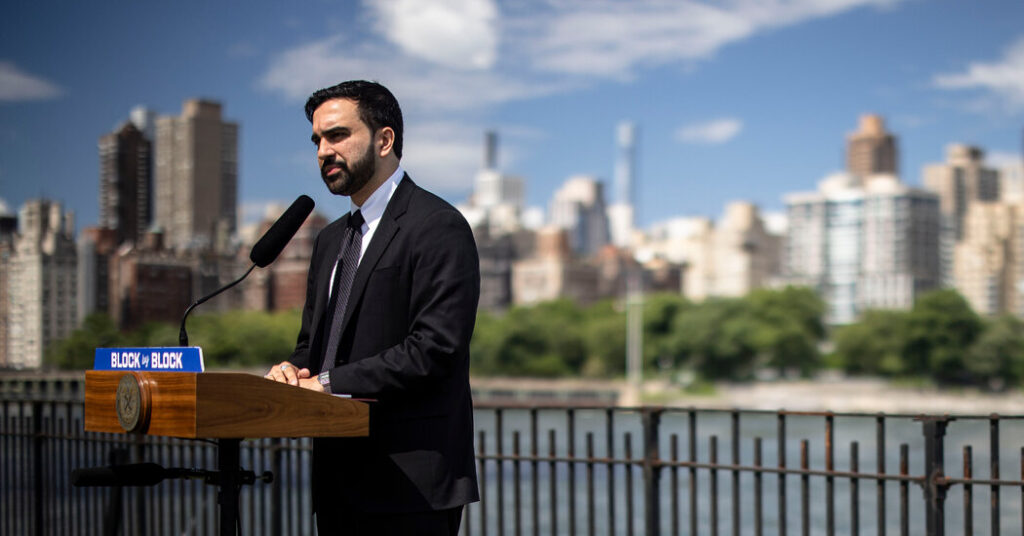
Over the course of his early tenure as mayor, Zohran Mamdani has filled out City Hall’s upper ranks with people he trusts to implement his democratic socialist-inflected agenda in New York City, the nation’s financial capital.
But one arm of city government continues to bedevil him: the Economic Development Corporation, whose mission is to leverage city real estate and tax incentives to attract private capital and drive job growth across the five boroughs.
Five months into the mayor’s tenure, the nonprofit corporation remains officially rudderless, with City Hall officials considering at least 10 candidates for E.D.C. president, including a consumer protection advocate and pro-business types. But the mayor’s team has been unable to coalesce around any of them, illustrating an internal debate over how to direct the organization.
The uncertainty surrounding the E.D.C.’s leadership and direction has fed the notion, widespread among business leaders and moderate Democratic politicians, that Mr. Mamdani is insufficiently attuned to the health of New York City’s economy, and that his inattention potentially comes at his, and the city’s, peril.
It also raises larger and more fundamental questions: What kind of economic policy does the mayor want to embrace? And is Mr. Mamdani quietly withdrawing from City Hall’s traditional role of courting business and using the E.D.C.’s power to support a thriving economic climate in New York?
“I have not heard one statement yet about how it is that the city sees industry growth, how the city wants to maximize talent, and, certainly, the absence of an E.D.C. head this far into the administration is a concern,” said Gregory Morris, the chief executive of the New York City Employment and Training Coalition.
When the mayor talks about the economy, he largely talks about his ambitious universal day care and housing programs, and how they will redound to the city’s economic benefit — a prediction that some analyses agree with.
But some business and work force development leaders argue that Mr. Mamdani cannot fulfill his vision for a more expansive government without a robust, tax-generating economy. They note that affordability requires not just cheaper goods, but also better-paying jobs. And they worry that he has yet to articulate what business growth in the Mamdani era will be, at a time when the challenges facing New York’s economy are legion.
The city’s job numbers are lackluster, even as office leasing has strengthened. Some financial sector jobs have migrated to Texas. The war in Iran continues to cast a haze over the country’s economic prospects. City officials are eyeing the coming disruptions from artificial intelligence with alarm. International tourism has declined.
“We have the worst job market we’ve had in decades outside of a recession and we are facing the most intense competition we ever have with other parts of the country and to some extent other global capitals,” said Mark Levine, the city’s comptroller. “And we have the possibility of an economic slowdown ahead. And that’s before you deal with the A.I. disruption.”
“Some of this is out of our hands, because these are national and global economic challenges,” Mr. Levine continued. “But we do have tools at our disposal and most of those tools are wielded by E.D.C.”
Unlike typical city agencies, the Economic Development Corporation — considered a pioneering example of a municipally run nonprofit designed to drive economic growth — exists outside of the city’s typical procurement rules. Its staff is not unionized, and it is perceived as a nimble arm of an otherwise sprawling, sclerotic government.
And so when former Mayor Bill de Blasio wanted to create a citywide ferry system, he turned to the E.D.C. When the mayor before him, Michael R. Bloomberg, wanted to bring a world-class research university to Roosevelt Island, he deployed the E.D.C.
In 2024, the corporation leveraged city assets to support as many as 6,475 companies, attracting $1.5 billion of private investment, it boasted in a report. Its recent work has included granting tax exemptions to small-bore projects, like a family-owned building supply company in Hunts Point, and overseeing large-scale master plans, like the multibillion dollar Brooklyn Marine Terminal. There, developers intend to build 6,000 units of housing and modernize port operations — a plan Mr. Mamdani’s E.D.C. has moved ahead with, despite the opposition of the local democratic socialist legislators.
One candidate who was interviewed for the position, and had worked at the E.D.C., was dismayed to find that the interview questions seemed to suggest a lack of understanding about the function of the organization. The questions focused largely on how it could regulate large corporations.
“Why don’t you just stop for a second and focus on keeping the good things going?” said Matt Hiltzik, a publicist who was appointed by Mr. de Blasio to the board of the E.D.C. and has felt confused by the organization’s lack of direction and by the emphasis placed on city-run grocery stores.
In a sign that complaints about the lack of an economic agenda are breaking through, Joe Calvello, a spokesman for the mayor, said on Friday that Mr. Mamdani is currently putting together a business advisory council to provide feedback on the city’s economic development plans, a move that may run afoul of Mr. Mamdani’s base.
Central to many business leaders’ concern is how Mr. Mamdani’s cabinet, or at least the more democratic socialist-aligned elements of it, seems eager to reshape the way the E.D.C. does business and de-emphasizes economic development. (Mr. Mamdani is the first mayor of the 21st century to have no deputy mayor with “economic development” in their title.)
On Jan. 2, Julie Su, then the city’s incoming deputy mayor for economic justice, circulated a memo calling for every E.D.C. program to be re-evaluated to ensure the corporation was advancing “not just economic growth or economic strength, but justice.”
Ms. Su’s interests seem to align with those of Lina Khan, the Biden-era Federal Trade Commission leader who helped lead Mr. Mamdani’s transition team and has been personally involved in the quest for a new E.D.C. leader.
Together they urged the mayor to consider hiring Rohit Chopra, a former director of the Consumer Financial Protection Bureau and Ms. Khan’s former colleague and co-author.
Mr. Chopra was also pushed by leaders of the city chapter of the Democratic Socialists of America, according to a person familiar with the selection process. He has since been scooped up by Gov. Gavin Newsom of California to manage a consumer regulatory agency.
It is not unheard-of for a major city leadership role to remain unfilled this long into a mayor’s first year. (Mr. Mamdani’s predecessor, Eric Adams, did not name a permanent fire commissioner until 10 months after taking office.) Nor is the E.D.C. incapable of operating without a permanent president.
In a recent interview, Gustavo Gordillo, the a chair of the D.S.A chapter in New York City, argued that the E.D.C. should focus on building “social housing,” adding, “we need an E.D.C. that isn’t afraid to fight business leaders to get the best results for the working class of New York City.”
“The E.D.C. has become a concierge service for a small number of wealthy New Yorkers — a public agency treated like private property,” he said. “The E.D.C. needs to be completely reimagined as a new agency that, instead of doling out tax breaks, sets the terms of a pro-worker local economy.”
Ms. Khan declined to comment for this article.
Other candidates have had more conventional backgrounds. City Hall has considered David Ehrenberg, a real estate adviser who once worked at the E.D.C. and ran the Brooklyn Navy Yard, the former shipping depot turned city-subsidized haven for industrial start-ups; the Navy Yard’s current president, Lindsay Greene; and James Katz, an E.D.C. veteran and economic development adviser to Gov. Kathy Hochul.
It has also considered Blondel Pinnock, the chief executive of the Bedford-Stuyvesant Redevelopment Corporation; Marisa Lago, a city, state and federal government veteran who served in senior positions in economic development, planning and trade; Andrea Batista Schlesinger, a public banking expert and partner at HR&A Advisors, a consulting firm; the corporation’s interim president, Jeanny Pak; Cecilia Kushner, another E.D.C. veteran and the chief of staff at Robin Hood; and Shaifali Puri, a former E.D.C. board member and the former executive director for global innovation at the Nike Foundation.
Mr. Mamdani and his team’s indecisiveness is an apparent reflection of dissension within City Hall between those who consider the E.D.C. an essential mechanism for nurturing business in New York City, and those, like Ms. Su, who are eager to to see it also embrace a more regulatory and social justice role.
“N.Y.C.E.D.C. is focused now — as it has been and will continue to be — on delivering generational projects that span decades and administrations, expanding opportunities for working New Yorkers,” said Jeff Holmes, an E.D.C. spokesman. Those include a new life sciences campus in Manhattan, major housing developments in Queens and Brooklyn, and Mr. Mamdani’s effort to build a low-cost, city-owned grocery store in each of the five boroughs.
Leila Bozorg, the deputy mayor for housing, is said to have a voice in the leadership decision-making, as does Ms. Su; Dean Fuleihan, the first deputy mayor and veteran Albany operative; and Elle Bisgaard-Church, Mr. Mamdani’s far left chief of staff.
It has proved difficult to find a candidate with the political worldview that can somehow satisfy all of those officials.
Mr. Chopra, for one, sparked some concern that he was potentially too left-leaning, according to an administration official.
“Economic justice demands that we focus on economic growth and on who benefits from that growth,” said Ms. Su in a statement. “E.D.C. is critical to that focus and has been since day one of this administration.”
“We will continue using every tool available to build a city that remains the center of economic growth in America, where public investment delivers real results, businesses continue to flourish and working people can afford to live with dignity,” Ms. Su continued.
The E.D.C. was born during the recession of the early 90s, when David Dinkins was mayor, and the city’s economic development activities were scattered among disparate entities.
To be sure, many of the E.D.C.’s plans do not pan out, at least initially. A bid to build a 630-foot Ferris wheel on Staten Island’s North Shore ultimately failed. A joint bid with the state’s economic development arm to bring Amazon’s second headquarters to Queens also failed, though the proposal did galvanize the borough’s political left and arguably helped create the conditions for Mr. Mamdani’s rise.
Matthew Haag contributed reporting.
Dana Rubinstein covers New York City politics and government for The Times.
The post Among Mamdani’s Priorities, Economic Development Seems Low on the List appeared first on New York Times.