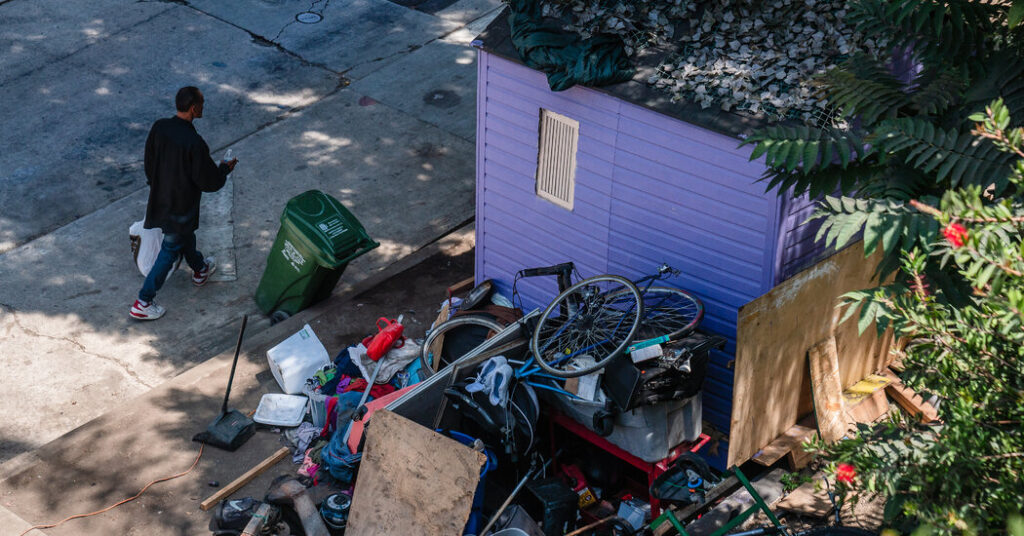
After climbing to a record peak, homelessness fell modestly in the last year of the Biden administration, according to data released Friday by the Department of Housing and Urban Development.
While the decline of more than 3 percent marked the first drop in homelessness in nearly a decade, it still left homelessness levels unusually high by historical standards. Nearly 746,000 people were living in shelters and on the streets in January 2025 when President Trump took office, a 28 percent increase from three years earlier.
Most researchers say that the surge in homelessness over the previous two years was largely driven by the influx of asylum seekers, some of whom have now found housing or left the country.
But the rise coincided with increasing divisions over homelessness policy, and many Republicans, including Mr. Trump, have cited the high homelessness numbers to justify strict new measures like camping bans or forced treatment of mental illness or addiction. An executive order he issued last year demanding a policy overhaul cited the national count down to the digit.
That made the new data showing a decline in homelessness, however modest, politically sensitive. The report was published months later than usual and released with no notice on a Friday afternoon.
In January, The New York Times published a story, citing local data reported to the federal government but not released, that projected homelessness had fallen by 3 percent to 5 percent.
In a statement Friday, Scott Turner, the housing secretary, noted that homelessness had risen by more than a quarter since 2013, when federal law made a policy called Housing First more prominent. He said the policy was responsible for “crisis levels of people living on the street.” Housing First provides long-term rental aid and offers treatment for mental illness or addiction but does not require people to accept it.
Tom Murphy, a spokesman for the National Alliance to End Homelessness, an advocacy group that supports Housing First, welcomed the decline in homelessness but said “the Trump administration is working to tear down the same programs and strategies that made it possible.” The administration is trying to steer most federal homelessness money, which totals nearly $4 billion a year, away from Housing First programs, but a federal judge has temporarily blocked the move.
The homelessness data, called the Point in Time (or “PIT”) Count, is compiled each year by about 400 local administrative groups. They fan out on a single night in January to count people sleeping outdoors, adding their numbers to counts from shelters. It is generally considered an underestimate of homelessness but useful in tracking trends.
After the annual count began in 2007, homelessness consistently fell through 2016. Homelessness then rose modestly through 2022 and surged in the next two years, amid the migrant influx.
Twenty-two states and the District of Columbia had declines in homelessness from 2024-25, the report found, including New York (8 percent), Colorado (11 percent), and Illinois (44 percent). These are all places that had housed large numbers of asylum seekers.
“The big increase in migration in those states wasn’t about Housing First and the decrease wasn’t about Housing First,” said Dennis Culhane, a professor at the University of Pennsylvania who previously led the research team that produces the annual HUD report. “It was due to the migrant crisis.”
Other places with large declines included Florida (11 percent), Minnesota (9 percent) and Maine (11 percent). California, which has the largest homelessness population, had a 3 percent drop in homelessness.
States with significant increases included Connecticut (10 percent), Kentucky (11 percent), Maryland (17 percent) and Mississippi (20 percent). North Carolina had a 33 percent increase in homelessness amid widespread displacement after Hurricane Helene.
Homelessness among veterans, a priority group for both parties, fell by 1 percent, continuing its long-term decline. Since 2010 it has fallen by more than half, under a program that largely employs Housing First principles.
At the same time, chronic homelessness, another issue that Housing First targets, continued to rise, as the policy’s critics note. Chronic homelessness has more than doubled since 2016.
Housing First supporters say rising rents have driven up need and aid has not kept pace, while the policy’s critics maintain that the prevalence of mental illness and addiction requires treatment mandates, rather than rental aid.
Housing First is “philosophically misaligned with the needs of the chronically homeless population,” said Devon Kurtz, an analyst with the Cicero Institute, a conservative policy group aligned with the Trump administration.
Friday’s report showed that homelessness fell in 2025 both for the populations living on the street and those in shelters. About a third of the homeless population was Black, the report found, a rate more than twice as high as the Black share of the U.S. population.
Jason DeParle is a Times reporter who covers poverty in the United States.
The post Homelessness Declined in 2024, According to Delayed Federal Report appeared first on New York Times.