As Iran and the United States appeared to be nearing an agreement to end hostilities this week, not everyone in Iran was on board.
The hard-line faction, a fringe but loud group with members in Parliament and a seat on the Supreme National Security Council, has openly opposed any concessions to Washington, using rallies, state media and private and public statements as tools to try to derail a deal.
It remains unclear when an actual agreement will be announced, if at all. President Trump met for two hours with cabinet members in the Situation Room at the White House on Friday, but he put off making a final decision, according to a senior administration official. Iran’s lead negotiator, Gen. Mohammad Bagher Ghalibaf, said in a social media post earlier in the day that Tehran did not trust Washington and that no step would “be taken before the other side acts first.”
But in Iran the political fight continues. State television, which is controlled by a hard-line director, has amplified the divisions in the country and portrayed negotiations as a failure. On Monday, President Masoud Pezeshkian scolded state television in a meeting with its senior leaders, calling on them to avoid sowing discord.
Mr. Pezeshkian said even Ayatollah Ali Khamenei, the former supreme leader killed on the first day of the war, “agreed that we must go to the negotiation table.”
“But now,” he continued, “we are advertising that we should not negotiate.”
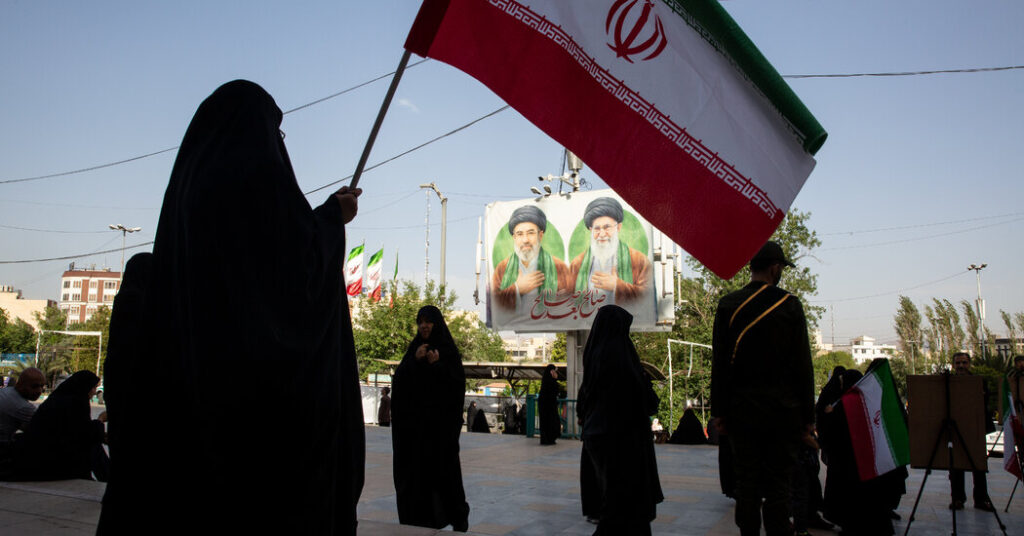
At a packed rally of hard-line supporters in Tehran on Friday, large crowds waved flags and chanted for defiance. A state television reporter asked some attendees if Iran should retreat or continue fighting the United States and Israel. “We want them to punish them good,” one woman attendee said. “Stand firm, we are with you until our last drop of blood,” said one man.
“Trump must know that Iran, as the victor and conqueror of the field, sets the terms,” said Ebrahim Azizi, a conservative lawmaker and the head of Parliament’s national security and foreign policy committees, in a social media post on Friday.
Analysts close to the government in Iran say that the hard-line faction represents a minority view, both in the general public and among officials. Still, ignoring it risks alienating the part of the population that has been among the most loyal supporters of the Islamic Republic through political and social upheavals.
“This faction does not speak for the majority of Iranians and has been marginalized from key decision making; the nuclear talks are proceeding despite their disapproval,” said Mehdi Rahmati, a political analyst in Tehran, in a telephone interview. But, he added, “the system needs to come up with a plan to control them and keep them in check, otherwise they can become very dangerous for Iran’s stability.”
Even Iran’s new supreme leader, Ayatollah Mojtaba Khamenei, who is the son of the slain former leader, is not immune from their ire. On Thursday, a hard-line lawmaker cleric, Hamid Rasaee, took a jab at Ayatollah Khamenei in a social media post titled, “Who is worthy of the supreme leadership?” (Ayatollah Khamenei, who has been in hiding since the start of the war in late February, has expressed support for the nuclear negotiating team in written statements.)
Mr. Rasaee wrote that the Prophet Noah had a son who was a nonbeliever and a rebellious black sheep, and that “familial relations don’t necessarily make for being righteous.”
The comparison was quickly condemned by political figures and Iranian media outlets, which accused him of undermining Ayatollah Khamenei’s credibility for political score settling.
Mr. Rasaee backtracked on Friday in another post, saying bad actors had misinterpreted his comments.
Earlier in the negotiations, Ali Bagheri Kani, a hard-liner who serves as the deputy secretary of the national security council, wrote a letter to Ayatollah Khamenei saying the Iranian negotiators, led by Mr. Ghalibaf, had been too conciliatory to the Americans when they sat across the table from Vice President JD Vance in Islamabad, according to two senior Iranian officials familiar with the letter. He asked the supreme leader to intervene and set guardrails for talks, the officials said.
The move was viewed in political circles as an effort to undermine the negotiating team and Mr. Ghalibaf, who is a close ally and friend of the new supreme leader. Mr. Bagheri Kani, who was a nuclear negotiator in the previous administration in Iran, was also the only member of the national security council who refused to sign a joint letter in April, written by Mr. Ghalibaf and Mr. Pezeshkian to the supreme leader, laying out the necessity for an agreement with Mr. Trump.
The letter warned that the economic situation was dire, the government faced an acute budget crisis, and there could be mass riots, the two senior officials said. They spoke on condition of anonymity to discuss sensitive issues.
Mr. Bagheri Kani not only did not sign the letter but shared its contents with hard-line members of Parliament, who in turn publicized the dispute. But Ayatollah Khamenei stood by his negotiating team, the two officials said, privately and publicly issuing statements of support.
On Thursday, Ayatollah Khamenei issued a new statement noting the reopening of Parliament for the first time since the war began. The statement called on all lawmakers to remain united and “refrain from nonsense political divisions and magnifying social divisions.” He said doing so would play into the enemy’s plan to divide and conquer.
Rozhin Razavi contributed reporting.
Farnaz Fassihi is the United Nations bureau chief for The Times, leading coverage of the organization. She also covers Iran and has written about conflict in the Middle East for 15 years.
The post Iran’s Hard-Liners Try to Derail Potential Deal With the U.S. appeared first on New York Times.