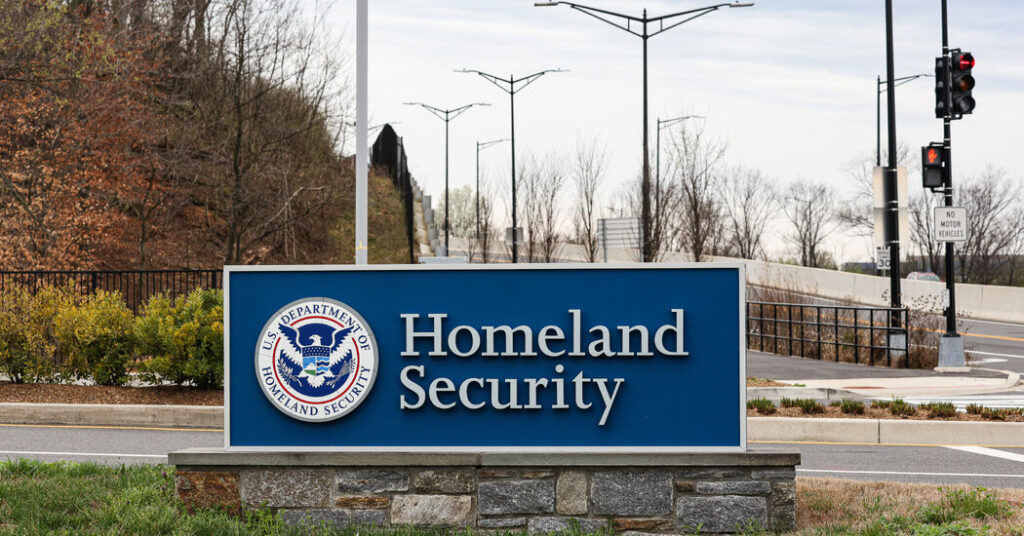
The Department of Homeland Security sought on Friday to clarify its announcement last week that immigrants seeking permanent residency would have to return to their home countries to await their green cards, claiming there was no major change in policy and that only some will have to go back.
The clarification appeared to be a partial walk-back of an announcement in a U.S. Citizenship and Immigration Services news release last week. Despite a longstanding policy of allowing immigrants to remain in the country while they wait for their green cards, it said individuals would now have to go back while they wait except in “extraordinary” cases.
But on Friday, the Homeland Security Department said it was not a blanket change and that it would be up to individual immigration officers to decide whether someone should be forced to go abroad to gain a green card. They said that officers have long had such discretion.
“This was just a reminder to officers of their discretionary authority, which has always existed on a case-by-case basis,” a D.H.S. spokesperson said in a statement. The spokesperson declined to provide a name. The person pointed to people who overstay visas or come from countries whose citizens are heavy users of public assistance as groups that could be affected.
It was a substantial shift from last week’s announcement, but was unlikely to reduce confusion or fear, as details are still scant about who might be affected and how. Even some inside the Homeland Security Department were confused as to the scope of the change when it was publicized.
Though announced with a news release, a senior White House official said this week that the effort was meant to be a housekeeping matter, not a change of strategy. The official discussed internal deliberations on the condition of anonymity.
Some immigration lawyers said their clients were already being asked by U.S.C.I.S. officers in interviews this week why they were applying for green cards in the United States, and if any factors prevented them from applying in their home countries.
“The public backlash has clearly sent the administration scrambling to clean up its own mess,” said Sarah Pierce, a former U.S.C.I.S. official who is now the head of social policy at Third Way, a center-left group.
She added that the “signature” of the administration’s immigration agenda was to “prioritize shock and awe over what is best for the country.”
Outrage over the original announcement was swift. Immigration lawyers widely expected it to be met with legal challenges, but the confusing rollout left them pondering the best way to do so.
“It does make it more difficult to figure out what you’re suing for when you don’t know what this thing really is,” said Benjamin Johnson, the executive director of the American Immigration Lawyers Association. “It’s too early to tell right now what will be the most effective way to challenge this in court.”
Some business groups also pushed back on the policy change as originally described. Neil Bradley, an executive vice president and chief policy officer at the U.S. Chamber of Commerce, praised the administration’s efforts to reduce illegal immigration, but said policymakers should build a “more robust” legal immigration system and that the policy change could be “incredibly disruptive for employers.”
About 1.4 million green cards were granted in 2024, with roughly 820,000 approved through a process known as “adjustment of status,” which allows prospective immigrants to apply while living in the United States. Many do so either through sponsorship by their employer, or a close relative such as a spouse.
Green cards can be granted to certain family members of Americans, a range of foreign workers and some people who gained status through humanitarian programs, such as refugees. People with green cards, or permanent residency status, are vetted and can wait years for approval. They must periodically renew their green cards and can eventually apply for citizenship.
The guidance announced last week seemed likely to have the most marked impact on immigrants applying through family sponsorship, since they are less likely to have an underlying business visa to live and work in the country.
Over the past few decades, many immigrants came on temporary visas, married U.S. citizens, and were allowed to stay in the U.S. while applying for green cards despite technically overstaying their visas. If forced to leave and apply from abroad, immigrants who have significantly overstayed a visa could well be prevented from coming back.
“It’s very clear they’re trying to go after that,” said Doug Rand, a senior U.S.C.I.S. official during the Biden administration. “Because if now suddenly you can’t adjust status, and you have to go home to your home country, joke’s on you, now you’re barred from coming back for 10 years.”
The original guidance was worded in such a way that made companies also fear for their high-skilled foreign workers on H-1B and other visas, many of whom have been waiting in line for a green card for years. Leaving the country and coming back could compound that, since wait times are already long at many consulates.
Consular officers also have more discretion to reject applications. Their decisions generally cannot be appealed, and applicants typically cannot have a lawyer present for an interview.
“The employers are incredibly worried about this,” said Bernard Wolfsdorf, a managing partner at Wolfsdorf Rosenthal, who helps large tech companies with their immigration issues. “These are the people who are at the very forefront of America’s technological advantage, and they’re being chased out of the country.”
The guidance also left open the question of whether people from the scores of countries for which immigrant visa processing has been paused will have to go back to apply for green cards, and what would qualify an applicant for an exemption based on their importance to the “national interest.”
Combined with other Trump immigration measures, the muddled guidance may deter people from trying to come to the United States in the first place. Interest from foreign job-seekers in U.S. positions has already fallen sharply, according to data from the hiring platform Indeed.
“It’s crazy how much panic this has caused,” said Victoria Slatton, managing partner with Slatton & Hass. “If the memo wanted to scare people into not applying, it’s doing a pretty good job.”
Zolan Kanno-Youngs and Nicholas Nehamas contributed reporting.
Hamed Aleaziz covers the Department of Homeland Security and immigration policy for The Times.
The post Actually, Most Immigrants Won’t Need to Leave U.S. to Get Green Cards, D.H.S. Says appeared first on New York Times.