If the Department of Homeland Security follows through on a threat to yank customs agents from major airports housed in sanctuary cities, industry watchers say fliers would face travel chaos that would make long TSA lines look like child’s play.
Airlines would be forced to redraw route maps on the fly — triggering all kinds of questions about staffing, facilities, and travelers themselves.
Consider, for instance, just one flight: American Airlines Flight 101, scheduled to depart London-Heathrow each day at 10:30 a.m. and land at New York’s JFK at 1:20 p.m.
- Where to land the plane? The airline would have to reroute Flight 101 to another one of its hubs that can accept international flights — but only in a city that isn’t a so-called “sanctuary city.” That means its hubs in Chicago, Los Angeles, and Philadelphia are off the list. So it could use its hubs at Dallas-Fort Worth, Charlotte, or Miami.
- Do those airports have room? DFW, Charlotte, and Miami are already busy airports, and American has only so many gates and so much room in its schedule at each airport each day. How does it weave in Flight 101 and the two other flights from London that arrive at JFK each day?
- What about staffing? The airline has gate agents, ramp workers, baggage handlers, and contracts with caterers, cleaners, and other staff at the airport. Will there be enough people to work the additional flights that are diverted to different airports? If not, what does the airline do? Send workers from JFK to Dallas? If so, for how long? And where does it house them? Who pays?
- What about passengers? Of the passengers aboard Flight 101, from London, let’s say one was going on to Santa Ana, California; two were going to Des Moines, Iowa; and five were going to Chicago. What happens if American lands the flight at its Miami hub? It doesn’t have direct flights to Santa Ana from there. So does it have to pay to put those passengers on another airline to get them to their destinations? Or does it have to fly them to somewhere else in its network — say, Dallas-Fort Worth — that can get them to their final destinations? In that case, who pays?
And those Chicago and Des Moines passengers: Let’s say the American flights are already full that day. Are the passengers just stranded? If not, how do they get to where they want to go? Does American have to figure that out, or are the passengers on their own? And again, who pays?
And that’s just one example flight on one airline. There are so many variables that removing customs agents from major gateways like JFK, LAX, or Newark, New Jersey, could cripple the entire international flight operation to the US — or at least slow it way down.
DHS hasn’t detailed its potential plan, so it’s unclear which airports would be affected if it were put into place. When asked for comment, DHS referred to recent television interviews by Homeland Security Secretary Markwayne Mullin.
“They don’t want us to enforce immigration, but they want us to process immigration at their facilities? Nothing about that makes sense to me,” Mullin said.
American Airlines referred Business Insider to a statement from the industry’s trade group, Airlines for America, which also represents United and Delta. The group said reducing Customs and Border Protection staffing at major US airports would “have a devastating effect on the airline and tourism industries.” It warned of major disruptions to airlines, travelers, and international cargo.
Richard Aboulafia, managing director of the aerospace consulting firm AeroDynamic Advisory, said that people clear customs at their point of entry, not necessarily their final destination. “The idea of hitting entry points in blue states and not having this impact businesses in red states is just extremely foolish,” he said.
Why Markwayne Mullin is suggesting changes at customs
Mullin has said taking customs agents out of US airports that are housed in sanctuary cities might be necessary to protect the country. He first floated the idea in April and reiterated his support for it again this week.
“If they’re a sanctuary city and they’re receiving international flights, and we’re asking them to partner with us at the airport, but once they walk out of the airport, they’re not going to enforce immigration policy — maybe we need to have a really hard look at that,” Mullin said on Fox in April.
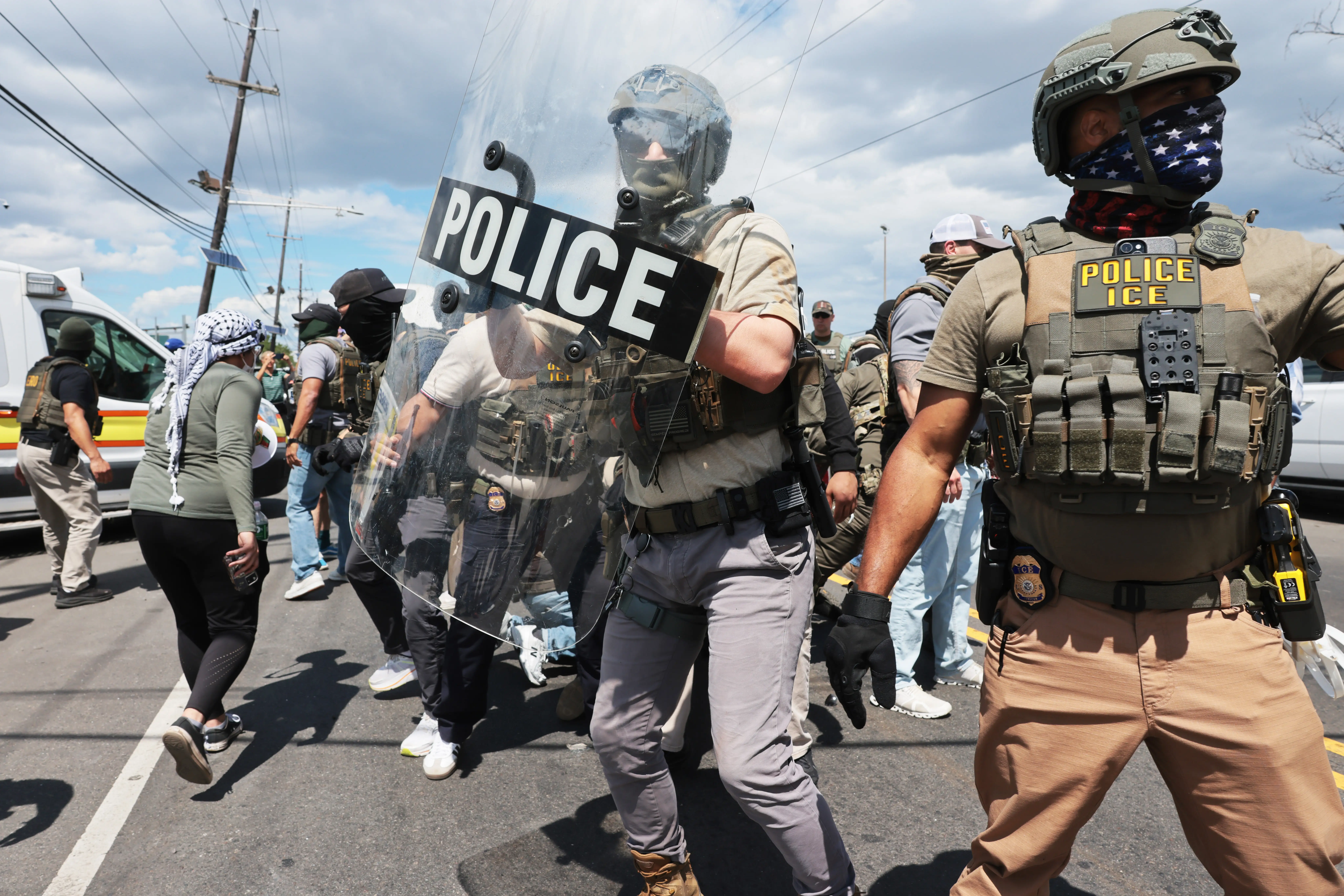
Mullin’s idea has been questioned by President Donald Trump’s transportation secretary, Sean Duffy, who said during a congressional hearing earlier this month that it would be “a bad idea to start restricting travel based on political views.”
The US Travel Association, which represents airlines, hotel chains, and other travel-industry businesses, said what Mullin has floated would affect American citizens traveling home from abroad more than it would international visitors.
“Secretary Mullin’s suggestion is impractical,” Henry Harteveldt, a travel analyst and the president of Atmosphere Research Group, told Business Insider. “The secretary needs to remember that regardless of where a hub is located, it serves travelers from both red and blue states, and sanctuary and non-sanctuary cities.”
How the DHS plan could affect airports
New York-JFK alone handles roughly 34 million international passengers a year and is the US’ busiest gateway; that’s far more traffic than any single replacement hub would suddenly be expected to absorb.
Mullin said that the policy wouldn’t affect “all” airports across US sanctuary cities, but said situations like those in New Jersey — where he singled out Newark over protests at a Homeland Security detention center — force the department to “prioritize” where it puts federal employees. One solution, Mullin said, is to pull customs officers from nearby airports to help at the ICE facilities.
Airlines can’t simply pack up and move
Forcing airlines to operate within a more restricted landscape would be a bear of a task. One of the biggest obstacles is logistics: Many airports in non-sanctuary cities cannot simply absorb hundreds of additional international flights each day.
Some airports are too small, too old, or already operating near capacity. Expanding terminals, gates, customs facilities, staffing, and ground operations would take years and cost billions of dollars.
Flights from places like Sydney or Tokyo may not be able — or even willing amid sky-high fuel prices — to bypass West Coast gateways like Los Angeles or Seattle for farther-inland non-sanctuary airports.
Plus, security and air traffic control systems across the nation are already dealing with staffing shortages, exacerbated by government shutdowns in late 2025 and early 2026. Concentrating even more flights into already-busy airports could trigger long lines and flight disruptions.
Take the entire state of Texas, for example. It has a blanket “no-sanctuary-cities-allowed” policy, so airports such as Dallas-Fort Worth, Houston, Austin, and San Antonio could, in theory, take on additional traffic under Mullin’s proposal.
But not every airport can handle every aircraft. San Antonio, for example, has a shorter runway than larger hubs, which can limit larger long-haul widebodies and reduce passenger or cargo capacity, and therefore, revenue.
Read the original article on Business Insider
The post How DHS’s threat to cut customs processing in sanctuary cities could snarl air travel everywhere appeared first on Business Insider.