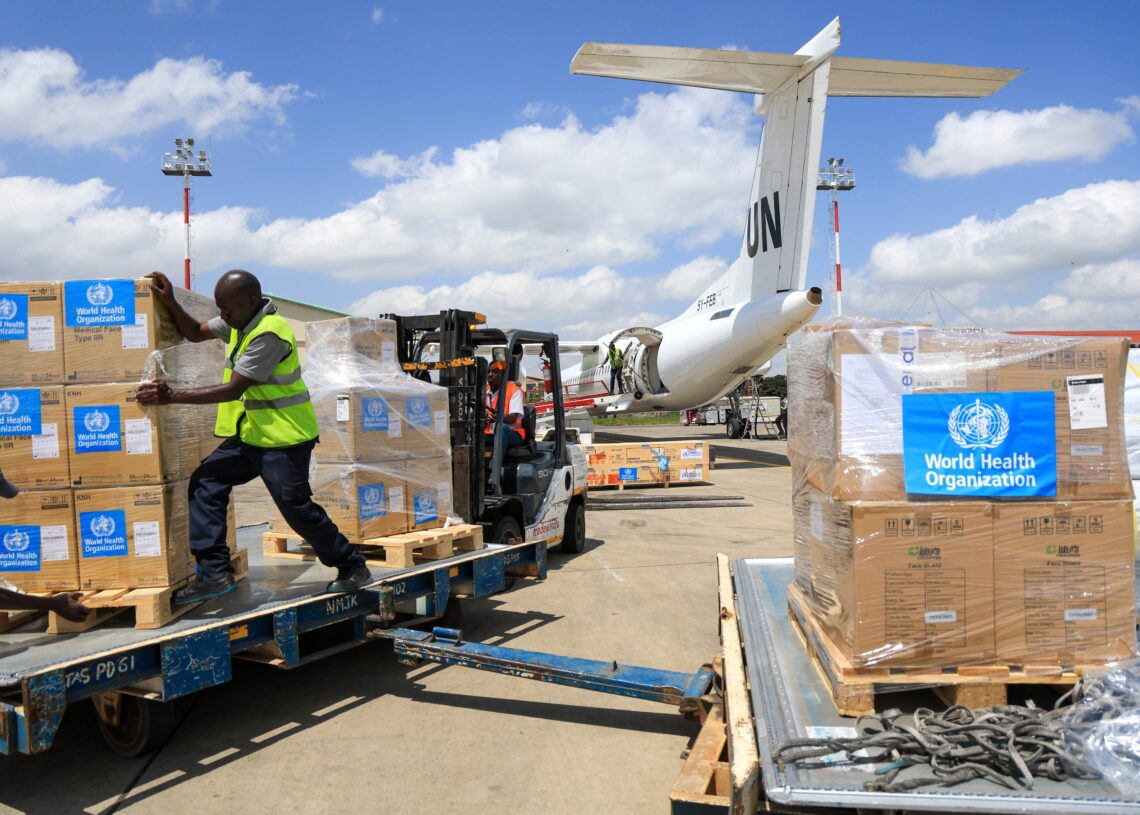
NAIROBI — A Kenyan court Friday suspended a Trump administration plan to establish a makeshift field hospitalin Kenya to quarantine and treat Americans exposed to or infected with Ebola.
The court, citing a threat to life, issued its ruling on the day U.S. officials said the facility would begin operating. It has capacity for up to 50 patients potentially exposed during the growing Ebola outbreak, which is centered in the Democratic Republic of Congo.
Authorities say suspected Ebola cases have passed 1,000, with nearly 250 suspected deaths.
The court ruling, which is temporary pending fuller consideration of the case June 2, nonetheless halted a key part of the strategy from President Donald Trump’s administration for handling Americans exposed to Ebola overseas.
The decision leaves uncertain how the U.S. government would manage Americans exposed to the virus if they need evacuation in the coming days, as there is no ready backup plan, according to a person familiar with the U.S. response.
The court ruling also puts added focus on ethical questions related to the administration’s apparent unwillingness to let ill or exposed Americans return home for treatment.
The State Department did not immediately comment on the ruling.
The U.S. policy has alarmed some public health advocates and Ebola experts, who say the United States has already invested heavily in specialized treatment centers specifically designed to safely care for patients with Ebola and other dangerous infectious diseases.
The U.S. also has extensive experience safely transporting Ebola patients from abroad back to the United States and treating them.
Critics, including physician Craig Spencer — who survived Ebola after contracting the virus in Guinea in 2014 — have suggested the administration’s refusal to bring infected Americans home reflects political concerns and public fear surrounding Ebola more than medical necessity.
At least one American doctor evacuated from Congo after exposure to Ebola is being treated at a hospital in Prague.
The administration’s plan had been to use the field hospital as a first stop for American patients, and then to send serious cases to more advanced hospitals in Europe.
Kenya agreed to the construction of the field hospital, but the announcement of it sparked public outrage in the country, and the Katiba Institute, a constitutional-rights advocacy group, challenged it in court.
In its petition, the group asked the court to stop entry of those exposed to or infected with Ebola and to compel the Health Ministry to present a contingency plan detailing Kenya’s preparedness for Ebola response, as well as to disclose terms of the agreement.
“At its core, the case is about preserving constitutional accountability, protecting public health, and ensuring that no government may place expediency above the lives and safety of the people of Kenya,” the Katiba Institute posted on X.
On Friday, a judge ruled that any person from the Ebola-affected regions should not be allowed to enter Kenya and that the field hospital should not operate until the court hears the case June 2.
The court stated: “A conservatory order is thereby issued restraining the respondents from establishing, operationalizing, facilitating, approving or permitting the establishment and/or operation of any Ebola exposure, quarantine, isolation or treatment facility in Kenya pursuant to any arrangement with the United States of America or any foreign government or agency pending the inter-parties hearing of this application.”
The facility, at Laikipia Air Base, was built by the U.S. military and intended to be staffed by officers from the U.S. Public Health Service.
Officials said doctors and public health service officers stationed in Kenya would decide if or when patients should be transferred to tertiary-care facilities overseas.
For patients who become ill before evacuation, officials said the Kenya facility would be able to administer monoclonal antibodies and a broad-spectrum antiviral called remdesivir, which is not approved to treat Ebola but is commonly used off-label.
A senior administration official said Thursday that the decision to establish the Kenya facility was based on medical and logistical considerations, not politics.
But Jeremy Konyndyk, a former U.S. Agency for International Development official who helped coordinate U.S. Ebola efforts during the West Africa epidemic that began in 2014, said the U.S. strategy to send Americans to Kenya was already a Plan B.
“Plan A would have been to use the capabilities for domestic isolation and treatment that we have built up through” a specialized system of U.S. hospitals and facilities that were established after the West Africa epidemic, Konyndyk wrote in a text message.
He added: “This whole ridiculous thing seems driven simply by a desire to block anyone with Ebola from setting foot in the United States under any circumstances, even an American in a responsible medical evacuation.”
There is no approved vaccine or therapeutic for the strain of Ebola, the Bundibugyo virus, now spreading in Congo.
Some Kenyan health professionals said the Trump administration’s plan risked introducing the Bundibugyo virus into the country, which has not had any reported cases.
“We know that there are cases in Congo, and there’s management there going on,” Davji Atellah, the secretary general of Kenya’s doctors union, told The Washington Post on Friday. “We don’t have any reported cases in the country, so the facility here is to form an epicenter in Kenya for the spread of Ebola within the country,”
Atellah added: “Our concern is that this is being done with the interest of the Americans, and there’s no interest of the Kenyan citizens, because there are no plans that the government has put in place to ensure that there is no spread of this disease in the country.”
The Kenyan government has defended the agreement with Kenya’s principal secretary for public health, Mary Muthoni, saying that the request by the U.S. government was within Kenyan law.
“Anything that comes from an international request, it goes by the laws of Kenya, so we will not be breaking the law to have a conversation with partners, not just the U.S. but any other partner,” Muthoni said.
“We want to affirm that our country is — we are ready, we are capable,” she said. “The ministry … we have taken all actions to ensure that we continue being guided by our health care workers and our policies to protect our boundaries and also to ensure that every Kenyan is very very safe.”
The American field hospital in Kenya was designed to provide hydration and respiratory support on-site. If more advanced care is needed, Americans would be sent to specialized tertiary-care facilities in Europe, a senior administration official said at a media briefing Thursday.
Officials from the U.S. Centers for Disease Control and Prevention were working with counterparts in Europe to identify those facilities.
Transporting Americans to those facilities will be safer and faster than long flights back to the United States, the senior official said.
Last week, the U.S. tightened its travel rules to ban travelers from Congo, Uganda and South Sudan because of the Ebola outbreak.
To concentrate and intensify screening, the United States also declared that U.S. citizens and permanent residents coming from those three countries can enter only through Washington Dulles International Airport.
Kenya is one of the 22 African countries that have signed bilateral agreements on global health with the United States, with the U.S. pledging $1.6 billion for Kenya over five years to support its health programs
In a statement Thursday, State Department spokesman Tommy Pigott said the United States pledged $13.5 million to Kenya’s Ebola preparedness efforts following talks between Secretary of State Marco Rubio and Kenyan President William Ruto.
The statement said the money was in addition to $112 million “committed” for regional response.
The outbreak is proving difficult to contain because its epicenter, in eastern Congo, is a region beset by armed conflict and displacement, causing security risks to health and aid workers.
The region is rich with minerals such as gold and cobalt, and the outbreak is believed to have started near a gold-mining site in Mongbwalu, a densely populated mining town.
The area is held by militias who control eastern Congo’s mineral trade.
Sun reported from Washington.
The post A court in Kenya blocks U.S. plan to keep American Ebola patients in Africa appeared first on Washington Post.