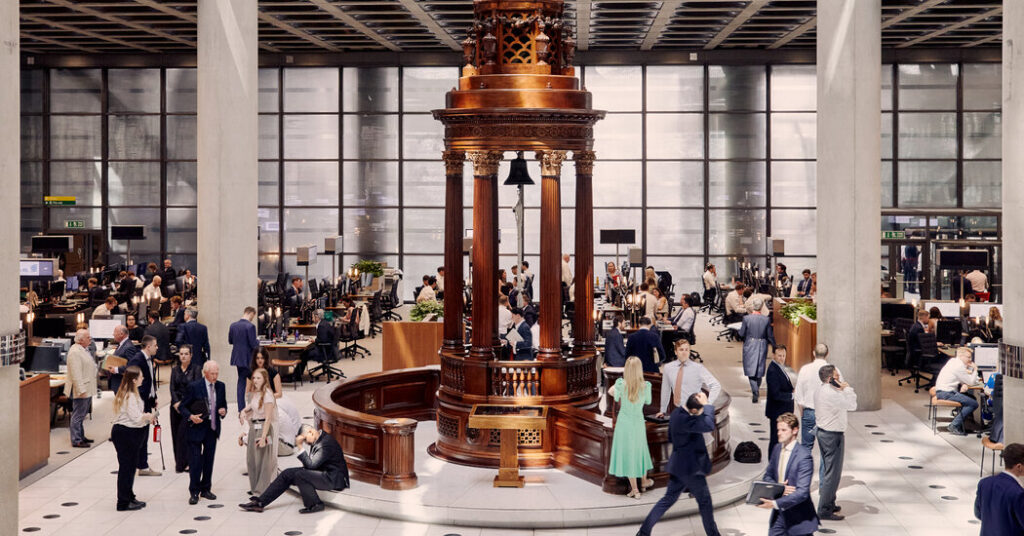
On any given day at Lloyd’s of London, insurance brokers mill around the 200-foot-tall atrium of the Underwriting Room, carrying documents in black folders. They are negotiating policies for ships carrying oil, gas and other goods around the world. There’s Shanghai to Los Angeles; Vancouver to Busan, South Korea; Valparaíso, Chile, to Sydney.
They are also negotiating policies for what’s become, these days, perhaps the most dangerous route in the world: the Strait of Hormuz.
It’s unclear when the approximately 1,500 ships stranded in the Persian Gulf for the last three months will be able to continue their journeys. But when there is an agreement to reopen the Strait of Hormuz, which handled one-fifth of the world’s oil and gas exports before the start of the war, policies negotiated at Lloyd’s will be a crucial part of what enables trade to restart.
That coverage will come at a price.
Insurance premiums in the region are likely to stay elevated long after the United States and Iran agree to reopen the strait, according to marine insurance executives and analysts.
“The market will remember that the Strait of Hormuz can be disrupted very, very quickly,” said Oscar Seikaly, chief executive of NSI Insurance Group, an insurance broker. “Deals can be reached but for insurers to go back to where it was prior to this? I don’t see that happening anytime soon.”
Soaring Premiums
Throughout the conflict, insurance to cover war risk has remained available in the London market for ships seeking to make the voyage through the strait. Rates for ships passing though the strait have soared to between 1 and 4 percent of the value of a ship, from up to 0.25 percent before the war. Companies can get rebates for any voyage that proceeds without incident. In the end, the rise in insurance costs could add up to millions of dollars extra for a single ship.
“In the aftermath of the war, people will be hesitant to expect things to go back to normal right away,” said Svein Ringbakken, the chief executive of the Norwegian Shipowners’ Mutual War Risks Insurance Association, one of the world’s largest marine war risk insurers.
The main reason ships have been largely at a standstill has not been because of the soaring insurance costs, but because of the dangerous conditions. More than 25 ships have been attacked, at least two have been seized by Iranian forces and others have been hit by shrapnel from Iranian missiles or drones.
Franziska Arnold-Dwyer, an associate professor of law at University College London, said she would expect rates to go down if there is a deal, but not to where they were before the war.
That’s because many risks will remain. Among them are the potential for one social media post to upend an agreement, for attacks to restart or for sea mines — if there are sea mines — to explode.
“Whether there are mines or only rumors of mines, the effect is the same,” Mr. Ringbakken said. “To get the full flow of trade again, there needs to be some reassurance that navigational routes are mine free.”
Founded in a 17th-Century Coffee House
The roots of Lloyd’s extend to around 1688, when a coffeehouse in London emerged as a meeting spot for shipowners and ship officers returning from sea. Insurers gathered there too, and the cafe began to rent out tables to businessmen selling insurance to shipowners for their voyages.
Business thrived and by the 19th century, the docks on the River Thames were the busiest in the world. Hundreds of ships arrived each week, delivering products such as sugar, rum, tea, cinnamon, tobacco, dates and canned meats, according to “Thames: The Biography” by Peter Ackroyd. In 1904, Lloyd’s expanded to car insurance. (In documents, its insurers, who were more well versed in marine policies, would refer to a car as a “ship navigating on land.”)
Today, the Lloyd’s market covers 10 percent of the world’s marine insurance and more than a third of war risk coverage. Its headquarters, a short walk from one of the 17th-century coffeehouses where merchants and traders gathered, is a gleaming 14-story tower designed by Richard Rogers, the British architect who designed the Pompidou Center in Paris. Most of the business conducted at Lloyd’s is still done face-to-face in the Underwriting Room, where $35 billion was paid out in claims last year.
The building’s basement features an exhibit that came after an apology, made in 2020, about the role Lloyd’s played in the trans-Atlantic slave trade, including by insuring enslaved people and the vessels carrying them.
The building also houses volumes of Loss Books that documents lost ships from 1774 to today — still written using a quill pen and blue-black registrar’s ink.
There is an entry for the H.M.S. Lutine, which sunk in 1799. Its bell was retrieved from the wreck and is displayed in the Underwriting Room. A 1912 entry is for the Titanic, insured for 1 million British pounds.
So far, no ships noted this year in the Loss Book are known to have been destroyed in the Persian Gulf. Insurers hope it stays that way.
Henrik Pryser Libell contributed reporting from Oslo.
Jenny Gross writes about business and economics for The New York Times and is based in London.
The post Inside the Room Where War Insurance Is Bought and Sold appeared first on New York Times.