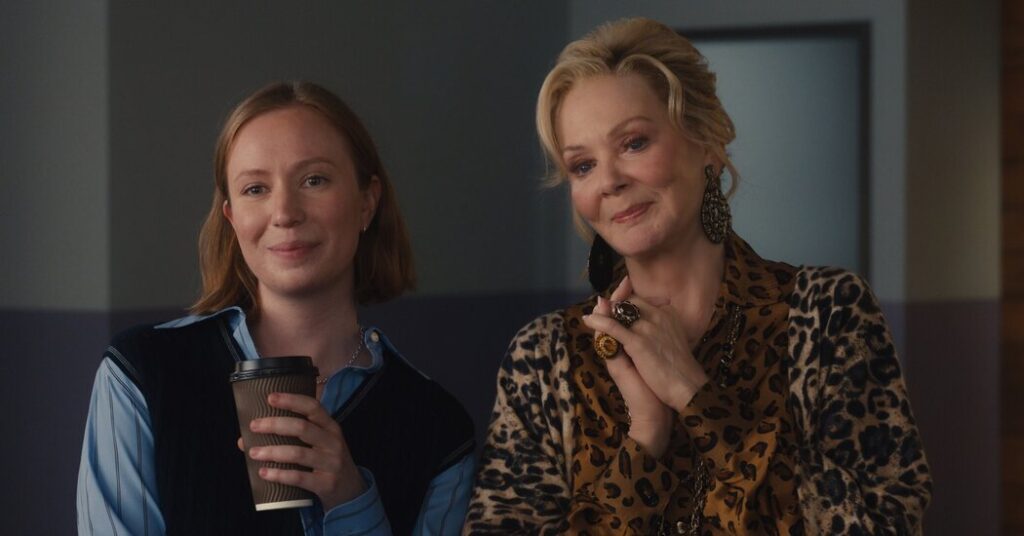
This article includes spoilers for the final episode of “Hacks.”
For five seasons, the HBO Max comedy “Hacks” has explored the ups and downs of May-December love.
Except the relationship at its center has been a platonic one — the friendship between 70-something trailblazing comedian Deborah Vance (Jean Smart) and her 20-something writing partner Ava Daniels (Hannah Einbinder).
Their connection — though turbulent and frequently dysfunctional — has also been a celebration of cross-generational friendship, exploring the many ways it can stretch and challenge those who become pals with people who aren’t their immediate peers.
“I love that they can learn from each other,” said Jaimie Krems, director of the UCLA Center for Friendship Research. Their friendship is evidence “that people can change, people can grow and people can see other points of view,” she added.
That kind of growth is what can make cross-generational connection so uniquely rewarding, according to Dr. Krems and others who study friendship — yet American society makes those ties difficult to find.
The Benefits of a Friendship Age Gap
Perhaps the biggest reward of intergenerational friendship is how it challenges a person’s point of view, several friendship experts pointed out. Older friends often offer wisdom, Dr. Krems said.
“Perspective matters,” she said. “Advice from people who have lived through it matters.”
Younger friends, on the other hand, can offer an “energy and vitality” that “can be infectious,” said Irene Levine, a psychologist and author of “Best Friends Forever: Surviving a Breakup With Your Best Friend.” “It can help us focus on the present and learn new things.”
But at an even more practical level, welcoming cross-generational friendship opens up one’s potential pool of friends, the experts said, at a time when many Americans are craving more togetherness.
“Older adults are isolated in the U.S., but younger folks are lonely,” Dr. Krems said. “There’s a massive opportunity for connection here.”
There is some evidence that Americans are already making friendships outside of their immediate age group. A 2020 survey by AARP found that 37 percent of Americans have a close friend who is at least 15 years older or younger than they are.
How to Attract Friends of All Ages
The main characters on “Hacks” bonded because they connected professionally — and that is often how cross-generational friendships begin, the experts said. That same AARP survey found that more than one-quarter of intergenerational friendships start at work.
Still, there are challenges. Ageism is one, Dr. Krems said, though she believes age-gap friendships can be helpful in combating it — in part, because they “humanize” older people.
“It lets you see another person as a real person — as a rich group of foibles, and values and things they excel at — rather than a representation of a category that you might have very little contact with,” Dr. Krems said.
That is why Danielle Bayard Jackson, who coaches women on friendship, says it is important for people of all ages to spend some time reflecting on any attitudes or stereotypes they may be holding onto about those who are older or younger than them.
Do you think older people are slow or set in their ways? Or that younger people don’t have much substance to offer? Think again, she said.
“Sometimes people will dismiss a bid for friendship based on a bias,” said Hope Kelaher, a licensed clinical social worker in New York City and the author of “Here to Make Friends.” “But remember: The more open-minded you are, the more likely it is that people will be attracted to you.”
Another major roadblock to forging intergenerational friendships is that so-called “third places” or “third spaces” — where people can convene outside of home and work to relax and socialize — are evaporating.
Those types of places, such as community centers, can enable people to “stumble” into friendships they might not have otherwise actively sought out, Ms. Kelaher said.
“One of the central appeals of a third space is that everyone’s invited,” Ms. Jackson said, noting that she befriended a group of women all decades older than her when she signed up for a water aerobics class during her second pregnancy at the local Y.M.C.A. She has also made older and younger friends at church. Repetition and proximity are important ingredients for friendship, Ms. Jackson said.
On “Hacks,” after several seasons of emotional turmoil and occasional back stabbing, both characters come to understand just how much their friendship has changed their lives. When, after her cancer spreads, Deborah decides to travel to an assisted-suicide facility in Switzerland, it is Ava she wants by her side. And ultimately, it is Ava who convinces Deborah to change her plans and pursue treatment.
As Ava says, with uncharacteristic sincerity, while pitching her own TV show about two women from different generations becoming friends: “They butt heads a ton on politics and etiquette and fashion. But at the end of the day, they help each other see the world differently, and they both become better people for it.”
Catherine Pearson is a Times reporter who writes about families and relationships.
The post ‘Hacks’ and the Case for Age-Gap Friendship appeared first on New York Times.