This is an edited transcript of “The Ezra Klein Show.” You can listen to the episode wherever you get your podcasts.
My pet theory right now is that President Trump is not trying to win the midterm elections. I’m not saying he’s trying to lose them, exactly. I just don’t think he cares.
What he cares about is controlling the Republican Party. The Republican Party is his power base. The Republican Party is his protection. The Republican Party is how he can wield power far into the future, long after his presidency, and so control of it is what he’s prioritizing.
I call this a theory, but it’s more like a hypothesis. It has predictions that you can test. Trump is more unpopular at this point in his second term than basically any of his modern predecessors. The midterm elections are less than six months away. He could easily lose the House. He could lose the Senate now. So what is he doing?
Well, if he wanted to win the midterms, he’d be moving to the center. He’d be focusing on the things that Americans are angry about, disappointed in him about. He’d be supporting the strongest Republicans in contested races and doing everything he could to bolster Republicans in vulnerable states and districts.
He’s not doing even a little bit of that. Instead, he’s doing the opposite. He’s announcing a $1.8 billion slush fund that appears designed to pay out to Jan. 6 rioters. He endorsed the scandal-plagued, very controversial Ken Paxton over John Cornyn in Texas, giving Democrats a real chance at winning a Senate seat that should be way out of reach for them. He helped primary Thomas Massie, the House Republican who helped release the Epstein files. He helped defeat Bill Cassidy, the Louisiana senator who voted to convict him in his first term. He is attacking Brian Fitzpatrick, one of the very few House Republicans representing a district that voted for Kamala Harris.
Archival clip of President Trump: He likes voting against Trump. You know what happens with that. It doesn’t work out well.
He’s threatening to escalate the Iran war. And when asked whether he was worried about Americans’ finances, about their pocketbooks, about their cost of living, here is what he said:
Archival clip
Reporter: Mr. President, to what extent are Americans’ financial situations motivating you to make a deal?
Trump: Not even a little bit. The only thing that matters when I’m talking about Iran — they can’t have a nuclear weapon. I don’t think about Americans’ financial situation. I don’t think about anybody. I think about one thing: We cannot let Iran have a nuclear weapon. That’s all.
What a gift to Democratic ad makers that clip is. Trump cares about control of his party, not of Congress. If he can win the elections in a way that tightens his control of Republicans, like through redistricting, he’ll take that. If not, he’s busy. He’s got other things to do.
I’m not saying he wants Democrats to win, but I don’t think he’d mind it if they did. A Democratic-controlled Congress gives him an enemy to fight. I think he gets a little lost without an enemy. It frees him from the tedious work of trying to pass legislation. It puts him back in the place he’s most comfortable, which is not wielding power; it’s claiming persecution.
What Trump would mind, what he does fear, is a Republican Party with a spine. He fears a Republican Party in which members of Congress begin to participate in the investigations of his scandals or they abandon him as his fortunes fall. And so he’s made his choice. He is showing them that to oppose him, even from the right, is to light your political future on fire.
The point isn’t just to defeat Massie or Cassidy or Cornyn or any of them. It’s to scare every Republican left in Congress, to make sure they know that Trump would gladly destroy each and every one of them personally, that he would gladly burn the entire Republican Party to the ground if that’s what it took to save himself.
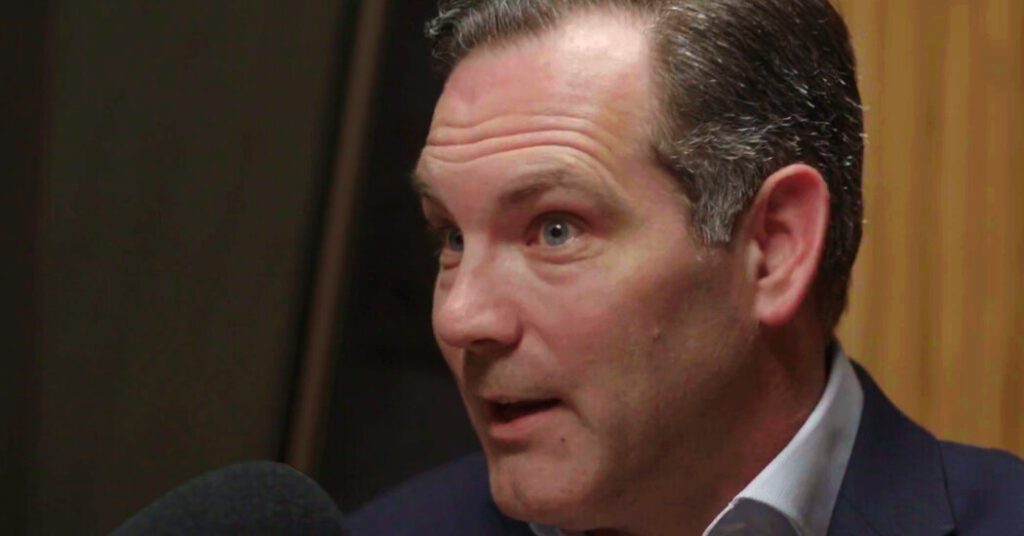
I thought it’d be interesting to hear how this looks to someone whose business has been winning elections for the Republican Party, particularly Senate elections. Liam Donovan is a Republican strategist and a president at Targeted Victory, a Washington public affairs and digital marketing firm. He has worked on the National Republican Senatorial Committee and for Cornyn, and his political commentary has appeared in The New York Times, The Washington Post and other publications.
Ezra Klein: Liam Donovan, welcome to the show.
Liam Donovan: Good to be here. Thanks for having me, Ezra.
Trump is now under 40 percent approval in a bunch of different polls — more unpopular at this point in his term than basically any modern second-term president. Let’s start with him. Why is he down there?
If you think about the mood of the country that produced the comeback of Donald Trump, putting together the coalition that he did, that was predicated on a rejection of the status quo and the bet that Trump would be able to return us to the economy and maybe the vibes of pre-Covid 2020.
Of course, that’s much harder to do than it is to talk about.
I think this is fundamentally about frustrations of how difficult some of these problems are to tackle. There’s an electorate that is not really looking to be told that everything is going well.
Then when you compound that with some of the policy choices that have been made — that I think might prove to be wise in the longer run, but they are legacy-minded moves, not immediate-term electoral plays.
Was it so much harder?
I feel you could imagine a Trump administration second term that sealed the border but didn’t do the aggressive internal ICE and C.B.P. enforcement, so you wouldn’t have things like the battle of Minnesota; that did not go to war in Iran; that did not do the tariffs.
They could then draft on what was a fairly strong and certainly well-recovering economy coming out of Joe Biden’s presidency, that was getting a bunch of A.I. investment and doesn’t make a bunch of what seem to me to be errors, and maybe he’s in a really different place.
The way you have to think about this is the mythology of the Trump first term as understood by Trump versus as it was understood by the electorate.
Looking back, the reason Trump lost, the reason he wasn’t as successful as he might have been was that he was held back from his impulses and his policy preferences by the “deep state,” by Never Trumpers, by the Bush-era Republicans that don’t reflect or respect his version of how the country should look.
At some level, you could argue he was saved politically by that layer of insulation. If you think about what’s changed, it’s that he has absolutely installed loyalists. There is a threshold question of: Are you absolutely committed to this project?
Therefore, he’s feeling for the first time what it looks like to get what you’re asking for. And the electorate that re-elected him just wanted to go back to the way it was.
This was very striking to me when I looked at the poll numbers on it: At this point in his first term, he had a 10 net disapproval. He’s now at 21 net. So he is twice as unpopular at this point in his second term as in his first.
But it all goes to this question, which is whether or not you understand the weakened political state he’s in as a function of the mood of the country or as a function of the country’s reactions to Trump’s policies.
Is it just dyspeptic, or does it not want this?
There are layers to it. There’s now a ceiling in a way that there didn’t use to be. We’ve seen this over the last 20 years, maybe since the Obama era, since our coalitions have shifted, the parties have and the country has polarized.
It’s very, very difficult to imagine a president getting above, say, 48 percent — the coalition that got him there. So in that sense, it’s a hard cap. You need to almost grade on a little bit of a curve, in terms of where these things are.
That said, the president’s approval rating — I don’t care which party you’re from — wants to be above 40. It wants to be at 42, 43. That is your firm base.
What we’re seeing here is that there are elements of the Republican coalition that consider themselves Republican who are disillusioned for one reason or another.
Either they are antiwar or skeptical of foreign entanglements, maybe they are simply upset about the cost of living, they don’t like tariffs or what have you — they just don’t like the way things are going. I think that is the layer that is the easiest to imagine getting back.
If we’re looking forward to “How does this get back to a place where Republicans stand to have OK or just par midterms?” it’s that he floats back up above 40, because that’s kind of where these people want to be.
They want to be given a reason to like Trump. They want to be given a reason to vote for Republicans.
So why doesn’t Trump want to give them that reason? This is where I wanted to get us to, this question of agency, because he could get some of them back.
I always took Trump as somebody who cared, on some level, about his popularity and who has a real sensitivity to the whims and wins of public opinion.
But as his numbers have fallen in the second term, he seems to be going on to tilt. He’s doing this $1.8 billion slush fund to hand out to people convicted around Jan. 6, or who he feels were the victim of Biden-era lawfare. He is talking about re-escalating the Iran war. He is intervening in a bunch of Republican primaries to purge people who opposed him in one way or another.
He’s not doing the things that you might imagine a president worried about losing the midterms would do. He’s not doing a big pivot to the center. He’s not trying to avoid certain kinds of controversy.
It seems he doesn’t care. Why do you think that is?
Well, I think we have to step back for a minute and think about how we got here. How did Trump get the nomination in the first place? It was, in a sense, running against the institutional Republican Party, running against the establishment.
The fact that he doesn’t find himself aligned with the broader forces of the party — he’s not of the party. That’s not what drives him. That’s not his imperative. That’s different than any president we’ve ever seen, maybe in both parties but certainly in the Republican Party.
We saw it in 2018. I mean, he went on a victory lap the day after the elections, even though it was rough, dunking on members that didn’t stay closer to him.
Flash-forward, and I think that lesson’s been learned. I think people realize you have the R next to your name, you’re going to, by and large, own what the president is doing, so you need to make the best of that.
And going against him, picking fights with him, except in very rare exceptions, does not redound to your electoral benefit.
That’s true, but it doesn’t necessarily answer the question of Trump himself. As you mentioned — and I think this is an important point to expand on a little bit — there’s a history here.
In 2018, Republicans under Trump do terribly in the midterms, but Trump comes out the next day and is excited about some of the ones who opposed him who lost.
In 2022, Trump is not in office anymore, but he exerts a lot of control over Republican primaries, and you end up with candidates like Blake Masters and Dr. Oz and Kari Lake. Republicans lose a bunch of very big and very winnable races.
Right now, you see Trump intervening in places, like Texas with Paxton, in ways that, at the very least, create the possibility that Republicans will lose some key races that they could have otherwise won.
So I take your point that Trump does not come from the institutional Republican Party, but he seems to care more about the control he has over Republicans than the control Republicans under him have over Washington.
He is running a risk here of losing the Senate but with more control over the rump Republican senators, when he could be trying to win the Senate but have a couple of people who might be more willing to oppose him.
Does he want to control Congress or control the Republican Party?
There’s something to the point. I do think he’s more committed to and sensitive to the risk of not having control than he was four years ago, eight years ago — whenever. Time doesn’t mean anything anymore.
I think that’s where the project of the structural gambit of trying to create a more resilient map for Republicans in the House ——
Redistricting efforts.
That doesn’t happen if the president doesn’t care. That doesn’t happen if the president doesn’t believe that a Democratic majority could do him damage.
Let’s think about Indiana, where it’s like, “What was their sin?”
Their sin was, well, one, not listening to the White House and doing what they said to do.
On not doing the redistricting map.
But what’s the interest of the redistricting? The interest of the redistricting is maintaining congressional majority.
So in that case, his priority was trying to win more seats. Is that self-interested? Sure. But it wasn’t punishing them for going against him; it was punishing them for going against what he saw as the interests of the party.
So I think that’s your signal right there.
In the Senate, I’d push back and say this is something the Republican Party has had to learn a number of times over.
If you think back — my time at the Republican Senatorial Committee was 2010. It was a great cycle, but they left a great deal on the table ——
Because of the Tea Party primaries ——
Picking bad candidates, not coordinating, and they did it again in 2012.
It wasn’t until 2014 that they figured out a path forward of how to find suitable candidates that could please the broader coalition and had a level of coordination that led to a great cycle.
Trump comes in and doesn’t even have a consistent set of preferences, so he just kind of mashed buttons.
I think 2022 is the example, kind of like 2012, where we realized: This is unsustainable. Republicans have to do something about this.
They figured that out in 2024, in both directions. Both the party and its leaders figured out how to work with Trump and his political operation, and Trump figured out where he can be effective.
I’d argue that Trump and his political operation have done quite a good job this time directing traffic in a way that they hadn’t previously. It’s what makes instances like Texas — to a lesser degree, Georgia — notable.
I think they’ve done a pretty good job there. But it makes the exceptions that much more glaring.
So your argument is that unlike in 2022, if you look at most of the competitive races, the Trump operation has cohered around a candidate who doesn’t look wildly out of step with the state.
But then there is this separate thing that happens of Trump going to punish and purge specific candidates who he feels were disloyal to him.
It’s more notable, but it’s not the macro story.
That’s right. For each state, there’s an interesting story we can get into. Louisiana is the most obvious. But he understands that in Maine, Susan Collins is the only Republican who can win there and should win there, and he’s not mucking around there in the way that he is in, say, Louisiana.
Texas is a unique one in that it became a bargaining chip, and in some ways, Cornyn became collateral in this broader tug of war.
You know that one well. You used to work for Cornyn.
I did.
What happened there between Trump and Cornyn?
I think in the White House’s ideal timeline, Paxton doesn’t get in. I don’t think there were entreaties from the White House or from the Trump operation to get him in to challenge Cornyn.
The problem is that he did it anyway, and it created a really difficult dynamic.
Why did it create a difficult dynamic? Why doesn’t Trump just say, “Cornyn’s our guy. What are you doing here?”
Because Paxton was his guy, too, so he’s got people competing for his affections in a way that the president, obviously, likes a great deal.
And maybe it’s worth it for you to describe who Paxton is in Texas politics.
Who is Paxton, and why did Trump decide in the final moments of that primary runoff to endorse him over Cornyn, possibly risking that seat?
Paxton is the sitting attorney general of Texas. He’s been elected statewide a number of times. It’s important to get out there. It’s not the Senate, it’s not the governor, but he has been elected, and he has been statewide elected since carrying some of the political baggage that he does.
To the extent that he’s known, it’s largely because he has gotten into hot water a number of different times. There was an impeachment effort. But there have been efforts at the state level to be rid of him.
He has prevailed. He has prevailed, in part, by aligning himself with Trump, being a leader on a number of the initiatives that the president cares a lot about, from the 2020 election standpoint and otherwise.
He has boosted his brand by wrapping himself in MAGA and donning the hat. He threw himself into this race.
Cornyn — who I adore — is a longtime incumbent and is very much of the flavor of the George W. Bush, Rick Perry-era Texas Republican Party, which is not necessarily the vanguard here. He spent a decade-plus in Senate leadership in ways that tie into the national party, in ways that can be complicated in these sorts of primary efforts.
Why does Trump get involved? Like I said, I think Cornyn became a bargaining chip for Trump with John Thune at a time when he wanted the Senate to do certain things.
In the Senate at that point, there was this big push to get the Save America Act across, to nuke the filibuster to do so — all these complicated things. When that didn’t happen, it became clear that there did not seem to be an inclination from the president to back Cornyn.
When I heard that he was going to endorse, that gave me a bad feeling in the pit of my stomach, because I had a feeling that it wasn’t going to be for Cornyn.
I question the idea that Paxton loses this seat. I think the real problem for Republicans is twofold.
No. 1, it’s always easier, cheaper, more straightforward to get an incumbent re-elected than it is to have an open seat. The more complicated the candidate is, the more expensive it is.
I think that’s the real problem. This is a massive state with a huge number of expensive media markets. The amount of resources that will be expended here — it was going to be expensive for Cornyn. It’s going to be insanely expensive for Paxton.
James Talarico has raised an insane amount of money.
He has. And that will be costly.
I feel, at this point, you still haven’t quite answered my question about Trump, which is that he did not have to come in and endorse Paxton. Cornyn was not an anti-Trump Republican.
If you look at Polymarket, the odds of Republicans holding the seat have gone from 75 percent in January to 55 percent now. So they’re favored, and I think you have to still see Paxton as a favorite, but it’s more narrow. It could look something more like the Doug Jones victory in Alabama over a very flawed candidate a few years back.
I take your point that there are places where they didn’t do a bunch of stupid things, but there’s a world where they wake up after the elections and Talarico won in Texas and that made Chuck Schumer majority leader, and that’s purely on Trump’s table. Like, he chose that outcome.
Are they mad about that, or does he on some level not care that much because fighting with a Democratic-controlled Congress is in some ways a pleasure for him?
I don’t think that’s what it is. I think a couple of things. No. 1, you asked the question: Why did he choose Paxton? Why didn’t he choose Cornyn? I think this is a bet of being for what’s going to happen.
If you thought in a vacuum that Paxton probably wins and you’re Trump thinking: I want to flex my muscles and look like I’m the reason — that, to me, is the logic of that kind of pick, at a time when, again, this has become a proxy match with the Senate Republican establishment.
I’d also suggest to you that I don’t see a universe where Texas goes blue and it stops there. I don’t think Texas is the marginal fourth seat where Democrats get to 51, and that’s it. So it’s much more likely to me that on a night where Talarico wins, it’s just lights out because it was such a bad night. I don’t think it’s going to be scrappy and clawing to 51 and it’s Talarico that puts them over the top.
And you think that’s how Trump thinks about it?
Oh, no. That’s just how Liam thinks about it.
OK, but I’m asking how Trump thinks about it. [Laughs.] Go a little bit further here. Because the big question I am struggling with Trump is: What does this guy want? What is his actual play here?
And maybe it’s not that strategic, but I think there is a strategy here, which is that he wants control of the Republican Party. I think he cares about that more than he cares about control of Congress.
I mean, his fury at Massie was obviously part of this. He took out Cassidy, the Louisiana senator, which is not a seat Democrats have any chance of picking up.
But I see something that is consistent here and goes a ways back, which is that Trump sees his power base as the Republican Party itself.
I think that he is less worried about a world where Democrats have power than he is about a world where, as his numbers go down, as he is a lame duck, Republicans feel empowered to oppose him, to join in investigations of him.
The danger is not that Democrats will win elections. It’s that Republicans ever feel empowered to abandon him.
That’s also Trump maybe controlling the Republican Party into the future. I’m not a person who believes he’s going to run for a third term, but could he continue to exert enormous power over the Republican Party by continuing to intervene in primaries all over the country? I think he absolutely could. You can be the kingmaker even when you’re not the king.
But I’m curious if you disagree with that.
Well, I think if we agree on the predicate that the present and future fortunes of the Republican Party in and of themselves are not of significant concern, then the next layer below that is: Well, what does he care about?
I think he certainly cares about the fealty to him. His impulses are to flex his muscles and have Republicans do what he wants. And as it looks less likely that the House stays Republican-controlled, then yes, you begin to start thinking about: OK, if I can’t have that, what can I have?
I think there’s a decision tree there.
But does he care about doing the sorts of things that make it easier for people to win elections when he’s not on the ballot? He cares a little bit, but when that’s in tension with his control over the party, I certainly think that shapes his decision making.
Let’s zoom out a little bit here to the midterms broadly. You’ve been involved in Senate elections on the Republican side.
I want to talk about some of the individual elections that are coming, but first, how do you understand the macro environment for Republicans right now?
The best barometer we have is presidential approval, generic ballot — and those indicators are rough. Trump has 58 percent disapproval, I think, in RealClearPolitics’ average. That’s not good.
I also think the thing that’s difficult to read about the elections that have happened in the meantime — they’ve obviously been very favorable for Democrats — there’s a built-in asymmetry based on the makeup of the coalitions now, where every Democrat is crawling over broken glass to go vote for Democrats for dogcatcher if it means sticking it to Trump.
Generic ballot might be the interesting delta there. Democrats only get 48 percent on the generic ballot — which is, of course, a good number. That’s significantly higher than what Republicans have.
But there’s a delta there of about 10 percent of voters who say they disapprove of the job Trump is doing, but they’re not yet willing to say, “I would prefer a generic Democrat in the vote for Congress.”
That’s the big question over the next six months: What’s more likely? Does Trump’s approval rebound such that those people go and vote Republican? Do they stay home altogether? Or do they just say, “I’m not voting for this. I want to check,” and end up saying, “Yes, I will vote for that”?
You could also think about the 2022 scenario here, which is that Biden’s approval rating was not quite as bad as Trump’s is, but it was bad. Democrats were pretty freaked out about a red wave going into the midterm elections, and it didn’t really end up coming to pass.
Biden’s approval rating was not that correlated with Democratic performance. Do you think there’s a possibility that happens here?
That’s the best-case scenario. 2022 was the first time we were in this particular map, and of course, there have been changes at the margins with this middecade redistricting.
But what we found in 2022, 2024, and we’ll see about 2026, is: This is a really resilient map. There’s not as much pool of competitive seats, and so even on a really good night — I mean, 2022 was instructive. Republicans won the popular House vote by a significant margin and yet only netted something like 10 seats.
Because we redistricted districts out of competition.
That’s right.
What a wonderful way to run a democracy.
I think the other piece is what Democrats were successful in doing, and Republicans failed in doing, was putting up the sorts of candidates that could win. And you ended up with messy primaries that produced suboptimal candidates that came out of those primaries with a party that was divided and expending a lot of resources.
And in the meantime, Democrats were able to otherize these candidates, make them weird. Like, Masters — that guy’s weird.
Some of them were pretty weird, man. [Laughs.]
Right. But I say that because you’re going to be watching this. This is precisely what’s going to happen, and whether it’s successful is an open question.
We’re already seeing this with Talarico.
Talarico and Paxton are going to try to otherize each other.
Something’s a little off. Graham Platner — that guy’s weird.
Whether it’s effective, that’s an open question.
Let’s walk through the Senate elections one by one here.
If you’re sitting there war gaming this out with Republicans, what are the states you understand to be competitive? And how would you rate the way the races are shaping up in them?
The first one’s pretty obvious. North Carolina is a seat that’s been just right on the cusp for so many seats. Barack Obama was able to break through in 2008. That, in fact, was the last time the Democrats won a Senate seat there.
It’s been a very expensive, very close state in the Senate since then. But Democrats haven’t been able to get over the hump.
In this case, it’s their single best candidate, in the former governor Roy Cooper. They got him straight away. He’s raising gobs of money. In an environment that stands to be quite good for Democrats, that’s a place where the open seat created by the retirement of Thom Tillis, who was kind of run out by the president and his relationship with the president, is a prime pickup opportunity. Open seat, good candidate, big resource advantage, which isn’t the case all over the map.
Also, another example where Trump is not trying to protect and make life easier for a plausibly vulnerable Senate Republican, which is one reason Tillis seems to have decided to retire.
I think that’s right. I could argue with a straight face that, all things equal, you’d rather have an incumbent than an open seat. The way things were, the dynamics with Tillis, he probably would’ve gotten a primary. It just would’ve gotten ugly.
So I think coalescing behind Michael Whatley — the then-R.N.C. chair, somebody that has access to national fund-raising possibilities — it has gone as well as it could go, but it’s still a lopsided situation.
All things equal, on a Democratic night, that’s the first one to flip. I don’t think it’s gone. There hasn’t been too much polling on this, and we’re certainly not into the endgame. But that’s the obvious first pickup. If you’re Democrats, that’s the one that has to fall.
I think it gets interesting after that because there is a significant drop-off. There’s only one state on this map that does not match the lean of the state at the presidential level, and that’s Maine, with Susan Collins.
She is a survivor. I think she confounded expectations in 2020, with Trump on the ballot, when she was given no chance of winning that race.
She was way behind in the polls.
Way behind in the polls. That is the one where I think, irrespective of who Democrats had put up there, there’s just this unknowable binary. Either Maine is still the kind of state that rewards independent known quantities like Collins or it’s not, and we just don’t know six years later if that has changed.
I do think they’ve done her a favor at some level, in that you can more obviously see the permission structure for why would a Harris-voting Democrat vote for a Republican for Senate? Well, because Graham Platner is a different kind of Democrat. They might have voted for Janet Mills, but they wouldn’t vote for Platner.
I wouldn’t say it’s No. 2, but it’s the most obvious kind of target.
What do you make of the polling, which has kind of consistently shown Platner as or more competitive against Collins compared with Mills?
I don’t have a good answer on the polling. The value of Platner is he’s the high-variance candidate at a time when, having lost with a Sara Gideon type, variance is your friend. So that’s the logic of a Platner pick.
I’m not quite sure what’s happening to the polling, except that Mills ran a somnambulant campaign. She didn’t seem to want to be ——
She’s 78.
Exactly.
And by the way, I think this is relevant on Collins, too. Collins is a lot older and seems it in a way that I think is more difficult for her as a campaigner.
I would argue — having been around Collins for 20 years — I think she’s as sharp as ever. I don’t want to turn it into Biden stuff, but I think that she’s strong and sharp.
Whether her brand is still what the people of Maine want — I hope they do, but we’ll have to see. It’s a stark contrast there.
But the dynamic of Platner versus Mills — one of these guys has energy; one of these guys is out there doing things that are at least interesting. You might not like him, but it’s at least interesting.
She seemed to have to be pulled into the race. She got in late. So that differential, at some level, makes sense to me. I don’t think that’s the same question as: When we go through a general campaign, do they perform the same way on election night?
We’ll have to see. But this becomes a strong question of: Is it just shirts and skins? Is it just D versus R? Are people willing to say, “OK, an independent-minded Republican that took big stands against Trump but has enough respect from this White House that she’s not getting torpedoed for it”?
Do people still want that? It remains to be seen.
The hope among the Platner fans is that he brings in voters who don’t normally like Democrats.
I think Democrats continuously have this question of: If we ran people more in the Bernie Sanders mold, if we ran people who did not seem that they came out of the same institutions, can you pick up some of these people who liked Trump because he’s an outsider? Not people who will naturally always vote for Democrats?
Well, I’d say a couple of things. No. 1, there’s something to that, in that you want to serve up something that’s differentiated. But I think the flavor that makes the most sense to me — I don’t need to be giving advice to the Democratic Party of Maine — but to me, that looks like a Jared Golden.
He’s the House member who represents the reddest district of any Democrat. And for a bunch of reasons — though also, he was getting primaried by another Democrat — he’s now retiring, which I think is a real loss for Democrats.
Right. I think he succeeds potentially in cutting a different image. He’s a combat vet Marine. But he’s not associated himself with Sanders, right?
I raise that only to say that the problem for Platner — it may not prove to be a problem, but the risk for Platner is — it’s a fascinating interview with your New York Times colleague. I found that very interesting when they probed how much of this is superficial. How much of that blue-collar affect is real and legitimate?
I mean, there’s some holes that can be poked in here that do not hold up to scrutiny. This is still a fascinating state with two districts — one of which is the conservative one up in Aroostook and Presque Isle, and then there’s the coast.
And I think however many voters that Platner can get from the Golden district, how many is he turning off on the coast, notwithstanding his oysterman background? Is that going to hold up with some of the people that know and liked Collins in the past?
I hear all that, but for Democrats to have any chance, they’re going to need North Carolina, they’re going to need Maine. Then what?
Maine’s the easiest kind of threshold. There is a path independent of Maine, but that just tells you, “OK, there’s the one state where she’s still got it.”
But after those first two, it gets really difficult, and there is a leap to — you can take your pick, but I think the Ohio race is probably where Democrats have the best shot.
Sherrod Brown is somebody who lost in the previous election to Bernie Moreno, who I don’t think Democrats expected Brown to lose to.
He’d been in elected office for the previous 50 years or so. He’s coming back. He’s able to raise a lot of money. But I think it’s hard to put Humpty Dumpty back together again.
When you are an incumbent and your strength is predicated on being the guy who can win and then you’re trying to pull yourself off the mat, it’s a little bit tougher.
You have an incumbent but an appointed incumbent in Jon Husted. The ticket there, with him and Vivek Ramaswamy, the polling’s been OK, but not ——
Ramaswamy is running for governor there.
Husted’s not done anything particularly offensive. He’s going to have the resources there.
On a night when Brown beats Husted and withstands the — I mean, the amount of money that’s going to come into that race from the outside, particularly from the crypto-mining groups and that kind of thing, it’s going to be astonishing.
If that happens, it was a really, really good night for Democrats.
Let’s put numbers on that. If I am remembering this right, Brown, who was a very strong candidate, lost that election by three and a half points.
You were saying about Moreno — who was in many ways a weak candidate, a car dealer who had settled all his wage theft lawsuits. And people talk about populism, but he was not obviously a great icon of populism.
But Brown lost to Trump, and he lost to the Democratic Party’s reputation in Ohio. He overperformed Harris by quite a bit.
It’s the last part that matters. Trump was on the ticket. We keep doing this. I think we had the same argument when it was Tim Ryan against JD Vance. At a certain point, when there’s special pleading of, “Oh, these are bad candidates,” well, when you say these are bad, I would argue ——
I’m not saying Brown’s a bad candidate.
No, no, no, no, not Brown. I’m saying Moreno, Vance.
I’m saying that candidate-quality-wise, and you can disagree with me if you want, but I think Brown is a better candidate qualitywise than Moreno is.
But the Democratic Party’s brand in Ohio is such trash that he could not overcome that — as Ryan couldn’t overcome it, as basically no Democrats in Ohio can now overcome it.
So the question with Brown is — let’s say 2024 is an environment where Democrats are minus two or three. It’s a little bit of a better environment for Republicans. If this is a plus-six or plus-seven Democratic environment, maybe that overwhelms the problems of the Democratic Party brand and Brown can win.
If it’s not, if it’s plus two, if it’s plus three, then probably Brown can’t win.
It really seems you’re looking at a pretty straightforward “How big is the Democratic wave? How much has Trumpism cost Republicans in this year?”
I totally agree with that on the Ohio front. I do think there’s been a tendency to underrate the Republican candidate.
However you thought of Vance or Moreno, Husted is completely inoffensive. He was lieutenant governor. I just think that matchup is worse for Brown.
But if you’re trying to count to three, that probably should be the third. And it’s not going to get any easier, in terms of the different states.
The pool of states that we’re talking about, and we talked enough about Texas, but I’d put that in that tier where it needs to be a Democratic plus-six or plus-seven environment to even be in the conversation.
But do you want to talk about that race for a minute? Because on the one hand, Democrats are very, very excited about Talarico. Republicans, I think, see him as having more attack surface than Democrats quite realize. Now, it’ll be Paxton, who also has a lot of attack surface.
As somebody who knows Texas politics fairly well, how do you think about that race individually?
I would just say Texas is so expensive. There are so many markets that it is going to be just an absolute resource suck. And I think because of that, smart Democratic strategists will play that one out, and they have high hopes.
But if you’re really looking to move the needle and make something happen, you’re probably more apt to look at Alaska. You’re probably more apt to look at Iowa. I don’t know that they’ll necessarily have more success, and in similar ways, you still need to have that D-plus-seven, D-plus-eight night to break through in those states.
But it’s much easier to move the needle and to differentiate your race from the other things going on on the ballot in those states, those smaller markets and smaller electorates — where just in terms of raw vote totals, a relatively minor shift in Alaska or Iowa is going to go so much farther than in Texas, where you’re just trying to boil the ocean.
Well, let’s talk about those two races. In Alaska they’ve got Mary Peltola, a former House member there. How do you see that one?
Alaska’s been another one where I’ve seen this movie before. There was a bit on Twitter in 2022, like, “Don’t sleep on Alaska.” It’s always the one. It’s a different state. It’s a differentiated state, where it’s a relatively small electorate, interesting demographics. There’s a blue-collar piece to it.
They’ve shown a propensity to support Democrats, whether that’s Mark Begich, or we can go back to Tony Knowles, Peltola herself in that House race.
There’s enough variance there that there’s opportunity.
I’d argue Dan Sullivan is a squeaky-clean incumbent Marine vet. To the extent that he had any challenges, it was probably met at the original threshold, when he beat Begich in 2014.
It’s hard to beat an incumbent, period. I think the hopes the Democrats have are based on the fact that Peltola won in the special election, then she won again in 2022, so she’s got this edge in ranked-choice voting.
That’s another thing that Democrats need to think about. There’s this notion that ranked-choice voting inherently benefits Democrats, and there might be cases where that’s the case. It certainly was the case with Peltola in the first place. But why was that? It’s because Republicans were divided. You had two flavors of Republicanism in Sarah Palin against ——
Say the name of the person it’s against, but we should just mention, as a background here, Alaska’s a weird system where four people advance. And then you have ranked-choice voting in the general with four candidates. It’s not the way people normally think of these elections, where there’s really just two candidates.
That’s right. And there was a Begich scion, so these names just weave in and out of Alaska politics.
But the first time he ran, it was against Palin, and in the immediate context of ranked-choice voting and those preferences, there were enough divisions on the Republican side that Peltola was able to triangulate and become the moderate middle against two Republicans. She ends up winning that and then holding it in that next general election.
When it was a straight-up race against Nick Begich when he came back, she lost.
So I don’t want to say she’s not the absolute strongest candidate Democrats could have put up. She absolutely is. I just don’t think the conditions are there, from the standpoint of Republican divisions. There’s not really blood in the water in the way there might have been.
The reason Texas is attractive is that you’ve got some issues with the candidate, you’ve got some divisions within the party. That doesn’t exist in Alaska.
Yeah, the situation there is the Democratic hope is partly that demoralized Republicans just don’t come out. Trump’s not on the ballot. They’re not happy with how things are going under Trump. They stay home, and Peltola wins because she’s both a strong candidate and Democrats are highly motivated in this environment to come out.
That’s right. I also think in the Anchorage market, you just go buy it out for cheaper than you could coming into San Antonio or something. In terms of the alpha there, in terms of resource allocation, it makes a lot of sense.
Similarly, Iowa — going back to this question of incumbent versus open seat — if it were Joni Ernst, it would be a different proposition. But an open seat is more expensive for the party in power to hold, and it creates opportunity.
Republicans have a great candidate there in Ashley Hinson — sitting House member, very dynamic, telegenic. I think they’ll be OK there. But this is a time when the Midwest is not loving life. The ag community is getting hit hard by the tariffs. There is enough going on there on that ticket.
I mean, there’s a competitive governor’s race.
Rob Sand, the Democratic candidate for governor there, is very strong.
That’s right. And I’d be more scared if Sand were running for Senate. But it does tell you that there are things happening at the state level that you can’t take for granted.
If I’m Republicans, I’m leaning into that one and making sure that we don’t get caught.
What do you think about Michigan? I know Republicans who seem to be getting more excited about the possibility of a pickup in Michigan, where Gary Peters is retiring because they think Democrats will nominate Abdul El-Sayed, who’s the more Sanders candidate, who campaigned with Hasan Piker and is now sort of leading in the Democratic primary there.
Democrats have not really been thinking about what happens if they lose a seat.
Yeah.
But do you think that’s becoming a pickup opportunity or not really in this environment?
Well, it should be a pickup opportunity anyway. This is a state that Trump won. He’s won it twice. Mike Rogers was a strong candidate who came up just shy last time. So, all things equal, it should be top of the list.
As you say, environment makes it more of a challenge. But to your point, the fascinating stuff going on in the Democratic primary there — it’s uncanny.
As somebody that’s worked in Republican politics, particularly Senate politics, long enough, it’s the first time in a while I’ve seen just an eerily similar situation to what Republicans have lived for a decade and a half. This experience of Democrats putting up candidates that are probably objectively weaker and more susceptible to lose.
I don’t know that it will come back to bite them, but it’s so clear that if you put up somebody that’s not fit for the state — and remember, this is something that Democrats have used to their benefit in Arizona.
I think back to Arizona, where both Kyrsten Sinema, in one instance, and then Mark Kelly, in the other, just got to wait around, had the field to themselves, stockpiling cash while Republicans spent money and beat each other up and divided the party.
The longer this goes in Michigan, the more divided they are.
It’s an August primary.
August primary. Exactly.
It’s not happening for a little while.
Just for people who don’t know, there’s a primary there in the Democratic side among El-Sayed, the more progressive candidate, then Mallory McMorrow and Haley Stevens. McMorrow is a little bit between the two. Stevens is definitely more the establishment Democratic candidate, and they seem to be splitting the vote between them.
Yep.
Also, El-Sayed has wrapped them around the axle of Gaza, which has become a pretty potent issue in Democratic Party politics, and neither of them has been able to navigate it in an effective way.
I think that one is a fascinating race. I absolutely think this is another case in point where the White House did a really good job of rallying behind Rogers early, cleared that field in a way. There’s an opportunity to sneak a seat right there.
On a night when all these things that we’re talking about are in play, Republicans have no business winning in Michigan. But we’re looking at a situation where this race will be on the board unless something changes.
Because even if Stevens ekes it out, this is not the kind of primary that yields a candidate with the resources and unity that puts the race away. I think it’ll be competitive heading into election night.
Something you see in Michigan — and I think you also just saw in the Kentucky House primary, where Massie lost — is a way that views about Israel, views about Palestinians, views about the war in Iran are splitting both parties in complicated ways.
Massie, of course, is a big Trump critic — although he didn’t use to be — and was key in the Epstein files coming out. He was defeated.
But he was a favorite of Candace Owens and Tucker Carlson. In his concession speech, he said, “I would have come out sooner, but I had to call my opponent and concede, and it took a while to find Ed Gallrein in Tel Aviv.”
AIPAC spent a lot of money against Massie. Massie said that he thinks he would have won if not for the fights over Israel.
And Massie, by the way, did much, much, much better among young Republicans than among older ones. There was a huge generational divide in that primary.
Something is happening here that I think is going to really flower — or fracture, I should say, maybe more precisely — in 2028 for both sides, which is that I think that Israel, Iran and Gaza have become very, very difficult for both parties to navigate. Their bases are internally split on these issues.
Yeah, I think the Massie one is really interesting because he’s been a gadfly throughout his career. That’s been his whole brand all along. It reminded me: He had one of the best quotes I’ve heard of the Trump era.
I think it was a 2017 interview that he had with The Washington Examiner. His line was: “All this time, I thought they were voting for libertarian Republicans. But after some soul searching I realized when they voted for Rand and Ron and me in these primaries, they weren’t voting for libertarian ideas — they were voting for the craziest son of a bitch in the race. And Donald Trump won best in class, as we had up until he came along.”
It’s just a great kind of summation of all these things, but it gives you a sense and a flavor for who Massie is.
I do think he was a thorn in the side of this White House and of the party for the longest time. But to your point, he was able to take issues that get a particular premium online.
If you can take some of these polemical issues that get a lot of engagement and make that your issue — that’s not really what we were talking about, but he was able to wrap himself in it in a way that got a lot of attention and was able to, in some ways, benefit him.
He was able to fight a pretty close race. And I think that is a valuable way of getting attention.
If you are a candidate, particularly an insurgent candidate, and you try to make races about these issues, you can find an audience for it, and whether or not it pays electoral dividends, that’s something to watch for.
Well, one thing we’re seeing in a bunch of different places is a schism between what I would think of as the Fox News Republicans and the YouTube Republicans.
You see this in the Florida gubernatorial primary on the right, where you have a very, very radical and, I would say, quite antisemitic candidate who’s been very popular among young Republicans in that state. And Trump has kind of been on both sides of this line. He sort of united, at least in the 2024 election, the podcast Republican world and the Fox News Republican world.
But those, to me, seem to be splitting apart. You could call it the Tucker Carlson-Ben Shapiro split. You see it over and over and over again. Obviously, Democrats have their own fractures around these issues, but I’m curious, in a broad way, how you see the divide. It seems to be very different politics among young Republicans from among old Republicans right now.
I think that’s right. It’s much easier to synthesize — who knows where it goes? — but I think Republicans have an easier time containing this and sorting it out.
I’m watching Vance as the one who has spoken up on this and is trying to sort that out, because there is a generational divide. There’s certain politics that have been imprinted on ——
What makes it easier to sort it out on the Republican side? Like, how are you going to hold Shapiro and Carlson together in one party?
Well, I don’t think Carlson wants to be involved in any party right now.
I mean, he endorses Republicans. He spoke at the Republican National Convention in 2024.
Unless and until Carlson runs in 2028, he has deliberately marginalized himself in a way that has, I think, been very successful in getting a grip around a certain audience.
Let me push you on this, because I’m really curious to hear you say this. To me, what seems to be happening is that Carlson is making a bet — I’m not saying it’s not sincere, it might be sincere for him — that the Republican Party is moving in the same way that Trump once was a strange, eccentric, vanity candidate but is now the dominant figure in Republican Party politics.
What Carlson sees and is maybe also helping to shape is that young Republicans have very, very different views on a bunch of these issues.
We live in a very, very attentionally thick society now. And I’m not saying he and Owens are donating to the Republican Senate campaign committee, but they are on the right. I don’t think that is arguable.
They are endorsing candidates in Republican primaries. They both endorsed Massie, for instance. Yeah, maybe they’re losing some of the fights now, but I think their view is that the only thing holding this together is Trump himself and that Vance can’t hold it together, Marco Rubio can’t hold it together.
So they’re betting that after Trump doesn’t have an iron grip around the Republican Party, what’s going to be growing is their side of it. In fact, picking some of these losing battles is good for them right now.
This is the attention economy, right? What’s good for Carlson is getting attention however he can, including right now picking fights with Trump, because there is an appetite for that in a way that there wasn’t a couple of years ago.
But I don’t know that that’s his project. I don’t know that his is an electoral proposition. I think he’s trying to build his own platform. He’s trying to build his own audience, and I think he genuinely has a lot of these positions that he’s sorting out in real time.
But I think the layers to this, the question of: Why do I think it’s easier for Republicans? Well, I think for Democrats, this is a litmus test issue in a way that is going to be on full display in 2028, to the point where the most obviously talented politician in the race — like, Josh Shapiro, does he have any chance?
It just seems like the kind of issue, just proximity to it, that would color the market for a Shapiro candidacy. They boxed him out on this issue even in the veepstakes in 2024.
I just think it’s so front and center that it makes it difficult, whereas this is underneath a lot of things in the Republican Party.
Generationally, you have a Fox News generation, a boomer generation, that’s imprinted with the more idealistic politics of the shared affinity of the state of Israel, the Christian imperative, the Mike Huckabee approach toward these things versus a younger Republican Party and a party that shifted over time to be the low-trust party that is skeptical of institutions.
In the same way that Trump exploited skepticism of the neoconservative project and the idealism of it to something much more skeptical and perhaps cynical, I think, you have to sell the Republican alignment with the cause and state of Israel on its own terms, in terms of an “America first” approach. Like, why does this benefit America?
That’s what Vance is exploring, in terms of explaining support for Israel in all its forms in a way that is much more of a transactional ——
But I wonder if he can hold that together, because I think I see this one differently from you. It seems, to me, the Democrats have — I don’t want to say a consensus forming, because I think there’s going to be a lot of debate.
Chris Van Hollen — who is a very establishment Democratic senator from Maryland but has been a leader on some of these issues around Israel — basically says: Look, we Democrats need a new consensus on this. You see the even more moderate or at least normie figures in the Democratic Party embracing that.
Meanwhile, it seems the schism on the Republican side will be harder because you really do have this Christian Zionism side, this war in Iran side, versus the Carlson-Owens side.
You mentioned Huckabee, but the Carlson-Huckabee interview is a very good example of how far those things are. You’re not going to have a pro-war-in-Iran faction in the Democratic primaries. That’s just not going to happen.
And Shapiro’s view, which is that Netanyahu is a disaster, is also going to be Gavin Newsom’s view, is also going to be Pete Buttigieg’s view, is also going to be Alexandria Ocasio-Cortez’s view, and then they’re going to have to figure out how they instantiate that into proposed policies.
It seems that when you look at the Republican Party factions of Fox News versus YouTube, what’s popular in one and what’s popular in another feel irreconcilable. They have — not the question Democrats are going to have to ask of “How far do you start moving in pressuring Israel to not be an apartheid state?” but on the Republican side, “Do you think Israel is great? Or do you think it has led us into a disastrous war in Iran and it is distorting our foreign policy?”
I’m very worried about the ways that will shade into antisemitism and other things, but it feels very hard for Republicans to reconcile.
And in some ways, Massie with that final line — I had trouble reaching my opponent because he was in Tel Aviv — struck me as a signal of things possibly going in pretty ugly directions over there.
Oh, the ugliness is going to happen. But as you’re looking at what Massie’s doing, what Marjorie Taylor Greene’s doing, even what Carlson’s doing — these aren’t necessarily electoral plays.
The political economy that exists now is you can have your career as a podcaster, as just a general media gadfly on YouTube or otherwise, in a weird way. Whereas your backbench House gadfly might have aspired to higher office or other things in cycles past, now your offramp is probably just keeping a hold on this audience.
OK, but we used to say attentional plays were electoral plays. Is that still true?
Because if I look at the big lessons right now, you can win through dominating attention, and Trump was probably the first figure who did this in a way you couldn’t before.
But you look at Zohran Mamdani defeating Andrew Cuomo and Brad Lander in a full field of Democrats. You look at Platner. He destroyed Mills through dominating attention.
Does Spencer Pratt have a chance in Los Angeles? It doesn’t seem entirely impossible to me that he does.
Talarico came out of nowhere because he became a huge figure on TikTok and ended up on Joe Rogan’s show.
One of the things that is significant about this era is that the attention economy is eating the political economy. Incumbents who were tuned for this older form of more institutionally gate-kept attention — you know, winning over the newspaper editorial board in your state or in your city — are getting defeated by candidates who know how to win attention online.
We totally agree on that. But I would say if you look at the individual personalities and habits of these folks, in particular like Greene — when she broke with Trump, that was not because she thought that was going to benefit her. There was an oppositional element to that. There were personal circumstances around that.
If you know Massie — and I do, and I like him at some level — he wants to stir up trouble. He does not want to turn this into a movement.
This goes back to the Carlson thing. I’m sure he has lots of interesting ambitions and wants to have max optionality, but I don’t know that this is about a broader — I think he’d be formidable and would ——
Do you think he’ll run for president?
I don’t expect him to, and I don’t know what would happen. That would be chaos. I don’t know. The train wreck would be interesting.
I don’t get the sense that that’s what he’s doing. I think he’s playing with a lot of things that could build that speculation, and I think that benefits him and it benefits his enterprise right now.
I genuinely think he is, in real time, toying with all kinds of things that have been floating around in his head for a long time.
That’s basically my gut on him, too.
But the point you make on Greene and Massie — the thing that is standing between the politics that they seem to think are more authentic and more viable, certainly what is happening in attention now on the right, the thing standing in the way of that is Trump himself, a quite elderly second-term president.
I agree that right now, if the Republican Party decides to pivot toward the more chaotic Carlson, Owens, populist, online, Epstein files, etc. energy that Trump harnessed a fair amount of in 2024 and now is doing a bunch of things people from that part of the coalition didn’t expect him to do, you still can’t beat Trump.
When he says, “I am MAGA,” he is right.
Yeah.
But Trump won’t be there forever. Can Vance put these things back in the bottle? Can he resist them? Is Massie just early? Are these the people who are telling you where the ball is going?
Once it’s not Trump — and he is the single dimensional litmus test of the entire Republican Party — it’s all going to fracture into chaos. These things that seem to have the energy right now but that he can put a stop to — there’s going to be nobody to put a stop to them.
Yeah. I think he’s been able to, through sheer force of nature, hold together some of these contradictions within the party.
But I think so much of it is attitudinal. It’s not even necessarily about what the issue is. It’s not necessarily about what the policies are.
His gift was being able to be all things to all people — being a walking contradiction in ways that kind of worked. I think that’s really tough for anyone to do in either party.
But just like anything else — and the Democrats are running into this, too — at the end of the day, you can have these conversations, but you need a vehicle and a vessel to harness all these things and resolve them in a way that at least gets you over the hump to 48, 49 percent of the vote that is able to overcome the other side.
Whether it’s Vance or whether it’s somebody else, I think a lot of that will be this ramp toward 2028. What does the president choose to do? He obviously has a ton of power institutionally, and to me, it obviously seems that the orderly path is to hand it off to his vice president and successor.
I think that whatever happens next, it’s going to be based on how Republicans deal with the fact that the old version of the party is not what the voters wanted. It’s not coming back, and it may not be in the form that we currently see it.
But you need to find something that appeals to your voters and that does not get stuck trying to solve the problems of the ’80s and ’90s, because that seems to be the tendency.
We’ve had the tug of war between Trump or Nikki Haley. It just can’t be that. There has to be something different, and there has to be something that acknowledges Trump’s appeal and what he’s figured out while also making it less personality-based.
That’s going to be the challenge for anybody, whether it’s Vance or anybody else.
Are there Republicans — and I don’t mean here just people who might compete in 2028 but Republicans who are elected and are coming up in the party — who you think represent or are trying to fashion interesting versions of that future?
I think Democrats have an idea of who their young bench is, but Trump is such a huge figure, and then you have, obviously, the Rubio-Vance expected succession race.
Yeah.
But as somebody who watches the Republican Party more closely, who do you watch as bellwethers or signals of where it’s going?
It’s a great question. I worry about being generals fighting the last war. I think people have been trying to figure out what Trumpism without Trump looks like for the past decade, because there was an expectation that he’d be a flash in the pan, so you’d have to figure out how to take the good and then jettison the rest.
The different flavors have certainly been — I think Rubio’s transformation has been fascinating and quite effective in a lot of ways. That’s too easy.
This has been Vance’s vision of things since he entered politics.
But the ones that have been playing with it at the congressional level, like Josh Hawley — I don’t think he’s necessarily the guy — but watching him and Jim Banks, similarly — the entrepreneurship is happening, trying to feel out “Let me see what I can do,” whether it’s harness attention or whether that’s something that the White House picks up in ways that don’t fit the orthodoxy of the old party.
I think those guys have been really interesting.
At the end of the day, the insight of Trump is that so much of this isn’t about policy. It’s about attitude. It’s about how you position yourself against the left. And I’ve yet to see somebody that has figured that aspect of it out.
I think there’s a tendency to overindex to interesting political ideas that excite you or me, and that’s not necessarily what excites a primary electorate in 2027 and 2028.
If you’re advising Republican candidates in some of these states we’ve talked about, there’s obviously the specific qualities of the Democratic candidate they’re running against. But broadly speaking, how would you tell them to run against the Democratic Party right now?
I think you do need to tie your candidate, whatever their eccentricities are, to the national party, which is seen even by Democrats as weak and feckless and, in some ways, tied to unpopular positions.
I do think there is a body of evidence, for anyone that was in politics in the 2020 to 2022 moment, there’s a deep trove of hits that are in there. We’re starting to see that with Talarico, but I think that exists for most people.
Put them on the defensive and make them account for the things that they said and did way back when, because under the light of day six years later, it looks and sounds like a dispatch from another planet.
Seeing where they were on Harris, seeing where they were on Biden, trying to tie them back to places where there’s already been a verdict rendered.
I mean, it’s just good old-fashioned opposition research, good old-fashioned message and ad making and — going back to that point about attention — finding ways for this to break through and to almost memeify them and otherize them.
Going back to Blake Masters being a weirdo — you have got to figure that out and crack that, because some people, maybe they’ll grok it just because it’s so obvious, but you need to paint a picture that’s compelling.
Maybe Pratt’s the future. I don’t know. Maybe we’re going to get some good A.I. video content.
But that’s the sort of thing that needs to break through in this attention economy.
As always, our final question: What are three books you would recommend to the audience?
Three books to your audience. I’m thinking of one that probably hasn’t been read by most of your audience but should be. Matthew Continetti wrote a history of the right called “The Right.”
He’s been here for the show.
Well, he didn’t recommend his own book, so [both laugh] — I really think it did the best job that I’ve seen of reminding us that not only did history not start in 2016; it didn’t start in 1980, either.
The iterations and evolutions of the Republican Party over 100 years are important and instructive in terms of the current moment and how it maps onto the point in time.
There’s always been this populist, anti-establishment, more conspiratorial wing.
Absolutely. And in interesting ways, it’s kind of full circle.
But yes, the fact of how fluid some of these things are — it’s worth it for the perspective of where this all came from. Obviously, there are other layers that are complicated, but I think it’s a really good book and a good read.
Another one that I think, especially in this moment, has a new significance now that we’re talking about A.I. and data centers and all these things is Patrick McGee’s “Apple in China.”
I found it very interesting from an industrial policy standpoint, from a foreign policy standpoint, from a national security standpoint. Really, really good and worth reading for your audience.
I’ll go abundance. I think “The Frackers” by Gregory Zuckerman is really interesting for understanding our energy dominance, evolution and revolution.
Watching us go from a scarcity mind-set in the 2000s, when I started my career, to being the Saudi Arabia of natural gas is not something that the elite saw coming. It’s not something that really smart people saw coming. It’s not what we indexed our policy and our politics to, and I think it still hasn’t fully set in how revolutionary that it was. It’s an important one for your folks to read.
Liam Donovan, thank you very much.
Thanks, Ezra.
You can listen to this conversation by following “The Ezra Klein Show” on the NYTimes app, Apple, Spotify, Amazon Music, YouTube, iHeartRadio or wherever you get your podcasts. View a list of book recommendations from our guests here.
This episode of “The Ezra Klein Show” was produced by Jack McCordick. Fact-checking by Michelle Harris, with Julie Beer and Mary Marge Locker. Our senior engineer is Jeff Geld. Our recording engineer is Johnny Simon. Our executive producer is Claire Gordon. The show’s production team also includes Marie Cascione, Annie Galvin, Rollin Hu, Kristin Lin, Emma Kehlbeck, Marina King and Jan Kobal. Original music by Pat McCusker, Aman Sahota and Dan Powell. Audience strategy by Shannon Busta. The director of New York Times Opinion Shows is Annie-Rose Strasser. Transcript editing by Sarah Murphy and Jose Fidelino.
The Times is committed to publishing a diversity of letters to the editor. We’d like to hear what you think about this or any of our articles. Here are some tips. And here’s our email: [email protected].
Follow the New York Times Opinion section on Facebook, Instagram, TikTok, Bluesky, WhatsApp and Threads.
The post Does Trump Want to Lose the Midterms? appeared first on New York Times.