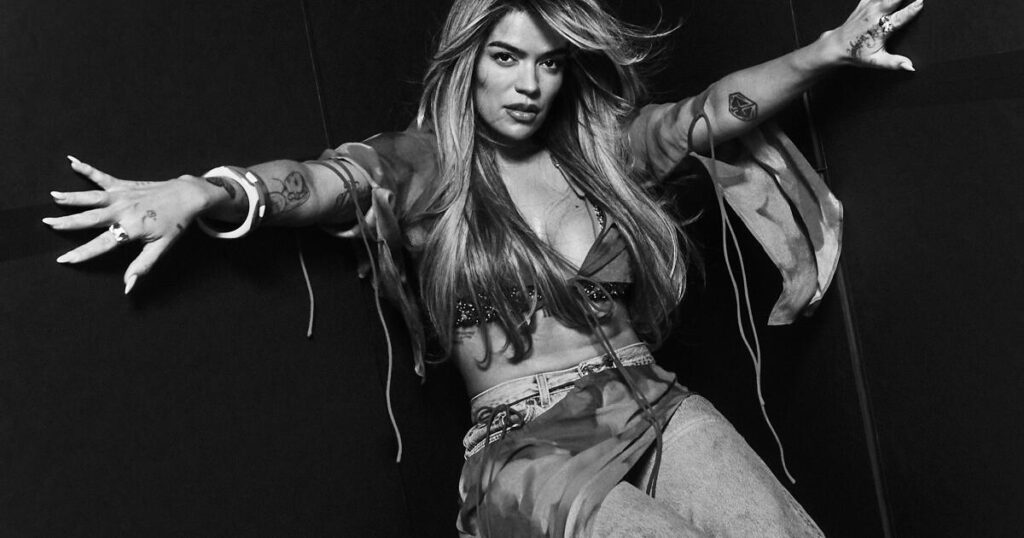
In February of last year, Karol G boarded a private plane out of Burbank with 16 passengers on board. Just minutes after takeoff, the Colombian singer — one of the biggest global stars in Latin and pop music — saw smoke pouring out of the cabin. The pilots signaled for emergency landing maneuvers; her life flashed before her eyes.
“I was with my parents on the plane, my whole family, and all of us were like, ‘No, it can’t be like this,’” Karol G said, recalling the horrific day in an interview from the top floor of the L.A. Times’ offices in El Segundo, overlooking the Los Angeles International Airport flight path.
“It was really terrifying, visually,” she continued. “Seeing smoke inside the plane, every alarm going off, it was crazy. We were saying goodbye to people. I was just thinking about my one sister that was still in Colombia, that if something happened, what’s that gonna do to her? We were just sitting, waiting.”
The pilots quickly brought the plane down to a safe landing in Van Nuys, mercifully avoiding the fates of peers like Jenni Rivera, Aaliyah and Ritchie Valens.
A year and a half later, the now-34-year-old Karol G released “Tropicoqueta,” her fifth LP. The 20-track album spills over with so much abundant life — searing emotion and refined songcraft, winking humor and quaking bass, Latin music history and “la hora loca” of her Colombian community’s block parties — that it stands in defiance of that near-miss with death.
“Tropicoqueta” is up for Latin pop album at the 2026 Grammys, where Karol G previously won for música urbana album in 2024. (She’s a multiple winner at the Latin Grammys as well.) She also has a Coachella headline slot coming in April, making her the first Latina to top the world’s most influential festival. And at an incredibly fraught moment for Latinos and Latin culture in the U.S., she’s bringing a hemisphere’s worth of history and hopes with her onstage.
“It’s kind of my mission. I see it like my purpose,” she said. “I have a big, heavy responsibility on me being the first Latina to headline Coachella. I need to go and represent my Latina community and speak for my people and for women. It’s a good opportunity to get to more people around the world, and I think it’s my opportunity to get them involved in the place that I come from.”
Carolina Giraldo Navarro is from Medellín, Colombia. As a teenager, her powerhouse vocals and brash charisma stood out onstage, and in a community famous for its raucous all-night street parties, like the ones she documents on “Tropicoqueta’s” self-titled closing track, she was serious about her music career: She had a brief teenage stint on Colombia’s version of “The X Factor” and went on to school in New York in the mid-2010s to study the record business. Later she racked up hits collaborating with Ozuna, Bad Bunny, J Balvin and others just as her home-base genre of reggaeton ascended to a global phenomenon on its own terms, in its native language.
Karol G turned heads not just for being a young woman in a hypermasculine genre, but for how she both mastered and expanded the genre from the moment she emerged in it. On her breakout 2017 hit with Bad Bunny, “Ahora Me Llama,” she brought both formidable bars as an MC and a poignantly melodic touch to that trap brooder. 2020’s “Bichota” became a mission-statement single for its bulletproof confidence and how she packed every line with fresh filigrees of hooks.
Her world-conquering 2023 LP “Mañana Será Bonito” had a post-breakup fervor of self-rediscovery, the first all-Spanish-language album by a woman to top the Billboard 200, home to her highest-charting Hot 100 single (the No. 7 “TQG,” with Shakira) and a Grammy winner for música urbana album. That year, she played two nights at the Rose Bowl to 120,000 fans, becoming the first Latina to headline a worldwide stadium tour.
What ground was left to break on a new album? Only her own.
“Tropicoqueta” is an adoring, comprehensive sweep through the generations of Latin music that made her. The LP starts with “La Reina Presenta,” a blessing from Mexican pop icon Thalía, a formative influence who passes the torch here over her classic “Piel Morena” — “You, showing me your new music? What’s the one I liked again? Play it, it’s so good,” Thalía says on the track.
Then come 19 more songs that cover the sweep of Latin music, past, present and future. There’s the sweltering bachata of “Ivonny Bonita,” with a guest turn from Pharrell; dips into the regional Colombian folk genre of vallenato; a veritable mariachi symphony on “Ese Hombre Es Malo”; and a heartrending duet with Marco Antonio Solís (of Mexican rock legends Los Bukis) on the regal “Coleccionando Heridas.” Even on the sly club-merengue “Papasito,” the album’s lone song partially in English, the tune and its charmingly retro video wink at, inhabit and critique the north-south love affair tropes that the first generations of Latina pop icons had to contend with and made magic within.
“I think it’s the riskiest album in my career because I didn’t know how to put all these genres together and have it make sense,” she said. “After ‘Mañana Será Bonito,’ I had a lot of pressure. I had everyone, like, asking, ‘What’s next after this album, what’s next after all of these hits?’ I was like, ‘Oh, my God, what is gonna be next?’
“But on this album, my people inspired the concept,” she continued. “I just wanted to go back to my roots, back to the music that I grew up listening to. In my house, I used to listen to everything because my father was a singer. He used to play for us salsa, merengue, bachata, reggaeton. I started thinking that I wanted my people to feel nostalgic and in a different time in life. With ‘Colleccionando Heridas,’ especially, there are moms with their girls and their grandmas listening together because grandma loves Marco Antonio Solís, moms love the song and girls love Karol G. To be music that all the family can listen to, that’s a super special thing for me.”
“There is something that goes beyond doing a musical collaboration with a colleague. It is to live a magical experience, full of sensitivity and authenticity,” said Solís, who performed a moving duet with Karol G at the Latin Grammys. “That has been my experience with this great artist and human being, who deserves to be in that place that only corresponds to her.”
“Tropicoqueta” wears its history lightly on record (though Karol G coaxed the legendary Cuban American journalist Cristina Saralegui out of retirement for a context-heavy interview about the album). It’s laced with a few ultramodern cuts as well: If the reggaeton bounce of the Nina Sky-sampling “Latina Foreva” felt slight as a standalone single, it takes new form on an album tracing just how a banger like that came to be. “Un Gatito Me Llamó” is the most revved-up club track she’s ever tried, and “Si Antes Te Hubiera Conocido” just brought home the Latin Grammy for song of the year, where Karol G gave a feisty speech in defense of its genre range.
“Lately, a lot of professional people have an opinion of what people should and shouldn’t do, what they should and shouldn’t like, how they should dress,” she said while accepting her award. “I started to feel like nothing I was doing was good and like I was losing my magic, like I was losing the wonder. This happened during a strange time in my life, and the only thing that was left from all of that for me was to go back to the root and the intention and return to the purpose of what I’m doing because I love it, because I like it and because I was born for this.”
“Tropicoqueta” sounds like a hundred different genres because, to be true, it had to.
“In Italy recently, I was in an interview, and there was a guy that told me, ‘Latin music is reggaeton.’ I was like, ‘Yeah, but it’s not just reggaeton.’ He was like, ‘No, I cannot tell them apart.’”
“Like, I know this is hard to explain,” she said, giggling at the comprehensiveness of his ignorance. “But we are a universe of cultures and different sounds.”
Fittingly, at this year’s Grammys she’s the front-runner in the more genre-broad Latin pop album category. (Her frequent writing partner, Edgar Barrera, is up for songwriter, non-classical.) And though nods in the big three mainstream categories didn’t materialize, that wasn’t a total surprise for an LP so meticulous about playing with classic Latin genres.
“I’m always gonna celebrate everything that I’ve got in my life, because I’m the only one that knows how hard it [was] for me to get to this point,” she said. “If I don’t get another Grammy, I don’t take it, like, super personal. But meeting Beyoncé at the Grammys was pretty special, right? The first time that I won the Latin Grammy, it was huge, celebrating with a lot of people that I grew up listening to, just saying, ‘Hi, I’m Carolina from Colombia,’ that was kind of unreal for me. It’s still unreal for me.”
In case this wasn’t abundantly clear, Karol G is one of the most commercially, creatively significant artists on the planet, of any genre, full stop. She needs no institution’s imprimatur, and there’s no corner of the industry promising anything she hasn’t already achieved.
Yet she still feels ambitious, hungry even, about the two weekends in April next year, when she will headline the Coachella Valley Music & Arts Festival, wrapping up a bill with Sabrina Carpenter and Justin Bieber as her main-stage mates.
Karol G last played the fest in 2022, a trial run for the history-sweeping philosophy of “Tropicoqueta.” “When they first invited me, I was like, ‘I can’t believe that I had this opportunity, because there’s a lot of artists that couldn’t perform in there, even having legendary songs.’ That’s why I decided I’m gonna celebrate the songs that opened the door for me. That’s why I did ‘Gasolina,’ Ricky Martin, Selena Quintanilla. It was a way for me to honor what all the different artists did for me to be there. I think I had a ‘before’ and ‘after’ with Coachella.”
While she’s tight-lipped about how next year’s set will update her raucous stadium tour, she did promise “a lot of different worlds for this show. I want to show all the evolution that I’ve had in my whole career, a really huge, innovative show.”
For her, there’s still something tantalizing about topping a mixed-genre bill before an audience that may not have heard her music at all. Is it weird to be one of the biggest musicians on Earth and yet still, in some circles, be introducing herself?
“I love that. If you are on tour, you know that the people there are waiting to see you, and they already know the songs,” she said. “But festivals give you the opportunity to open doors for more people that don’t know your music, who don’t know nothing.”
Coachella is just one place she’s opening more of her life to. In her May Netflix doc “Karol G: Tomorrow Was Beautiful,” she spoke about being sexually harassed and retaliated against by a former manager when she was a teenager.
“It’s always a challenge, you wake up and you think you forget things, but you’re never gonna forget,” she said, recalling that painful era in her career. “That part was specifically hard to put out, but my team were saying, ‘There’s a lot of people that are going to understand you, and they have their own crosses behind them getting really heavy. So maybe if they see through you, they’re gonna get more power to hold them.’ It was hard, but I think I’m an instrument of something.”
She also headlined the NFL’s halftime show in its Brazilian debut in September, an homage to her South American neighbor’s rhythms and plumage bookended by the United States’ flagship expression of sporting and economic muscle. “We don’t really do American football in our Latino countries,” she said. “So when the NFL called for that specific show, I told them I’m gonna bring the flavor of this album. ‘You are American football, but I’m Karol G and my album is about my roots.’ They were like, ‘No, we love that. Actually, that’s what we want.’ I loved that show, it was an opportunity to keep growing our movement.”
So what does she make of the right-wing backlash to her peer Bad Bunny — an outspoken American citizen of Puerto Rican descent who declined to tour the U.S. due to ICE raid fears — performing in Spanish at next year’s Super Bowl?
“It’s crazy. I think it’s only a few people that think that way, and most are really enjoying the decision to have him on the stage,” she said. “The people that are saying no, they’re powerful and they have a voice, so people listen and they make it like a big deal, but I can tell that Bad Bunny is going to kill it. He’s ready for that. He’s part of both worlds — Puerto Rico is an American territory, and at the same time, is Latino. I think, for the moment that we are having as humans, it’s great to have him represent everything. They’re just gonna make him do it even better and higher.”
What first made the likes of Bad Bunny and Karol G remarkable has, subtly, emerged as a key feature of their massive international appeal. No one blinks at Karol G headlining the world’s biggest festivals singing entirely in Spanish, drinking deeply from Latin music history. Reggaeton is the backbeat of the Global South and thrills the North; “Tropicoqueta” was a gift of the music she adored growing up with, it belongs to the world now too.
“When you start doing music, you just do music that you love, and everything is so good. But then you get teams, and they have expectations about numbers. They have expectations about streams, consumption, everything. That puts a lot of pressure on the artist,” she said. “You can get lost between the purpose and the results, and this can change all the art. So I tried all the time to be focused on my purpose, on what I want to do.
“Like, I don’t want to do an album in English, because maybe it’s time to do a crossover thing, because it’s gonna get more people. No, I don’t want to do it that way. It would be falling expectations of who I am. I just want to do that if I feel that,” she said. “‘Mañana’ killed for streaming. But the things that ‘Tropicoqueta’ brought me are super different. I thought I was doing an album for my Latina community, and it brought me fans from all over the world that I didn’t expect. That’s why you have to take care of the purpose instead of the result. The success, the love, that’s gonna be gone one day. The unique, real thing that I have forever is the feeling for my music. This is the one that I have to take care of the most.”
The post The only ground left for Karol G to break? Her own appeared first on Los Angeles Times.