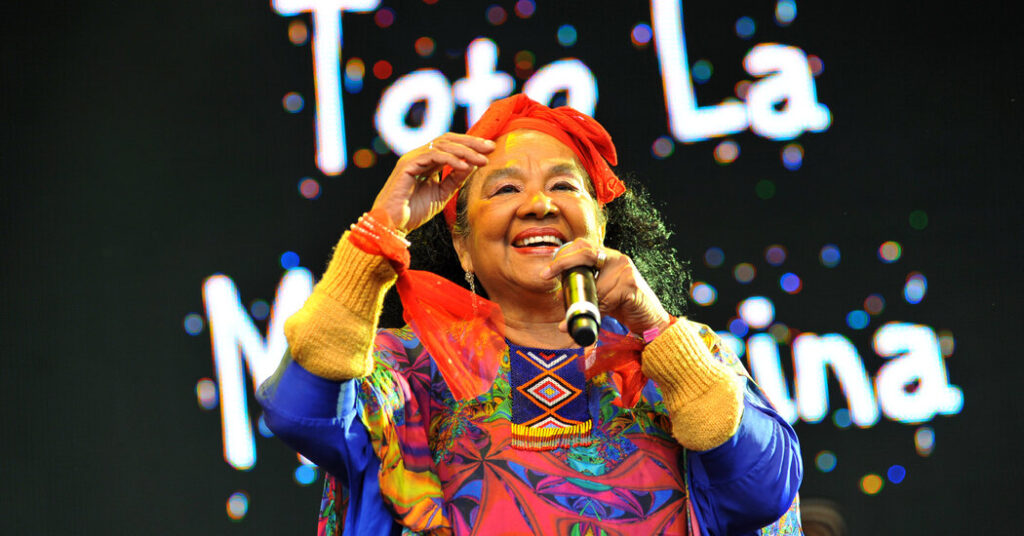
Totó la Momposina, an internationally acclaimed Colombian singer and dancer whose vibrant performances highlighted her Afro-Caribbean and Indigenous heritage and her country’s folkloric traditions, died on May 17 in Celaya, northwest of Mexico City. She was 85.
Her family announced the death in an Instagram post and said the cause was a heart attack. Totó, as she was widely known, retired in 2022, after being diagnosed with Alzheimer’s disease and aphasia, according to her website.
Unlike many artists of her generation, who embraced dance music thought to be more commercially viable, Totó emphasized traditional folk styles and instruments, including the tiple (a small, 12-string guitar), gaita (a flute) and tambora (a double-headed drum).
“You could describe our music as an enterprise that began 500 years ago, a process that has developed and changed but perpetuates the village traditions from which it has emerged,” she told The UNESCO Courier, a U.N. publication, in 1998. “What we want to do is inject our own energy into it, develop it to the full and help to strengthen our national musical identity. We want to help our country’s music express the culture of all our people.”
Carolina Santamaría-Delgado, a professor of musicology at the Universidad de Antioquia in Medellín, Colombia, said in an interview that Totó, who grew up in both the rural, tropical north and cosmopolitan Bogotá, represented a confluence of styles and a symbolic resistance against musical conformity.
“If you wanted to record a disc in those times, you had to sing with an orchestra,” Professor Santamaría-Delgado said. “But Totó, she said no.”
Her career began in the late 1960s, performing the energetically rhythmic cumbia and related genres like bullerengue, fandango and porro. After she appeared at Radio City Music Hall in New York in 1974, as part of a showcase of Colombian music, she toured Europe and the Soviet Union.
But in 1979, told that her support for left-wing causes might not only hamper her career but also leave her in physical danger in Colombia, she self-exiled to France.
She left so suddenly that, in her new country, she initially slept on the floors of theaters, using a mink coat as a blanket, and busked in the Paris Metro.
She studied the history of dance and music at the Sorbonne University and joined an eclectic troupe of performers known as the Collectif de la Rue Dunois, a member of which later described their collaborations as a “true festival, featuring French, Yiddish and Colombian music, a barrel organ, a children’s show with a merry-go-round, a moving cinema in a truck, an English double-decker bus, and even releasing a hot-air balloon.”
By the late 1980s, Colombia was once again her home base, but she continued to spread her music internationally. Her 1991 performance at the World of Music, Arts and Dance festival in England, which had been founded by a group that included the rock star Peter Gabriel, led Totó to record her breakthrough 1993 album, “La Candela Viva,” for Mr. Gabriel’s Real World Records label.
Of a 2004 appearance in Manhattan, Jon Pareles wrote in a New York Times review: “Her voice could be bright and cutting over the drummers’ six-beat propulsion and the sound of the gaita. She could also sound loving and forlorn as she turned to a Cuban-rooted son, and reverent when she sang an unaccompanied prayer for peace. Through the set, she sounded gutsy and resilient.”
Pop artists such as Timbaland and Jay-Z sampled her work, as did the electronic group Major Lazer. Her voice was featured by the Puerto Rican group Calle 13 on the chorus of “Latinoamérica,” which won song of the year and record of the year at the 2011 Latin Grammy Awards. Totó received a lifetime achievement award from the Latin Grammys in 2013.
Although often associated with folkloric traditions, she insisted that she was part of a dynamic process that stretched to the present.
“While I respect the word ‘folklore,’ to me it means something that’s dead — in a museum,” she once said. Traditional music, she added, “is still alive. Many people are working with it, and it’s always evolving.”
Sonia Bazanta Vides was born on Aug. 1, 1940, in the northern Colombian town of Talaigua Nuevo along the Magdalena River, the principal river in Colombia.
Her father, Daniel Bazanta, was a cobbler who also played drums; her mother, Livia Vides, was a singer and dancer who instilled in her daughter pride in their Afro-Indigenous roots.
After her father was briefly imprisoned during a period of heightened political tensions, the family resettled in the Colombian capital, Bogotá.
“We had to leave everything we had,” Totó later recalled to Songlines magazine. She added that the family “put the few possessions that we had on a truck to go to a city totally unknown to us, where we had to face many difficulties, since at this time there were not many people of our culture and color.”
In Bogotá, she began to establish herself as a singer and dancer, assuming a stage name that combined a childhood nickname, Totó, with a reference to the Momposina Depression, a geological feature in the region where she was born.
Her marriage to Hernando Oyaga, a doctor, ended in divorce. Her survivors include their three children, Marco Vinicio, Angélica María and Eurídice, and several grandchildren, some of whom have carried on the family musical tradition.
One of the highlights of Totó’s period in self-exile was an invitation to perform in Sweden after her compatriot Gabriel García Márquez received the Nobel Prize in Literature in 1982.
The Colombian writer Julio Olaciregui, long based in France, later recalled having heard her perform around that time.
“I did not imagine that Totó, who cast a spell on me in Barranquilla in the ’70s, would cure me sometime later, in Paris, of homesickness, that climatic phenomenon stirred with nostalgia, an indefinite malaise, far from the sea,” Mr. Olaciregui said.
“Guided by her,” he added, “I returned to the Magdalena River.”
The post Totó la Momposina, Colombian Folk Music Star, Dies at 85 appeared first on New York Times.