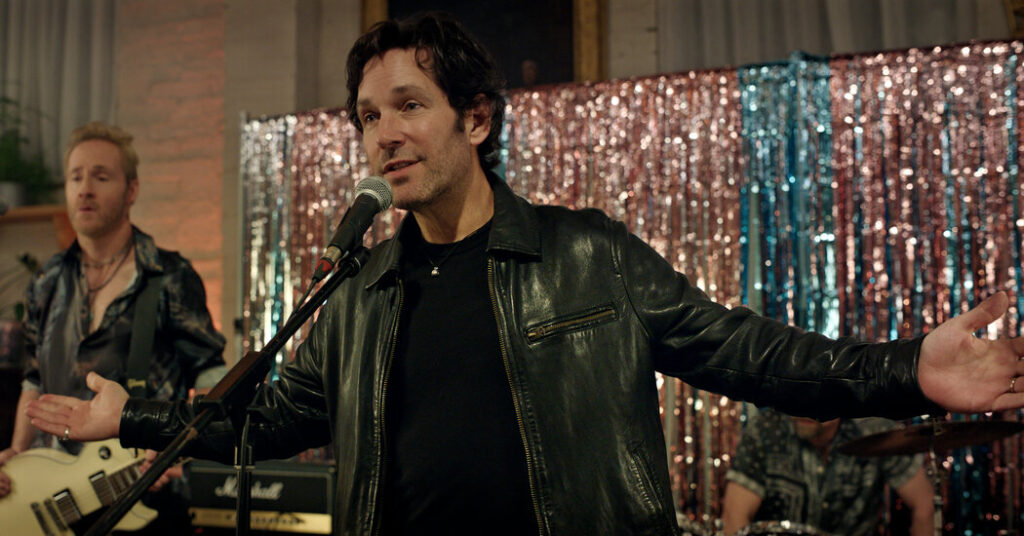
Every so often in “Power Ballad,” a tougher, angrier version of this aggressively superficial movie bobs to the surface. Paul Rudd plays Rick, an American musician who’s settled down in Dublin with a wife, a teenage daughter and a regular gig as the lead singer in an all-guy wedding band. When not performing oldies for newlyweds, Rick drives his daughter to school, flirts with his wife and noodles on his own music. He’s an affable, easygoing smiler and while he seems content enough, now and again a flicker — of regret, perhaps, or resigned disappointment — passes over his face like a shadow, briefly unsettling him and this movie.
Rick once had his own rock band (he still has the shades and saunter), but his dreams of stardom now just burble up like memories, reminders of what could have been. His life takes a turn one night when the band travels out of town for a lavish wedding and one of the guests, Danny (Nick Jonas, serviceable), a pop musician and former boy-band member, joins the group onstage for a song. Rick and Danny get into an easy groove and later, after the partying subsides, they run into each other. This accidental encounter soon morphs into a friendly, late-night jam session filled with talk, booze and making music together.
By the time this one-night bromance has come to an end, Danny has gifted Rick with a guitar. Rick, in turn, has inadvertently provided Danny with the means for a professional breakthrough. While the guys were hanging out, Rick had played “How to Write a Song,” a mewling tune that he had been working on for years. With Rick on guitar and Danny at the piano, the song became an emblem of their harmonizing convergence. It soon becomes something else when Danny, who’s under pressure from his label to produce something new, takes the song, juices it up and passes it off as his own. It becomes an unlikely monster hit, resuscitating his career. Rick finds out, and sets off to secure his rightful due.
There are some promising themes in “Power Ballad” — the soulful joys of collaboration, the precarity of celebrity, the evils of the music industry — but the movie never develops them. Instead, the director John Carney, who wrote the script with Peter McDonald, keeps everything nice and insistently light, gesturing at complexities rather than delving into them. This commitment to the glib extends to the characters, notably Rachel, Rick’s wife (Marcella Plunkett) and daughter, Aja (Beth Fallon). Neither makes any sense emotionally and psychologically, and, much like the unassuming house that the family lives in, their only function is to express something about Rick: He loves and is loved (more or less) in turn.
If the movie doesn’t demand much of Rudd it’s because it doesn’t demand much from the audience, either. That’s too bad. “Power Ballad” is a comedy salted with tears, and while Carney (“Once”) likes skimming the surface, there are moments that suggest the movie that could have been. (He wrote the original songs and score with Gary Clark.) Both Rick and Danny are flailing when they meet, which is part of what unites them. They’re strangers who mirror each other, sometimes uncomfortably. Neither has a convincingly satisfying home life, and each is preoccupied by the specter of professional failure. That a rich, loving personal life may be of greater value never seems to cross either man’s mind, nor that of the filmmakers’.
Rudd is the way into the movie, and the actor is about all that tethers “Power Ballad” to something like life. As usual, he doesn’t have to go either hard or deep here. He has to smile a great deal, sing nearly as much (which he does pleasantly enough), look engaged and throw some punches (and tantrums) as he helps move the story forward. Mostly, he has to deliver another variation on the Paul Rudd type, that reassuringly nice, uncomplicated, low-wattage charmer with crinkly smiles who’s the human equivalent of a Golden Retriever. No matter what happens — however high the stakes or low the comedy — everything will turn out just fine in Ruddland. Yet while likability is the actor’s superpower, even he can’t save “Power Ballad.”
Power Ballad Rated R for language. Running time: 1 hour 38 minutes. Not rated.
Manohla Dargis is the chief film critic for The Times.
The post ‘Power Ballad’ Review: Hitting All the Wrong Notes appeared first on New York Times.