Nearly two months past deadline, New York finally has a state budget.
Lawmakers cast the final votes to pass a roughly $269 billion state budget late Wednesday night — the latest approval in nearly two decades.
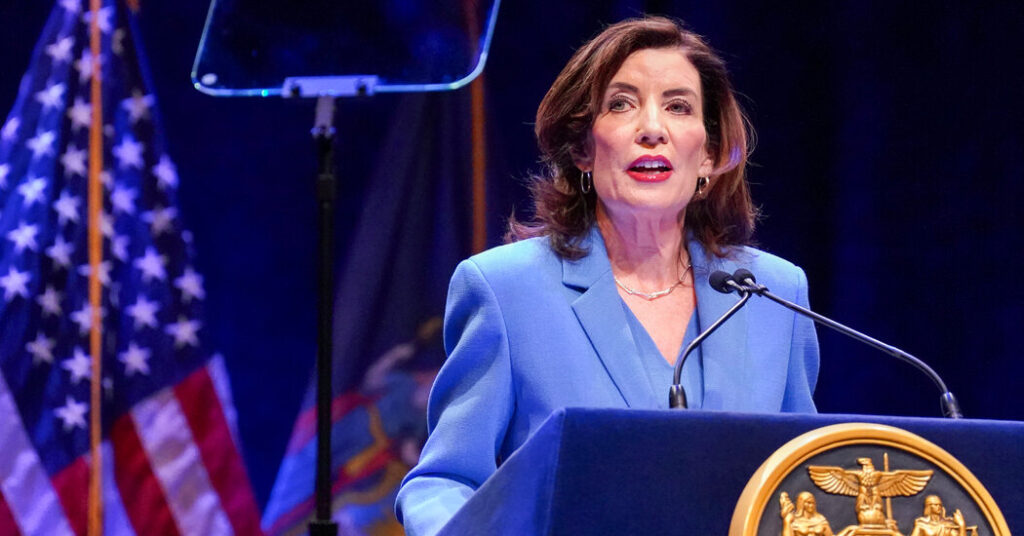
Passage was delayed by a variety of contentious policy issues. Many of those were priorities of Gov. Kathy Hochul, a Democrat who is running for re-election this fall. In the last budget of her first full term, she successfully pushed to reform auto insurance, streamline state level environmental reviews and delay mandated climate goals.
Yet the lateness of the budget frustrated many in the Legislature, who will now have just one week to try to pass their own priorities before the 2026 session is scheduled to end.
Even so, the budget does include things pushed by the Legislature, including a sweeter pension deal for police personnel, teachers and firefighters. There are also new taxes on multimillion-dollar second homes in New York City and nicotine pouches.
Here are six key things to know about the budget, and why it’s about a lot more than money.
New York shirks its climate leader status
New York is not on track to achieve the goals laid out in the ambitious 2019 Climate Leadership and Community Protection Act. The budget offers two means of addressing that.
One way is a fresh $1 billion allocation to develop renewables. The other — insisted upon by Ms. Hochul — rewrites the fine print to make the goals easier to reach. Because some of the climate goals may drive up consumer costs, the governor may be betting that voters may be more concerned by their own finances than fossil fuels come November.
But many lawmakers and environmentalists say that weakening climate goals backtracks on Democratic promises and runs counter to environmental justice imperatives.
Assemblywoman Jessica González-Rojas, a Democrat, spoke for many when she voted in favor of the budget, while castigating the changes to the climate law. “I do not support weakening our commitment to confronting the climate crisis,” she said, describing the choice between affordability and climate justice as a “false choice.”
Republicans said the Legislature should have done more to weaken the law, which they said leaves a major burden on industry and consumers.
Teachers, police and firefighters benefit
In 2012, when Andrew M. Cuomo was governor, he negotiated a deal to reduce pension benefits for teachers, the police and firefighters that he said would save the state $80 billion over the next three decades.
The state created a sixth tier for newly hired teachers and other public employees, who would receive less generous retirement benefits than their longer-tenured colleagues.
Ever since, labor unions have been pushing Albany to “fix Tier 6” by improving its benefits, which they say would help recruiting and talent retention. Albany relented this year.
The president of the state teachers’ union, Melinda Person, praised the agreement, which will improve benefits and allow teachers to retire at 58 rather than 63.
“This Tier 6 agreement is proof that when workers organize and stay united, change is possible. This is a victory for public workers across New York,” she said.
But many lawmakers expressed concern that the roughly $550 million yearly cost to state and local governments.
“The mother of all pension sweeteners will leave a sour taste in the mouth of taxpayers,” Assemblyman Michael Fitzpatrick, a Republican representing Suffolk County, said, suggesting that the change was a giveaway to the labor interests that supported lawmakers.
“We’ll vote against the taxpayers’ interest before we vote against our own,” he said, with a sigh.
Taxing the rich and bailing out Mamdani
The governor was adamantly opposed to raising taxes. But New York City faced a multibillion-dollar budget gap, and its new mayor, Zohran Mamdani, repeatedly appealed to Albany for help — preferably by taxing the rich.
The mayor was ultimately successful, winning nearly $8 billion in state assistance over the next two years, as well as a new tax on high-end second homes in New York City that the Senate has said will bring in $506 million annually.
The tax will be instituted in two phases. Initially, second homes with a so-called market value of $1 million or more will face a tax surcharge between 4 percent and 6.5 percent. But New York City’s definition of market value often vastly understates a home’s true worth; one Midtown penthouse with a market value of $4.2 million recently sold for $135 million.
The city will eventually set up a new valuation system based on the sales price of condos and co-ops, with tax rates ranging from 0.8 percent for units valued between $5 million to $15 million and 1.3 percent for homes worth $25 million or more.
Mr. Mamdani also won state approval to delay existing pension payments — a short-term play that will eventually cost the city billions of dollars over the next decade.
New restrictions on ICE in New York
State lawmakers passed a long-awaited package aimed at curtailing abuses by immigration agents. The legislation would bar agents from wearing masks; require judicial warrants to search schools, hospitals and churches; and end agreements that allowed for resource sharing between local law enforcement and Immigration and Customs Enforcement.
Some immigration advocates have raised concerns that the legislation does nothing to address more informal communication between the police and ICE agents that can be the basis for many deportations.
The legislation also would allow New Yorkers to sue ICE agents in state and federal court if they believed their constitutional rights have been violated — a measure that, like the mask ban, is expected to end up in court.
Hochul versus trial lawyers
For years, the trial lawyers lobby wielded tremendous influence in Albany — particularly when Speaker Sheldon Silver, a lawyer himself, was serving in the Assembly.
The reforms included in this year’s budget — aggressively opposed by the trial lawyers — mark a clear diminution of that influence.
Under the changes, people found to be more than 50 percent responsible for causing a crash will not be eligible for pain and suffering damages. The definition of “serious injury” was also made narrower — a change that Ms. Hochul said will help prevent fraudulent staged accidents.
Ms. Hochul proposed the changes with a goal of lowering the state’s sky-high auto insurance rates. But the idea was met with great skepticism by enough Democratic lawmakers that they were able to add bill language to ensure that savings were not merely pocketed by insurance companies.
The fight quickly became ugly, as the lawyers’ lobby repeatedly accused the governor of acting on behalf of Uber, which backed the changes.
And so much more …
Also tucked into the many thousands of pages that make up the budget:
-
There will be a new tax on “alternative nicotine” products that will raise the price of Zyn, a nicotine pouch.
-
People who have received 16 speeding tickets in a one-year period will be required to install a speed-limiting device on their car, or lose their registration.
-
A much-heralded commission to study reparations for the descendants of enslaved people has been delayed.
-
There are new protections for children online.
-
The state streamlined its environmental review process so as to speed the construction of new housing on previously disturbed land.
-
A controversial measure aimed at protecting worshipers has passed. The legislation sets up a 50-foot perimeter around temples, churches and community centers. Similar legislation passed in New York City over the opposition of Mr. Mamdani. Free speech groups have said they had grave concerns about the effects of the measure on speech.
And though the 50-foot buffer was included in a larger omnibus bill, many lawmakers still spoke up on the floor, describing it as a way to push back against antisemitism. “This legislation isn’t about Israel,” said Assemblyman Jeffrey Dinowitz, a Democrat from the Bronx, explaining his support for the measure. “But it is, in a certain way.”
Benjamin Oreskes contributed reporting.
Grace Ashford covers New York government and politics for The Times.
The post Much More Than Money: Inside New York’s $269 Billion Budget appeared first on New York Times.