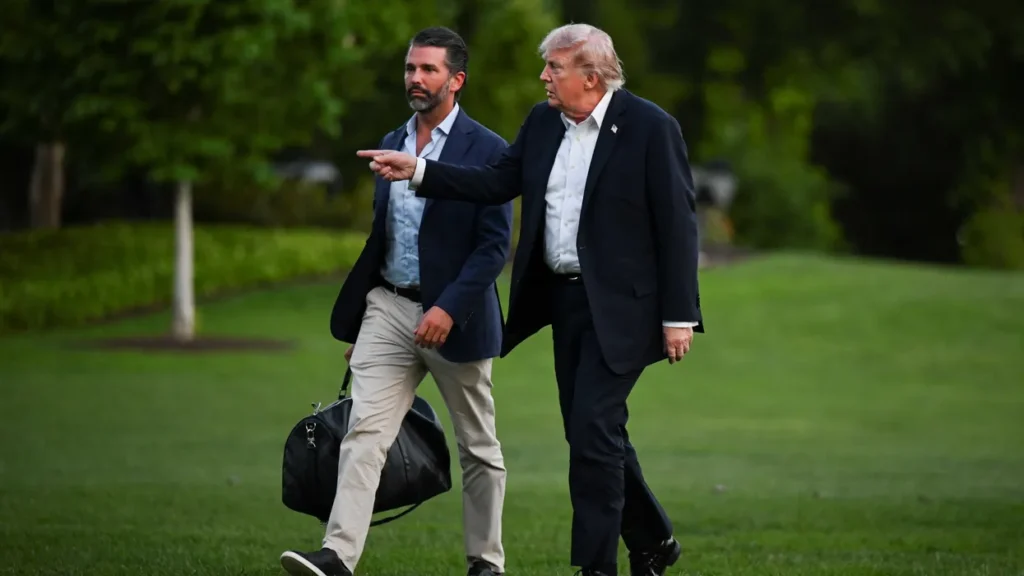
When the Pentagon announced a $620 million loan last year to a small North Carolina startup linked to Donald Trump Jr., defense officials and the company tried to tamp down suspicions of cronyism.
The president’s eldest son said through a spokesperson that he wasn’t involved. The Pentagon said Trump Jr. played no role in the record-setting deal. And the startup’s founder told reporters that his company, Vulcan Elements, received no political favoritism.
But interviews and Defense Department records reviewed by ProPublica show that the request to loan hundreds of millions of dollars to the firm linked to Trump Jr. was made by Peter Navarro, a White House adviser to President Donald Trump and a friend of Trump Jr.’s.
Of the dozens of companies the Pentagon was considering funding at the time, Vulcan’s was the only deal initiated by a top aide to the president, said an official at the Pentagon who was not authorized to speak publicly.
After defense officials got the White House request, they asked Pentagon staff to move at an unusually rapid pace, said another person who was involved in the deal at the Pentagon but not authorized to speak about it. The staff worked late nights and with little sleep to get the loan through in a matter of weeks, the source said.
“The call came from the White House: We have to get this done,” the person said.
The deal is one of many actions by the Trump administration that have helped companies in which the Trump family holds stakes. Government contracts and other benefits have gone to various Trump-linked companies, prompting allegations of self-dealing by Democratic lawmakers and good government experts. But ProPublica’s reporting on the Vulcan loan represents the first time the awarding of a contract from a federal agency has been directly linked to White House intervention.
The loan was a massive financial commitment from the Pentagon in its effort to fund companies that could help the U.S. reduce dependence on China’s critical mineral supply chains. The deal was a dramatic win for Vulcan, a North Carolina rare-earth magnet company launched just two years earlier. Estimates of its valuation grew tenfold after the deal was announced. It was also a win for Trump Jr.’s venture capital firm, which took a stake of undisclosed size in Vulcan about three months before the Pentagon announced the deal.
And there may be more good news on the way for the president’s eldest son. Among other companies under review for a Pentagon loan was a drone parts manufacturer that Trump Jr. advises and owns a stake in, according to one of the defense officials who spoke to ProPublica.
Navarro, who served as trade adviser in Trump’s first term, and Trump Jr. have formed a close bond in recent years. The president’s son visited Navarro in prison while he served time for defying a subpoena from lawmakers investigating the Jan. 6, 2021, Capitol riot. Trump Jr. was one of the small group of people Navarro dedicated his latest book to for having “my back when it was against the wall.” And a week before the Vulcan deal was announced, Trump Jr. hosted Navarro — now the president’s senior counselor for trade and manufacturing — on his streaming show, encouraging his nearly 2 million subscribers to buy Navarro’s book. That interview was not long after word came down from Navarro to Pentagon staff to make the massive loan to Vulcan, one of the defense officials involved in the deal said.
Navarro did not respond to questions from ProPublica sent to him directly. Neither did Vulcan. A White House spokesperson said in a statement that the administration is working “in the best interest of the American people,” adding, “The President’s entire team, including Senior Counselor Navarro and officials at the Department of War, is working together and with private industry to secure America’s critical mineral supply chain at Trump Speed.” Trump Jr.’s spokesperson said the president’s son does not discuss companies he has invested in with federal government officials and did not speak to Navarro about Vulcan. He “has no knowledge about how this deal came together,” the spokesperson said. A spokesperson for 1789 Capital, the venture firm where Trump Jr. is a partner, said it also played no role in Vulcan getting the loan and did not learn about the deal before it was public.
“No company receives preferential treatment,” a Pentagon spokesperson said. “Outside affiliations, investors, or political connections play absolutely no role in the Department’s funding decisions.”
Richard Painter, the chief White House ethics lawyer during the George W. Bush administration, said aides to the president should not be intervening in contracting and lending decisions by agencies, particularly in matters that financially benefit the president’s family.
“This is our money they’re spending,” Painter said. “This is corruption we pay for.”
The Office of Strategic Capital, the Pentagon division that made the deal with Vulcan, aims to address a bipartisan concern: that China’s grip on rare-earth elements and other critical minerals threatens national security.
It is hard to overstate the country’s dominance in this arena. As of last year, for example, China produced the world’s entire supply of samarium, an obscure rare-earth metal that is an essential component of magnets that help guide Tomahawk missiles and start the engines in F-35 fighter jets. Other rare earths are central to the manufacturing of a vast array of commercial and military products, from car parts and semiconductors to drones.
Finding the raw materials is generally not hard, but separating them from other materials they’re bonded to is, and it’s that process that China largely dominates. Virtually every advanced military in the world depends directly or indirectly on the country’s supply chain of rare earths. The danger of relying so heavily on a single supplier for these essential materials was underscored last year when China announced it was restricting exports of some rare-earth metals.
The Office of Strategic Capital, started under the Biden administration, funds private companies that are working in this space or developing certain military technologies so that the U.S. can stop relying on its top rival to equip its own military.
The Trump administration supersized the effort, expanding its lending authority from about $1 billion to $200 billion. It also radically changed how the office operated, according to interviews with more than a dozen people who worked there or interacted with it from the private sector or other parts of the government.
The Biden administration had set up an open application process for interested companies, with each firm to be vetted methodically, a process meant to ensure good bets — but one that people involved acknowledged was set up to be slow and bureaucratic.
“The Trump administration is more interested in going out into the market and finding what it wants. We’re not going to wait for people to apply to us,” said one former Office of Strategic Capital official.
The Trump Pentagon handed the reins to hard-charging former Wall Street executives, who have been recruiting others to make the leap from finance to government. A leaked presentation from a headhunter seemed to suggest they could parlay their tour in government into future riches: “If you ever want to raise your own fund, you will gain access to fundraising channels that include royal families and foreign sovereign contacts.” (It’s unclear whether the Pentagon approved the presentation.)
The office’s new leaders aim to make as many deals as possible, including loans and investments in exchange for ownership stakes, people who have worked with the office say. They said the new officials are relying more on their own personal networks, not applications, to choose companies to fund. So far, outside of Vulcan, a small number of other companies have been selected, including Korea Zinc, a metal refiner; MP Materials, a Nevada rare-earth mining company; and ReElement Technologies, an Indiana producer of rare-earth elements and battery metals that partners with Vulcan. The Pentagon’s announcement said the loans to Vulcan and ReElement were conditional on the firms fulfilling certain legal and financial requirements but did not detail them.
Last week, Bloomberg reported that the Pentagon may ultimately not lend to ReElement because of concerns over the company’s revenue projections and ability to scale up its technology that were discovered after the conditional loan was announced.
Because of its size and connection to Trump Jr., the Vulcan deal has drawn the most scrutiny. A group of Democratic senators demanded that the Pentagon provide an accounting of how the company was awarded the loan, writing that the Trump family’s conflicts of interest could be “resulting in a waste of taxpayer dollars and a threat to national security.” (The Pentagon’s response did not address how Vulcan was selected, explaining only how the department addresses conflicts that arise from its employees’ financial holdings, not those of the president’s family.) Democrats in the House tried to subpoena Trump Jr. to testify on the Vulcan deal but were blocked by Republicans. “Donald Trump Jr. must be made to answer whether the president’s son illegally profited from his father’s presidency,” Oregon Rep. Maxine Dexter said earlier this year.
Vulcan was launched in 2023 by a student at Harvard Business School. The private company quickly began securing a series of relatively small defense contracts, beginning during the Biden administration. Its first manufacturing facility opened in March 2025; according to an interview with its founder published that month, the firm’s funding around that time was less than $10 million. The kind of rare-earth magnets the company focuses on are needed for critical military technologies, including drones and satellites.
In August 2025, Vulcan announced $65 million in investments, including from 1789 Capital, the venture firm that Trump Jr. joined as a partner after his father was elected to a second term. Neither 1789 nor Vulcan has publicly disclosed how much of a stake the venture firm has taken.
Staff in the Office of Strategic Capital learned of the White House request to give a loan to Vulcan around September or October, an official involved said. It’s unclear how the White House request was delivered or if it was presented as an order or a recommendation. Companies considered for funding are generally vetted for many months, the person said, but this deal was completed in a matter of weeks because they were told it was a White House priority.
Asked about the Vulcan deal being expedited, the Pentagon spokesperson said defense officials balance “lightning speed with rigorous diligence to close high-impact deals that directly strengthen America’s defense and empower our warfighters.”
In November, the Pentagon announced its plans to lend $620 million to the company and another $80 million to its partner, ReElement. The company would also get $50 million in incentives from the Commerce Department. In exchange, the government would take a $50 million stake in Vulcan with the right to buy more later.
Vulcan, which at the time had fewer than 50 employees, said it would use the windfall to build a large new facility that would churn out thousands of tons of magnets a year. It said it planned to ramp up in the coming years, adding hundreds of new jobs.
The deal was good news for Vulcan’s investors, including Trump Jr.’s firm. Estimates of Vulcan’s valuation went from around $200 million near the time 1789 Capital first invested, according to Bloomberg, to around $2 billion.
Navarro’s role in initiating the deal was not publicly disclosed. Even if he didn’t discuss it with Trump Jr., the loan represented a win for someone Navarro considered a dear friend. In an October episode of Trump Jr.’s streaming show, “Triggered,” the two showed a close bond. The president’s son called Navarro “my boy” and complimented him on the “jacked” physique he developed while in prison. Navarro called Trump Jr. “brother” and thanked him for his support “in my hardest of times.” (Navarro had argued he was wrongly imprisoned for not complying with a congressional subpoena because he was protected by executive privilege.)
Although Vulcan was not mentioned, the two spoke about rare earths, a topic Navarro has frequently discussed publicly. “China has revealed itself with this rare-earth issue as a country which is using the weaponization of their manufacturing floor, their supply chains, to exert pressure, not just on the United States, but to every other country that might do something that gets in the way of the Chinese dream of world domination,” Navarro said. “That’s what we’re fighting now.”
The Office of Strategic Capital is expected to deploy billions more in loans in the coming months to critical mineral and military technology companies.
Among the companies under review was Unusual Machines, a Florida drone parts maker, a Defense official said. Trump Jr. sits on the company’s advisory board and holds millions of dollars worth of shares. The Pentagon was accused of cronyism last year when it awarded the company a contract to make drone engines for the Army.
Executives at other companies hoping for Pentagon loans or other types of investments are scrambling to figure out how to get in front of the right people.
Brodie Sutherland, CEO of Nevada-based tungsten mining company Patriot Critical Minerals, said his firm hired a lobbyist. That person knew someone who was previously connected to the Office of Strategic Capital and was able to introduce the company to a current staffer.
“It’s like any industry: A lot of what it is,” Sutherland said, “is who you know.”
Speaking to ProPublica last month, he said his company had had conversations with Pentagon staff and he was optimistic the firm could get funding.
“Whether you need someone on the inside track to get it across the line I don’t know,” he said. “We’re hopeful you don’t need to be chums with Trump Jr. to get a project across.”
Defense Department records reviewed recently by ProPublica show Sutherland’s company had already been considered for a loan but was rejected. The records did not say why. Sutherland said he still hoped his company could secure some kind of Pentagon funding in the future.
The post White House directly intervened to win $620M deal for company linked to Trump’s son appeared first on Raw Story.