On the streets of Kyiv, it can be hard to tell who is a soldier and who isn’t.
Young men and women in olive-colored, army-style vests and pants walk past camouflage-patterned trucks idling at stoplights. Many of them carry cross-body bags emblazoned with military patches; some bags have tourniquets attached, as casually as keys on a carabiner.
Some of these people are veterans or soldiers on leave. But most have no actual ties to the military. They are I.T. workers, university students and other urbanites who have absorbed the visual language of war into their daily dress, a marker of how the conflict has reshaped life in Ukraine’s capital.
Soldiers and civilians alike call it a show of solidarity, not a shallow trend.
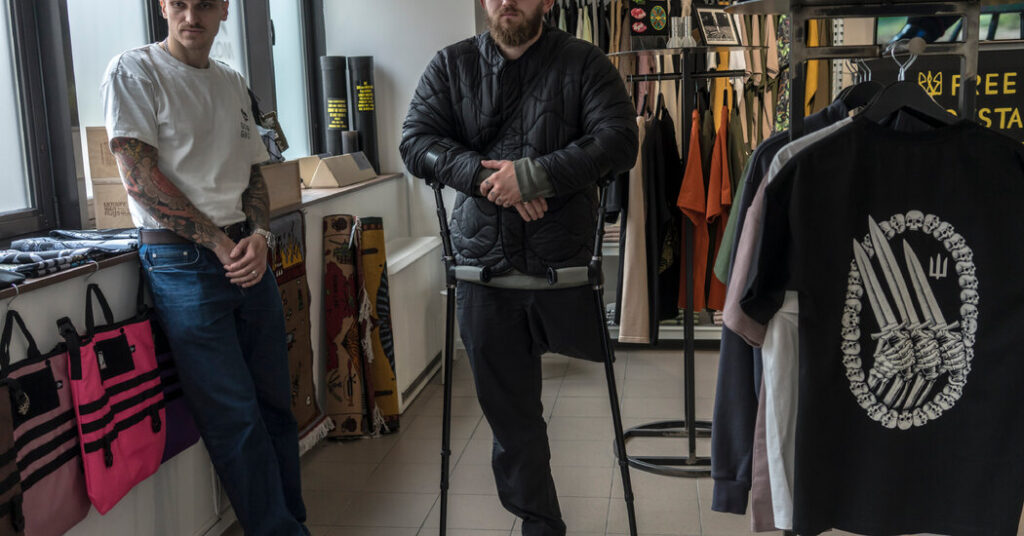
“Fashion is a way to show that the army is our new elite,” said Artem Vulkovskyi, 30, an I.T. specialist who was discharged from the army in 2023 with a serious hand injury. “This is not about arrogance, but about respect.”
Hundreds of thousands of soldiers like Mr. Vulkovskyi have rotated between the front lines and home during four years of war. People in Kyiv say this new street style came from them. “When they return, they bring the experience back, not as fashion, but as a lived experience,” said Danylo Sliusar, a 32-year-old theater director with connections in the fashion world. “Veterans have become the real influencers today.”
A number of Ukrainian streetwear brands have developed the look. One is M-TAC, whose army-inspired clothes are sold at a high-end Kyiv department store alongside Maison Margiela and Celine. Another is Riot Division, whose shop on Reitarska Street is a fixture of the Golden Gate neighborhood, the closest thing Kyiv has to New York’s garment district.
Founded in 2010 by the designer Oleg Moroz, Riot Division built its reputation on modular jackets and garments engineered to change form. Its customers came largely from Kyiv’s creative industries, its activist circles and its underground scene.
After the war began, many of those people joined the military or began contributing to the war effort in some other way, like raising money for the armed forces or helping to evacuate civilians near the front. Riot Division’s aesthetic — built around mobility, functionality and technical fabrics — aligned with the new reality and became more popular.
“Many of our friends are in the army — we support them, and that’s why our popularity grew naturally,” said Mr. Moroz, who is serving in the military.
Riot Division actively hires veterans and offers a 50 percent discount to soldiers, medics, emergency workers and journalists covering the war, a policy that has made the brand especially visible. (Mr. Vulkovskyi, the wounded veteran, said he shopped there.) Its logo, the silhouette of a hooded figure throwing a Molotov cocktail, has been taken up as an unofficial symbol of resistance to Russia.
Riot Division’s shop has an industrial, minimalist atmosphere. One display looks like a contemporary art installation. A television screen, mounted above a fireplace, shows video of a man assembling a drone. Below the screen are ammunition boxes, shell casings and cardboard signs reading “Free Azov,” a rallying cry in support of prisoners of war from a well-known military unit.
Another streetwear boutique, Mojave, features more than 70 Ukrainian brands that make patches, prints, apparel and accessories connected to real brigades and units, with the proceeds going to support them. This merchandise is a common sight in Kyiv. In some cases, the military units themselves produce it.
“Each print, each patch tells a story, about friends who were killed, about battles we survived,” says Sergii Prostakov, 33, who serves with Gonor, a frontline combat unit that opened a Kyiv shop in January.
Yaroslava Shundrii, 25, a fitness trainer whose clientele includes soldiers and wounded veterans, has adopted the new look. “My style reflects respect for the military community,” she said in an interview last fall. “Wearing military-inspired streetwear during the war feels appropriate. It’s a way to support the country’s morale.”
Many people in Kyiv feel that way, most famously President Volodymyr Zelensky, who has worn military-style shirts and trousers to express solidarity with soldiers since the war began.
But unwritten rules have developed. Adopting the colors, the practical qualities and the general look of military clothing is one thing, but it is possible to go too far.
“Civilians should not wear pixel — it is bad form,” Ms. Shundrii said, using a colloquial term for the digital camouflage worn by the security forces. “It is a matter of respect. You can wear olive, khaki, utilitarian cuts but pixel must be earned.”
Oleksandr Karasov, a co-founder of M-TAC, which has made military-style apparel for more than a decade, agreed. “If you want camouflage, join the army,” he said.
M-TAC has experienced the war firsthand. Its Kyiv production facility was damaged by a missile strike in 2022, and another one in 2024 destroyed materials worth $13 million. The company rebuilt and expanded; its new fashion line, “Phantom Project,” is modeled on tactical clothing and uses veterans in its advertising.
“Soldiers coming back don’t want to wear their uniforms all the time,” Mr. Karasov said in an interview. “They want something stylish yet functional. And now civilians wear it too. It’s become part of our national identity.”
In a city where airstrikes are part of daily life, the new style accounts for practical necessities, like being ready to dash to a shelter or administer first aid. People dress with emergencies in mind: sneakers instead of heels; hoodies instead of jackets; tourniquets and power banks in the bag instead of cosmetics and notebooks.
Ms. Shundrii, the fitness trainer, said the olive-colored skirt she was wearing, wide with a long slit up the side, was suitable for running during an air raid.
“We’re not just wearing clothes,” she said. “We’re wearing the time we live in.”
Constant Méheut contributed reporting.
The post How War Reshapes Street Style in Ukraine appeared first on New York Times.