Subscribe here: Apple Podcasts | Spotify | YouTube | Overcast | Pocket Casts
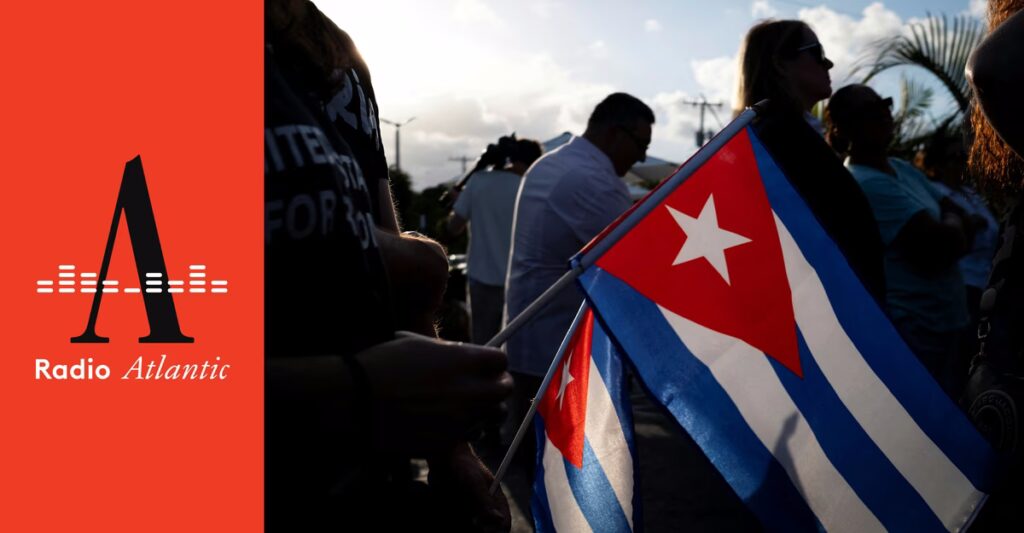
Sometimes when President Trump talks about Cuba, he throws in compliments. “They have a nice landscape. You know it’s a beautiful island,” he said during a signing event at the Oval Office in March. “I do believe I’ll be having the honor of taking Cuba. That’d be good. That’s a big honor.” Sometimes he toys with the idea of conquest a little more menacingly, such as when he said at the same event: “Whether I free it, take it—I think I could do anything I want with it.” Almost as soon as U.S. commandos swiftly extracted Venezuelan President Nicolás Maduro and flew him to the United States, some administration officials set their sights on the next target: Cuba.
Trump, per usual, is focused on business. His administration seems to have turned its attention to Cuba’s nickel and cobalt deposits, in an effort to get ahead in the race with China for critical mineral deposits. In the case of Secretary of State Marco Rubio, the motivation for the U.S. to focus on Cuba seems more personal. Rubio’s parents left Cuba shortly before Fidel Castro took power, and he has long harbored the dream shared by many Cuban exiles of regime change on the island. In a recent address from the State Department delivered in Spanish and intended for Cubans, Rubio promised them a “neuva vía”—a new path.
From the Cuban perspective, the prospect of the U.S. bringing regime change is fraught, coming after centuries of conflict and colonial extraction. As the Cuba historian and Princeton professor Ada Ferrer describes it, American presidents dating back to Thomas Jefferson have dreamed of acquiring Cuba in one way or another. Now, as Cubans are suffering from sanctions and oil shortages and soaring food prices, she worries that the bellicose rhetoric from the White House could put U.S.-Cuba relations on an openly violent path.
On this week’s Radio Atlantic, I speak with our staff writer Vivian Salama and Ferrer, author of the Pulitzer Prize–winning Cuba: An American History, as well as the new book Keeper of My Kin: Memoir of an Immigrant Daughter.
The following is a transcript of the episode:
Hanna Rosin: For clues about what’s on President Donald Trump’s mind, sometimes it helps to track the movements of the USS Nimitz, oldest serving aircraft carrier in the world. Last year, she—the ship goes by “she” in military circles—was rerouted to the Middle East. In March of this year, she embarked on her final voyage, which has turned out to include a stop in the Caribbean. More specifically within striking distance of Cuba.
Janine Stanwood (WPLG): A new U.S. aircraft carrier is moving into the Caribbean amid more U.S. pressure against the Cuban government.
Rosin: Last week, Trump told reporters, “We have Cuba on our mind.” That was just after the Justice Department charged Raúl Castro, brother of Fidel, with murder for his role in the shooting down of two planes that killed four U.S. nationals 30 years ago. A few days ago he said we’ll be, “freeing up Cuba.”
Donald Trump: It’s a failed country. Everybody knows it. Other presidents have looked at this for 50, 60 years doing something, and it looks like I’ll be the one that does it.
Rosin: I’m Hanna Rosin. This is Radio Atlantic. Trump is not the first president who’s said he wanted to “save” Cuba. In fact, American leaders have dreamed about controlling the island in one form or another for over a century. But no U.S. president has really pulled it off. And yet, here we are again.
Ada Ferrer: This moment in U.S.-Cuban relations right now is unprecedented. No U.S. president has taken such a stark, combative, imperialist stance vis-a-vis Cuba certainly not in my living memory.
Rosin: That’s Pulitzer Prize–winning historian Ada Ferrer. We’ll talk to her later in the show.
First, staff writer Vivian Salama, who writes about politics and national security and who’s been writing about Cuba for the last few months.
[Break]
Rosin: Vivian, welcome to the show.
Vivian Salama: Great to be with you, Hanna.
Rosin: President Trump tends to zero in on countries, as you know, Iran, Venezuela, and now it seems as if Cuba is next. When did you first start hearing administration officials talk about Cuba?
Salama: Almost the moment that Nicolás Maduro was seized in Venezuela about three days into this calendar year.
I wrote a story that said Cuba is next for The Atlantic because it seemed like almost immediately their attention, their interests, were diverting to Cuba, that Venezuela was, in a way, a domino where they would ultimately wanna topple the Cuban regime.
Secretary of State Marco Rubio, who is a central figure in anything we talk about regarding Cuba, this has been sort of a lifelong dream of his: topple the communist regime in Cuba—that Castro/post-Castro regime—and usher in a democratic future.
Rosin: So is that the kind of language they were using publicly even initially, this regime change–type language, Topple the regime, as opposed to say, Cuba’s a danger to the U.S., or—there’s many different ways they talk about countries that they set their sights on.
Salama: I mean, you say “they” and it really depends because President Trump packages everything differently from the way the rest of the folks in his administration do. Marco Rubio has been very blunt about toppling the Cuban regime in the past. He has said it very bluntly. He has been very clear about that.
Marco Rubio: The bottom line is their economy doesn’t work. It’s a nonfunctional economy. It’s an economy that has survived on subsidies from the Soviet Union and now from Venezuela.
They don’t get subsidies anymore, so they’re in a lot of trouble. And the people in charge are in, they don’t know how to fix it. So they have to get new people in charge.
Salama: There’s no ambiguity there. He has said multiple times over the course of the last few months that the Cuban regime needs to go. President Trump sort of waffles back and forth about it.
He kinda says, Cuba’s next. We’re going in there. Those guys are no good. But he’s been a little noncommittal as far as what happens.
Because for President Trump, what he wants is a deal. He wants a transactional approach to Cuba, which is, If these guys stick around and they just let us invest, get money flowing between our two countries, then, I can live with them sticking around. We build some hotels on the coast. We go in and take their minerals, for example. And that’s a satisfactory solution for President Trump.
And that’s what we saw in Venezuela is that the regime didn’t change, just the leader changed. But the same regime has stuck around and President Trump has been very satisfied with that.
He has praised the now acting president, Delcy Rodríguez, multiple times because she’s letting American oil companies go in there and she’s letting America do business in there once again. And that’s enough for President Trump.
Rosin: And what about Rubio? Because we’re used to Trump’s interests steering policy. But the secretary of state has seemed unusually influential on this.
Salama: Marco Rubio is very influential in this administration.
In fact, it’s pretty extraordinary how influential he’s been, and we’ve been watching that now for a year and a half unfold. For him, this is an existential thing for Western Hemisphere politics. It’s very close and personal to him. He comes from Cuban descent and grew up sort of with the stories of the communist revolution of 1959 and what it did to Cuba.
So for him, it’s very personal, and this is something that he’s built his political reputation on. And remember, Marco Rubio, there is a chance that he runs for president again in the future. And so achieving this not only would go down very well back home in Florida where he’s from, but would also potentially prop him up as a lead contender for a GOP nomination, for example, whether that’s 2028 or beyond.
Rosin: So he’s the idealist in this situation. Trump is the dealmaker realist. You wrote this weekend about the mining industry in Cuba and how it plays into this latest conflict, which is, I suppose, what Trump is focused on. What is the story there?
Salama: So briefly speaking, minerals have been the bread and butter of the Cuban economy, nickel in particular.
Their mines have been very prosperous and they’ve been able to once upon a time sell their minerals to the Soviet Union. When the Soviet Union collapsed, a Canadian company stepped in and invested in their mines and did a joint venture with them so that they could mine their minerals and then they would export those minerals, primarily to China, but also a couple of places in Europe, as well.
And so they have been getting a really good amount of revenue from those sales. Now, in recent months, the Trump administration has been looking to squeeze every last financial lifeline away from the Cuban regime in order to basically allow them to collapse from within. We saw the embargo that has been put in, the blockade of oil. And that Venezuelan oil, was something that was really sustaining the Cuban regime.
So you cut off oil coming from Venezuela. He cut off oil coming from Mexico, and they were really suffering in the last couple of months. There have been mass blackouts across Cuba. Hospital generators are not working, and patients are on the brink. People are not able to get gas for their cars. There have been protests in the streets partially because of the fact that people have been struggling. And now they put sanctions on the mines. And that was a really key sort of final stroke to say, Okay, this is one of their last lifelines. We’re gonna try to cut it off.
So this is twofold. It’s cutting off the revenues that go into the Cuban regime. It’s also trying to pull away critical minerals from China, which, I would argue, that’s a bipartisan interest that the Biden administration was also very interested in doing similar activities.
Rosin: Yeah. I see. So there’s tension always in all these motivations. It’s like, We wanna bring down the regime. Marco Rubio cares more about that. But also, We wanna win this critical mineral fight, which is a self-interested motivation.
Salama: And that is something that President Trump himself is very interested in.
Rosin: Right. Okay. So we’ve brought up Venezuela a couple of times in the analogies. Recently, the Justice Department indicted Raúl Castro, as you know, Fidel Castro’s brother. They charged—
Salama: —who is turning 95 next week.
Rosin: Ninety-five. Wow. Okay. Okay. Well, they charged him with being involved in an aerial attack that killed Americans, which happened 30 years ago.
So I’m guessing this news is about having a pretext to arrest him the way they arrested Maduro? Has anyone connected all those dots all the way to, We’re gonna do to him what we did to Maduro, or not quite yet?
Salama: A hundred percent they are connecting it. And in fact, when the Maduro operation took place in early January, everyone was talking about, Cuba would be next, in terms of what they describe as a law enforcement operation.
Very different from, let’s say, the Iran operation, which is solely a military operation. This is a law enforcement operation, which means that the military supports what would be the arrest and extradition of the leaders. In this case, it’s not the president who’s being indicted like it was in Venezuela. It is the old guard, who is still very influential even at 95. When the Justice Department indicted him, they made no secret of the fact that they intend for him to face a jury of his peers and suggested, hinted at the fact that they would do something very similar to what they did to Nicolás Maduro.
And adding to that suspicion is the fact that, remember, so many military resources were dragged to the Middle East to support the Iran war. The USS Nimitz just arrived back in the Caribbean about a week ago. And so now you have a carrier near the shores of Cuba, which added to the speculation that something was coming that might suggest a military or a law enforcement operation of some kind in Cuba.
Rosin: I know you’ve been talking to foreign policy experts. How realistic a sense do you think they have of what it means to do regime change in Cuba?
Salama: So not only have I talked to experts, I’ve talked to folks in the administration who are very involved in this. And they are a lot more optimistic about the opportunities or the prospects of a regime change, that it can be done with a lot of planning. They insist that a lot of planning goes into any of these operations.
Obviously we kind of question it once they unfold, especially after Iran. But in the case of Cuba versus Venezuela, there’s so many differences that make it so much more challenging. In particular, the fact that seven decades of socialist Castro regime have all but squeezed the opposition to a point that they are not a coherent, unified opposition. They’re scattered all over. So many of them are operating out of, let’s say, Florida or elsewhere in the diaspora. Those who are domestic are under very close watch by the regime because they don’t take dissent well. There’s a lot of disagreements among them.
And also, again, seven decades of one-party rule can really do a number on an opposition movement.
And so everyone I talk to, from the experts who are closely watching this say, Okay. You could stand up or lean on the Venezuelan opposition very easily because you know who the players are. They’ve even been elected by the people. But you don’t have that in Cuba. So who are you gonna lean on?
And then the question becomes (a) do the people rally behind that leader? And (b) how do you ensure that it goes well? Any kind of regime change where the U.S. has propped up a leader that is not necessarily supported by the people has not gone well historically.
And so this is a major concern for people. You have the risk of migration flows if things start going to hell in a handbasket. All these other issues that could directly impact the United States if an operation in Cuba were to go poorly. The administration insists that’s not gonna be the case, though.
And so it’s a wait-and-see moment.
The Trump administration is so wrapped up in Iran right now that it’s hard to imagine they have the bandwidth to fully kind of execute on a Cuba regime-change operation. But they insist that the situation is ripe for change.
Rosin: Well, Vivian, thank you so much for explaining this to us.
Salama: It’s my pleasure.
Rosin: After the break, I talk to Princeton professor Ada Ferrer, author of the Pulitzer Prize–winning Cuba: An American History and her new book, Keeper of My Kin: Memoir of an Immigrant Daughter.
[Break]
Rosin: Professor Ferrer, welcome to the show.
Ferrer: Thanks for having me.
Rosin: So the way we’ve experienced the last few months is, newsflash, Trump has suddenly set his sights on Cuba. But from where you sit, which is a historian of Cuba and also a Cuban, I imagine the feeling is more like, Here we go again.
Ferrer: Yeah. Here we go again. The U.S. setting its sights on Cuba is not anything new. Ever since the days of Jefferson, American leaders have fantasized about taking Cuba in one way or another. But still, it feels different this time. It does feel new because there’s never been a moment in my living memory where an American president has talked so crudely about taking Cuba. His famous statement back in March—
Trump: I do believe I’ll be the honor of, having the honor of taking Cuba. That’d be good honor. That’s a big honor.
Reporter: Taking Cuba?
Trump: Taking Cuba in some form, yeah. Taking Cuba. I mean, whether I free it, take it. I think I could do anything I want with it, you wanna know the truth.
Ferrer: No president has spoken that crudely about Cuba in over 100 years, so it is still startling to me.
Rosin: Okay, so let’s make our way there. I really wanna understand how we landed in this moment and what’s the historical context for it.
First, I know your latest book is a memoir, so I know you have a lot of family still in Cuba. What are you hearing from them at this moment?
Ferrer: Well, what I’m hearing is just that things are awful. There’s no other way to say it. Even cousins in Havana are going 22, 23 hours without electricity a day. It comes and goes. It’ll come for, like, a half hour, and then it disappears. I have family in the interior, which is even worse off than Havana, and they’re going days at a time without electricity, and that means it’s impossible to do anything. It’s impossible to turn on a fan at night to sleep. It’s impossible to store food for any length of time.
The price of food is just through the roof. There’s no transportation. Garbage isn’t being picked up. You may have seen videos of protests—some in Havana, but some in smaller cities around the island—where people just start banging pots and pans at night, and they’re burning garbage because there’s nothing else to do with it, ’cause no one is picking it up.
So it feels completely unsustainable, but it has felt unsustainable already for a while. The last time I was there was December ’23, and there were already blackouts. You could see the garbage. But what it feels like now is just that on steroids with no apparent out, with no sense of what a solution will be.
Rosin: Yeah, so is that what you most worry about? That they’ll be stuck in this situation for a while, or is there something worse that you worry about?
Ferrer: Oh, I’m a worrier, so I worry that, you know, people talk about collapse or something being unsustainable. But we know from history that collapse doesn’t just happen and then something disappears. Things can keep getting worse. No matter how bad they are, they can still keep getting worse.
So I do worry about this spiral that never hits bottom and people suffering in the meantime. But then I’m also worried about the possibility of violence. I worry maybe leaders in the U.S. imagine regime change or some kind of military operation as much more simple than it will be.
I worry about violence of Cuban against Cuban. I know Cuban history. Times when there has been a change in government after an unpopular government, there has been violence of Cuban against Cuban, and I think there’s a real possibility of that. So I worry about all of the above.
Rosin: Yeah. Can you set up the story of the memoir for us, which is also the story of your own life?
Ferrer: Yes. So I was born in Cuba in 1962, so a few years into the Cuban Revolution of Fidel Castro’s rule. My father left while my mother was pregnant with me. She was seven months pregnant with me when he left and came to New York City, and my mother decided to join him with me. So my mother and I left Cuba in April—April 29, 1963.
She had to make the excruciating decision to leave behind her son, my half-brother, her son from her first marriage. He was nine-and-a-half years old. And the reason she left him was that his father, who was a member of the revolutionary police, thought it wouldn’t look good for his son to go to the U.S. So he refused to grant permission for him to leave. So she left with me and left him behind, thinking that he would join us, that his father would relent and grant permission. And it didn’t happen.
So from that decision that she made, my brother and I came to lead two very different lives. He was traumatized by her, by our departure, a separation that was meant to last a few months, maybe a year or two at most, stretched on for 17 years.
So he was 26 years old when he first arrived in the U.S. during the Mariel boatlift of 1980. and he got here as a damaged young man. And the memoir basically tells the story of that separation, of the family around it, who lived through that separation and were influenced by it, shaped by it.
And I think one of the things that that history did is that it made me a historian. I just became interested in understanding this place that was always so present for me while I was growing up. It was present in its absence, because I didn’t get to go there until 1990 when I myself was 28.
But it just nurtured in me this intense curiosity about the place, but also about the people.
Rosin: Yeah. I mean, the main things I learned from reading your books is that this long and tortured relationship is almost as old as these two countries, including many periods of violence and a dominating impulse from the U.S. towards Cuba. So where does this start? Like, you mentioned Thomas Jefferson, third president of the United States, just like Trump, had his sights on Cuba. How was he talking about it then? How was the U.S. talking about it?
Ferrer: Back in the 19th century?
Rosin: Yes. Yes.
Ferrer: Well, it’s a new country, right? It’s a fresh republic, and it wants to extend its borders, and it wants to ensure its security. Cuba has the fortune or misfortune of lying in a very strategic place for that, right in the Gulf of Mexico.
One of the major ports in the 19th century was New Orleans, where so much went out of the Port of New Orleans to the Eastern Seaboard—this is before the days of railroad—out to Europe. And Havana sits right there. So whoever controlled Havana could block American commerce. So that was part of the interest of early American leaders of ensuring the prosperity of American commerce, et cetera.
And if you read what people like Jefferson and Adams were saying, to us it feels strange because they would say things like, The well-being of our republic rests on acquiring Cuba, and you think, Why was Cuba so important? It’s an island in the middle of the Caribbean Sea. But that was how they thought about it.
And then a little bit later in the 19th century, you had people very invested in the institution of slavery in the United States, and Cuba, of course, was a slave society. It was, from the 1820s on, the largest producer of sugar in the whole world and one of the major slave societies of the Atlantic world in the 19th century.
So the slave power in the U.S. believed that if the U.S. acquired Cuba, it could incorporate it into the Union as multiple slave states, and that would increase the power of slavery in the United States. So those were the two things that were really important in the 19th century.
Rosin: So back in the 19th century, the U.S. leaders were talking about acquiring Cuba, essentially making Cuba part of the U.S. That was the idea. And then what about from within Cuba? Because what you’ve just described is an American projection: This is what we fear. This is what we need.
Ferrer: Yeah. Well, interesting, you know, history’s always more complicated than we imagine from the outside or at the outset. There were people in Cuba who very strongly supported that idea, and they tended to be very wealthy men, powerful men. They were slaveholders.
And if you think about it, the 19th century was also a time of increasing abolitionism, and the British were very powerful. They were policing the slave trade. They had abolished their own slave trade and their own system of slavery in 1834. So part of what Americans feared and part of what Cuban elites feared was that Britain might either take control of Cuba or they would exercise power over a weakened Spain and enforce the end of the slave trade and the end of slavery.
So there were Cuban elites who saw the U.S. as an answer. It was a way to avoid the abolitionist activism of the British, and to protect slavery. So when slavery ended during the Civil War, that impetus to acquire Cuba waned.
Rosin: Right. Although the desire to dominate Cuba in some way never went away. Around the sugar trade, for example, where Cuba was essentially dependent on the U.S. to buy sugar, and the U.S. could use that dependence as a political tool.
I am pulling us into details of this history because when I was reading your books it became so clear—there are these recurring themes to this U.S.-Cuba relationship. And we may live them all over again. So I want our listeners to have that context. So what’s the next critical moment?
Ferrer: The next really important moment, and in some ways the most important perhaps, the most important moment comes at the end of the 19th century when Cuba launches three different wars of independence against Spain. It’s a process that began in 1868. And then the final war began in 1895, and it ended in 1898. And it ended with the intervention of the United States.
The U.S. declared war on Spain and fought against Spain and acquired the last remaining Spanish colonies, right? So that was when the U.S. acquired Puerto Rico, Guam, the Philippines. And with Cuba, for 30 years, people had been fighting for independence.
So the U.S., I think, knew that it couldn’t just come in and take over Cuba, right? So the precondition for intervention was something called the Teller Amendment, which recognized that the sovereignty of Cuba lay with the Cuban people. And so what the Americans did was saying, We’re going in for humanitarian reasons in aid of a sister country searching and seeking its independence. And once the island is pacified, we will leave because sovereignty rests with the Cuban people.
Of course, that didn’t happen. The island was pacified, and they didn’t leave. And then the Americans said, Okay, when Cubans prove themselves capable of self-government, we will leave. And then the Cubans had peaceful elections and drafted a constitution, and still they didn’t wanna leave.
To leave in 1902, the U.S. set up this condition, which was called the Platt Amendment. And it forced Cubans to include it in their first constitution as an appendix. And the Platt Amendment said, among other things, that the U.S. had the right of intervention in Cuba.
So basically, if the U.S. thought life and liberty or American businesses were in danger, they could intervene militarily. It also prevented Cuba from entering into treaties with third countries, accruing debt from third countries. It also gave the U.S. the land that later became the Guantanamo Naval Base.
Rosin: So the themes that are getting set up in this period is the U.S. as a necessary savior maybe to Cuba and a thwarted desire for Cuban independence. It feels like those are the two sides here.
Ferrer: Yes, exactly. It’s funny. You look at political cartoons from the era, and the American cartoons portray that—Uncle Sam helping the Cubans acquire independence. And the Cuban cartoons, many of them, not all of them, are very different.
Rosin: The period most people know about, the name most people know, and it’s popping up again, is Fidel Castro. It’s fair to say that at the very beginning, a young Castro was fighting for Cuban self-determination. It maybe wasn’t that explicit, but was on the side of, We get to determine our own fate.
Ferrer: I think the Cuban Revolution of 1959 is a fascinating historical event. I think there’s a lot of misunderstanding about the history of it. That revolution was fought explicitly against the dictatorship of Fulgencio Batista.
The rallying cry that united all different revolutionaries was not about self-determination, actually, and it wasn’t about the U.S. It certainly wasn’t about socialism or communism. It was that people wanted to restore the 1940 constitution. They wanted to restore democracy.
It was a very imperfect, flawed democracy, but that was the thing that united people. Get rid of Batista, who had taken power illegally, restore the 1940 constitution, and deal with the problem of corruption, which was rampant. So those were the unifying forces.
And then what happens is that Batista flees. By that point, Fidel has become the most important figure in the anti-Batista opposition. It wasn’t like that in the beginning, but over time, for complicated reasons, he became the most important, visible figure. And the new government is set up, and they get to work right away. They pass something like 1,000 decrees in a week or something like that. The agrarian reform comes five months after taking power. The urban reform reduces rents by half. That was three months after taking power. And so it’s a moment of euphoria, of hope for change, et cetera.
What begins to happen is that the new government begins to butt heads with the U.S. The agrarian reform in May of 1959, nationalizes some U.S.-owned land, and that begins that process. It’s almost like in those first two years, one government will do something, the other government will respond. The other government responds with a little more oomph, then the other one does the same, and it just escalates until you have the U.S. Embassy in Havana closed, the Cuban Embassy in Washington closed. You have planning already for the Bay of Pigs invasion. You have Eisenhower and other folks in DC saying, We can’t work with this government.
So the confrontation with the U.S. is not yet clear in January 1959. It becomes clear over the next months and the first year or two of the revolution.
Rosin: What’s poignant and kind of tragic about this period is that the initial stages of the revolution seemed very amenable to an American vision: It’s democratic. We want elections. It feels like something the U.S. could get behind. But then this enmity that you describe drives everyone into extremes.
It seems to drive Castro more sort of pro-communist and less interested in democracy. It’s a momentum which—it’s almost like the United States created a more communist Castro.
Ferrer: Historians love to debate, and there is a debate about that, right? Whether to what extent was Castro communist beforehand or leaning communist, right? So it doesn’t all just come out of the blue, but I do think that the U.S. did things that pushed Castro further left.
Rosin: And I think it’s important to articulate all of this because of the place where we’re headed. We’re headed to another moment like this where we’re intervening, and so to be aware of the effects that that has within Cuba and to the relationship at this moment, I think is really important.
Your memoir, your latest book centers around your brother, and one thing that really jumped out is, as he’s writing letters to your mother, just this intense longing, like for you, for his sister, for his mother. But also for the U.S., like an idea about the U.S. And just reading them, I was wondering how did that sit alongside a kind of deep Cuban pride and longing for self-determination and independence? Like, how those two things coincided with each other.
Ferrer: Yeah. I mean, they’re both there. They’re there in my brother’s letters, but they’re there in so many other kinds of sources, right? There’s a fascination in Cuba with American culture. If you look at the period before the revolution, most consumer goods came from the U.S.
Many of the movies people watched were American movies. They listened to American music. There was regular ferry service between Key West and Cuba. Tourism was a lifeline of the economy from the 1920s forward, and most tourists were American tourists. So there was this fascination with American culture.
But then you had intellectuals who were very aware of U.S. political and economic influence on the island and wrote against it. But it wasn’t ever a kind of blanket anti-Americanism.
Rosin: Right. It wasn’t a cultural anti-Americanism. So given this incredibly complicated history that you are very familiar with, when you heard Donald Trump or even Marco Rubio talk about wanting to change Cuba or lead Cuba to freedom, what was your first thought?
Ferrer: Oh, where to begin? I had so many thoughts all at once. One thing that has struck me is the extent to which Rubio and Trump are talking less about freedom and democracy than I expected. I thought that that was all they would be talking about, and instead they seem also to be talking about economic negotiations, right? So that struck me.
Rubio did a speech to the Cuban people in Spanish, on May 20th, which is Cuban Independence Day, and he barely—I’m not sure he even mentioned freedom or democracy. He talked about GAESA, which is this military conglomerate in Cuba that controls most of the Cuban economy.
The thing I worry about is that the bellicose nature of Trump’s rhetoric regarding Cuba is being matched on the other side by a Cuban rhetoric that’s equally bellicose, right? So Cuban leaders are saying, We’re not afraid. Just come. We’ll match you. It’ll be a bloodbath. You know, that kind of, We will resist. We will fight.
And I’m not sure the Cuban government is understanding that that is not probably as easy as they imagine because most people—it’s not clear they have the food to fight. It’s not clear they have the will to fight. They are so beaten down by how horrible things are right now. And so I think both sides are underestimating how difficult and how much more complicated the scenario is than they’re admitting. And then I worry that sometimes that kind of combative rhetoric can create its own reality, right?
It mounts. So one side says something, the other side escalates, the other side escalates back, and it can create its own momentum. It can create its own sense of inevitability. It can create its own kind of reality, and that worries me.
[Music]
Rosin: Thank you so much for helping us to understand this moment better.
Ferrer: Thanks for having me.
[Music]
Rosin: This episode of Radio Atlantic was produced by Kevin Townsend. It was edited by Claudine Ebeid. Sam Fentress fact-checked. Rob Smierciak engineered and provided original music. Claudine Ebeid is the executive producer of Atlantic audio, and Andrea Valdez is our managing editor.
Listeners, if you enjoy the show, you can support our work and the work of all Atlantic journalists when you subscribe to The Atlantic at TheAtlantic.com/Listener.
I’m Hanna Rosin. Thank you for listening.
The post History Repeats in Cuba appeared first on The Atlantic.