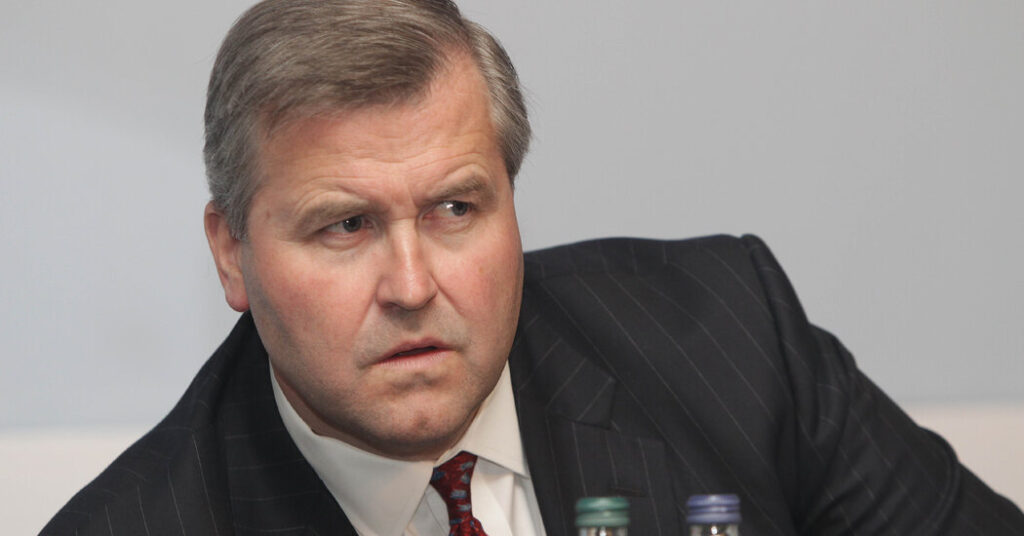
The former chairman of the British energy giant BP, Albert Manifold, issued a new series of denials on Thursday about his abrupt dismissal, pushing back against what he said were “lies” about his tenure.
In a 770-word statement with his observations about BP’s corporate strategy and details about office life, Mr. Manifold conceded that during his relatively short stint, he had “pushed hard and challenged people.” He said that he tried to “set an example” by eschewing chauffeur-driven limousines, private jets and other perks. On the days he spent in BP’s offices, he made his own coffee and bought his own lunch, he said.
BP removed Mr. Manifold as chair on Tuesday, citing “serious concerns” raised to its board about “governance, oversight and conduct issues.” In his initial response, Mr. Manifold said he disputed the characterization, and would “not allow a false narrative to go unchallenged.”
On Thursday, Mr. Manifold said that he accepted the BP board’s decision to remove him, but “what I do not accept is that lies can be told about me.”
Mr. Manifold has been described in news accounts as hard-charging and controlling in his management style. BP stood by its accusations on Thursday, saying in a statement: “We have a duty of care to all our employees, particularly those impacted by his behavior.”
When he joined BP last year, Mr. Manifold said that he found a company that “lacked strategic cohesion and direction.” In addressing those matters, “it felt to me that my priorities were not always shared by everyone,” he added.
He sought to cut costs and simplify operations. He also wanted to “streamline and refresh” the board, pushing for a review of how it worked to “improve efficiency and effectiveness,” he said.
Mr. Manifold addressed media reports suggesting that he acted as if he had a more hands-on executive role, calling them “nonsense.” This year, he said, he had spent only 13 days at BP’s headquarters in London. “I am a part-time nonexecutive with many other commitments,” he said.
During his time at BP, he said, he was adamant that his behavior never crossed a line. “Is it possible that in my determination to drive change on costs, performance, the balance sheet and shareholder communications, I pushed hard and challenged people directly? Yes, it is,” he said. But there was a “considerable distance” between his actions and “the characterization of my conduct that is now being put about,” he added.
“In my 40-year working career, I have never once had accusations made against me such as those made in recent days,” he said.
BP has gone through a series of leadership changes in recent years, amid investor discontent over its strategy and performance.
Mr. Manifold, the former head of a building materials company, CRH, joined the BP board on Sept. 1, and took over as chair on Oct. 1 on the promise to improve returns at the company. An ill-fated plan in 2022 to invest billions into renewable energy and pull back on oil and natural gas production sent the company’s stock on a downward spiral, raising the ire of shareholders.
BP changed its position the next year, partly because Russia’s invasion of Ukraine had sent energy prices soaring.
In December, BP appointed Meg O’Neill, who had led the Australian oil producer Woodside Energy, as its chief executive. She replaced Murray Auchincloss, who had stepped down under pressure from activist investors that pushed to pump more oil, which was more profitable.
Bernard Looney, who preceded Mr. Auchinicloss as chief executive, left the company in 2023 after acknowledging that he had failed to fully disclose personal relationships with colleagues.
Despite the executive turmoil, BP has been able to revive its bottom line by refocusing on oil and gas. It doubled its profit in the first quarter, to more than $3 billion, from a year earlier. Its shares are up nearly 20 percent this year.
In his statement on Thursday, Mr. Manifold called Ms. O’Neill and other BP executives “among the finest people I have worked with” and “brimming with integrity.”
BP’s board named Ian Tyler, a director since April 2025, as interim chair, and said it would begin a process to find a permanent replacement.
Gregory Schmidt is a Times business editor overseeing coverage of the European economy. He is based in London.
The post Fired BP Chair Rejects ‘Lies’ About His Ouster appeared first on New York Times.