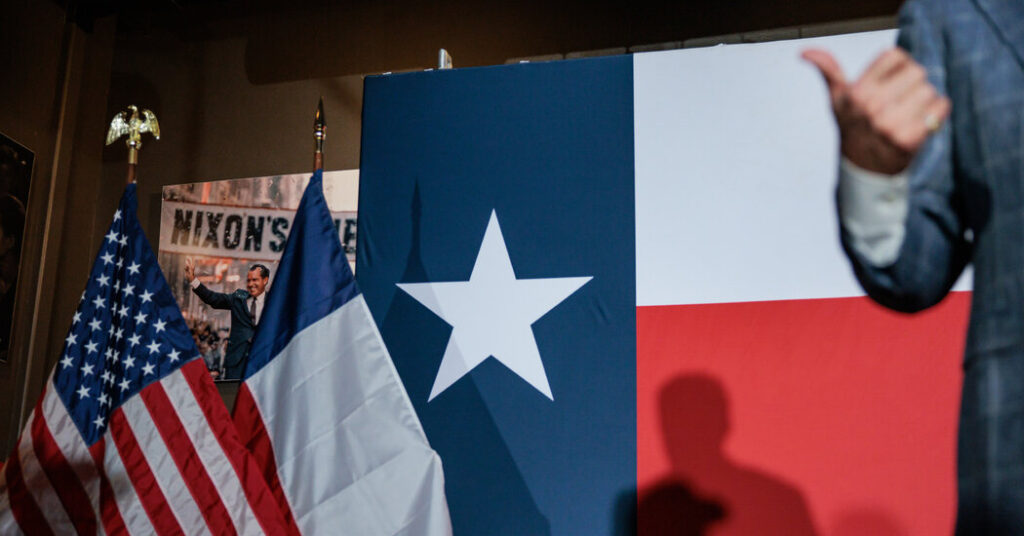
Bret Stephens: Hi, Frank. Did President Trump just hand Democrats a gift as big as Texas?
Frank Bruni: I sure hope so. And I’m betting that James Talarico — Texas’ Democratic nominee for the U.S. Senate, who now gets to face the despicable, execrable and (naturally) Trump-endorsed Ken Paxton in the general election — has a very, very wide smile on his face.
Bret: Much as there is much to detest about Paxton — and as much as I think Republicans were fools to cashier John Cornyn, the reasonable and experienced incumbent — I’d be shocked if he loses in November: Texas is nearly as red as California is blue. And Talarico has baggage of his own: He’s not as popular as he needs to be among Black voters, and comments of his like “God is nonbinary,” whatever the theological merits, just aren’t going to help him politically.
Frank: Well, aren’t you the definition of a buzzkill? Can we not have just one week, just one day, just a few fleeting hours in which we imagine that Talarico — who seems to be a transcendently decent man in an abysmally indecent age — becomes the first Democrat in a generation to win statewide office in Texas and denies the kleptocrat in chief a Senate majority during the second half of his ruinous second term? Can you not give me that, Bret?
Bret: I’ll give you that Democrats now have a chance in Texas, when previously they had none. I also think that Paxton’s unfortunate ascent in state politics is a good reminder of why parties tend to become dangerous to themselves when they go for years without facing meaningful political opposition from the other party. Something similar may be happening in Los Angeles right now with the mayor’s race and the rise of Spencer Pratt ahead of next month’s primary.
Bruni: I can tell you want to pivot to the Democrats’ excesses and woes, and I will follow you westward to L.A. in a bit — —
Bret: Oh, come on.
Frank: — — but not before we linger a minute longer on what Trump’s endorsement of Paxton and Paxton’s primary victory over Cornyn (by nearly 30 points!) say about Republicans. An overwhelming majority of Republican officeholders compete with one another to prostrate themselves more sycophantically before Trump, and Paxton trounced Cornyn along those lines: As Texas’ attorney general, he filed lawsuits in 2020 to challenge Joe Biden’s victories over Trump in Georgia, Michigan, Pennsylvania and Wisconsin. And on Jan. 6, 2021, he spoke at the rally in Washington just before the mob stormed the Capitol.
Sheer narcissism and blunt transactionalism drive Trump’s assessment of character. Unfettered fealty to Trump is virtuous; even occasional, minor defiance is intolerable. That — not the Democrats’ failure to provide meaningful political opposition — is the immoral moral of this story.
Bret: As my rabbi’s rabbi used to say, you’re 100 prozent right. Now let me tell you why you’re also 100 prozent wrong.
Frank: That’s some unkosher arithmetic, Bret.
Bret: Talmudic math, Frank. Anyway, didn’t you recently write a column lamenting Graham Platner’s rise in Maine but saying you’d vote for him — despite his record of wretched social media postings and a Nazi-themed tattoo — on the theory that Trump must be opposed at all costs? Well, Texas Republicans have now done what Maine Democrats just did: They chose ideological purity over moral decency, political extremism over moderation, and now the rest of the country may have to suffer for it.
Frank: While I understand the point you’re making, I must say that the word “purity” in proximity to the name Paxton is jarring.
Bret: Pure in the sense that sulfuric acid can also, I suppose, be pure.
Frank: I’m not comfortable with putting Platner and Paxton in the same pontoon, but you’re right that they reflect some of the same larger dynamics, one of which is illustrated by this statistic from the Tuesday returns in Texas: Only about 8 percent of registered voters (Texas has open primaries) showed up, as Cornyn pointed out in his concession speech. Primary elections are often dominated and decided by the extreme elements of each party, and we end up with nominees — and then elected representatives — who are resistant to compromise, bad at consensus and unrepresentative of most Americans.
Bret: I wonder what would happen to our politics if a requirement for voting in a general election was to have also voted in a primary, asking ordinary voters not only to decide the winners but also to select the candidates. But can we get back to Los Angeles?
Frank: Do you have a timeshare there, or are you just trying to rack up frequent-flier miles?
Bret: I love L.A. more than I care to admit. But my question to you is: Does Karen Bass deserve re-election?
Frank: In the abstract, probably not. Her performance and record are unimpressive. And in terms of the Los Angeles wildfires, she violated a cardinal rule of governance: Get the natural disasters right. (Did no one learn anything from President George W. Bush and Hurricane Katrina?)
But elections are choices among imperfect and sometimes unappealing options. And while Pratt, a former reality television star, has given powerful voice to Angelenos’ understandable discontents, he has no experience and, from the evidence we’ve seen, a shaky grip on policy. He’s also one of these internet-era candidates surfing big swells of rancor. Big swells of rancor are not serving America well. You could even say they’re capsizing it.
Bret: There’s always a risk that a political neophyte like Pratt will have no idea how to work the municipal system if he gets into City Hall — that is, he won’t know how to translate charisma into competence. Something similar, I think, happened to Arnold Schwarzenegger when he rode a wave of popular discontent into the governorship of California and then sort of floundered in the job.
But Los Angeles is a great American city that happens to be a mess right now, and it — along with the Democratic Party that has ruled it like a fief for decades — could stand to be shaken and stirred. As Jefferson said, “A little rebellion now and then is a good thing.”
Frank: So is a big martini. Sorry, your “shaken and stirred” brought me straight to cocktail hour.
Bret: On a less unsober note, Frank, you spent a couple of years as The Times’s Vatican correspondent. (Nice gig!) Any thoughts on Pope Leo’s new encyclical on artificial intelligence?
Frank: I’m fascinated by both the fact of it and the rapt attention to it. The Roman Catholic hierarchy has so often been so far behind the (lowercase) times, and here’s Leo hopping on a profoundly challenging, rapidly evolving issue precisely when people are most panicked by it. With this encyclical and with his upbraiding of Trump about the Iran war, the pope is asserting the church’s relevance and claiming headlines in a fashion that’s not a foregone conclusion, given how many Catholics don’t typically concern themselves with the Vatican’s edicts. Your feelings about him, Bret?
Bret: Mi piace questo papa. He seems approachable and wise, serious but not self-serious. And it’s entirely appropriate for someone in his position to tackle an issue like A.I., because technology isn’t morally neutral. In the 18th century, a technological innovation, the cotton gin, made slavery immensely profitable for slaveholders, setting the stage for its westward enlargement and the Civil War that followed. In this century, we’ve seen how social media leads to antisocial behavior. Artificial intelligence raises even greater concerns than social media. I was especially struck by one line in the encyclical, in which Leo writes of the “paradox of material progress and anthropological regression.” I’ll think of that every time I hear of college students having A.I. write their term papers for them.
Frank: It’s a great phrase. I’m starting to regard Leo as our country’s retort — on the global stage — to Trump. We’re watching the first American pope redeem the worst American president. One man is eloquent, earnest, measured, big-minded. The other is trying to steal $1.776 billion from taxpayers so that he can give financial rewards to unhinged conspiracy theorists who bloodied police officers at the Capitol on Jan. 6. The saintly versus the sordid.
Bret: Someone please make a T-shirt with Leo’s face on it and a caption that reads, “Americans: We don’t all suck.” Sold at airport kiosks everywhere.
Frank: I promise to buy 1,000 of those and, if they come in really small sizes, even hand them out as christening gifts for infants who, by dint of nursing, are technically sucking.
Bret: Speaking of A.I.: Several commencement speakers this graduation season have been booed by graduates for raising the subject. A happy exception is Steve Wozniak — a founder, with Steve Jobs, of Apple — who gave a talk at Grand Valley State University in Michigan and spoke of a different kind of A.I., “actual intelligence.” He was met with a huge cheer. Anything you recommend to our readers to enhance theirs?
Frank: Yeah. Good old-fashioned books. I was moved and delighted by our Times colleague Alexandra Jacobs’s article this week about a new biography of Marilyn Monroe, “Marilyn and Her Books: The Literary Life of Marilyn Monroe,” by Gail Crowther. It not only underscored how pointless and wrong it is to reduce any person to a unidimensional stereotype but also paid tribute to reading as an act of self-improvement and self-empowerment.
Bret, get a load of this statement that Monroe once made and that Alexandra quotes: “If you are ignorant, books won’t laugh at you.” How great is that?
Bret: Brilliant. Norma Jean was no boob.
The Times is committed to publishing a diversity of letters to the editor. We’d like to hear what you think about this or any of our articles. Here are some tips. And here’s our email: [email protected].
Follow the New York Times Opinion section on Facebook, Instagram, TikTok, Bluesky, WhatsApp and Threads.
The post Saints and Sinners, From the Vatican to the Alamo appeared first on New York Times.