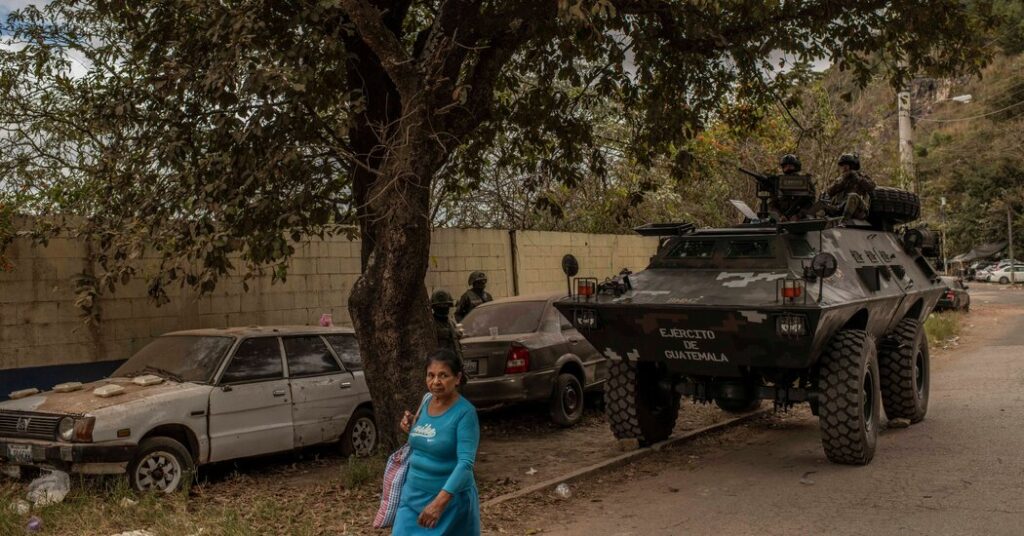
Guatemala has agreed to carry out joint strikes with the United States military inside its territory to target drug trafficking groups, according to three people familiar with the talks, in a further expansion of the Trump administration’s military campaign across Latin America.
Last week, President Bernardo Arévalo of Guatemala agreed to both airstrikes and other military action in a call with Defense Secretary Pete Hegseth, two of those people said, with operations to start as early as next month. It was unclear what other military activities could be included in the agreement.
Guatemala has formally requested “cooperation in operations led by Guatemalan security forces against drug trafficking organizations” in a letter to Mr. Hegseth, Mr. Arévalo’s office confirmed in a statement to The New York Times. His office said that Mr. Arévalo and Mr. Hegseth spoke by phone on May 19 to finalize terms but did not disclose specific details.
Guatemala would become the second country in the region to allow joint military action against criminal groups inside its borders; Ecuador agreed to a similar deal earlier this year. Under that arrangement, U.S. forces are advising and assisting Ecuadorean troops on raids and airstrikes against suspected drug gangs that have turned Ecuador into one of the deadliest countries in Latin America.
One of the next countries that the Defense Department intends to press to accept joint military action is Honduras, said two of the people familiar with the plans.
The Trump administration is targeting Guatemala and Honduras to pressure Mexico into accepting joint counterdrug operations, those two people said. While Washington has been pushing for U.S. boots on the ground and drone strikes, President Claudia Sheinbaum of Mexico has staunchly rejected the requests. The White House’s broader strategy is to normalize an American military presence across Latin America to gain leverage over Mexico, according to the two people.
That strategy is being advocated by Stephen Miller, Mr. Trump’s deputy chief of staff for policy and homeland security adviser, as well as Joseph M. Humire, for now the Pentagon’s top policy official for homeland defense and the Americas, the two people said.
Mr. Miller chairs a bimonthly meeting — called a “wins” meeting — at which various government agencies report on recent successes, with the Pentagon’s death toll from boat strikes regularly highlighted as one of the biggest, according to those two people and one other person familiar with the meeting.
The people interviewed for this story spoke on the condition of anonymity because they were not authorized to speak publicly.
The White House denied the characterization of Mr. Miller’s so-called wins meeting. “The administration continues to work to carry out the President’s agenda,” the White House said in a statement to The Times.
The deal with Guatemala, which has not yet been publicly announced, is part of a broader effort by the Trump administration to press countries throughout the region to allow joint operations inside their territories, according to those three people and a fourth person with knowledge of the strategy. Nearly 20 Latin American countries are already part of the Americas Counter Cartel Coalition, which was formed earlier this year by the Trump administration to target cartels and organized crime across the Western Hemisphere.
President Trump met with conservative and right-wing Latin American leaders in Florida in March, promising that together they would “eradicate the criminal cartels plaguing our region.”
The U.S. military is “knocking the hell out of them where we can, and we’re going to go heavier,” Mr. Trump told the leaders. “We need your help, you have to — just tell us where they are.”
The administration has deployed U.S. military resources to the region on a scale not seen in decades and designated more than a dozen Latin American and Caribbean groups as foreign terrorist organizations.
Joel Valdez, the acting Pentagon press secretary, declined to comment on any agreement with Guatemala, citing operational security.
So far, most countries in the coalition have been reluctant to allow the Pentagon to strike inside their nations because of concerns about domestic backlash, said three of the people familiar with the effort.
While many citizens across Latin America want their governments to do more to curb drug-related violence, they remain weary of the U.S. military operating inside their countries after decades of intervention by Washington, including bloody political coups.
In January, a delegation from the Pentagon, including Mr. Humire, visited Guatemala to meet with the country’s president and defense minister. They agreed to “reaffirm the strong alliance” between their security forces, according to the U.S. Embassy in Guatemala, but neither government released more details.
At a security conference at Florida International University earlier this month, Mr. Humire said new regional partnerships like the Americas Counter Cartel Coalition have given countries in the region a “platform to be able to elevate their partnership with the United States.”
“The Department of War wants to work with other countries, but they have to show that will and capacity to go after the problem set,” said Mr. Humire, referring to what the administration now calls the Department of Defense. “Part of what we’re doing is showing you that we are going to win.”
Earlier this month, Guatemalan military officials were hosted on the aircraft carrier Nimitz as the Pentagon sent equipment and troops to help train Guatemalan forces.
Last September, the Pentagon began striking boats in the Caribbean Sea and the eastern Pacific Ocean, in what it said was an effort to deter drug traffickers from using those routes. So far there have been 59 strikes that have killed at least 196 people, according to a tally by The Times, though the Trump administration has given scant evidence that the targets were drug smugglers.
Experts say the boat strikes may be illegal and carry legal risks for the Pentagon. An expansion of that effort inside Latin American countries may come with even more legal risk, people familiar with the effort said.
Former U.S. officials have said that even if the Defense Department’s leadership approved the strikes, the lower-ranking officers who actually carry them out could be held culpable for killing drug trafficking suspects who may in fact be innocent.
“As with the boat strikes, depending on the facts, further attacks could amount to premeditated killings outside of armed conflict, which some of us lawyers would refer to as murder,” said Brian Finucane, a former State Department lawyer who specializes in the laws of war. “Congress never authorized any of these strikes. So U.S. personnel who participate in these actions could face consequences down the road, after the Trump administration.”
Even if U.S. forces only provide intelligence or other logistical support to Latin American countries to conduct their strikes, they could be culpable for aiding and abetting violations of U.S. and international law, he said.
The U.S. military strikes are part of a shifting strategy in Washington’s war on drugs, which has traditionally been carried out by the Department of Justice and its Drug Enforcement Administration. The antidrug effort has long been seen as a law enforcement issue, with Washington prioritizing the arrest of suspects — whose interrogation can help investigators dismantle smuggling networks — rather than killing them, as in a conventional war.
Many Latin American countries have been bombarded with various requests from the Trump administration that they have tried to accommodate, to placate the region’s superpower. Guatemala last year agreed to accept planeloads of deportees from other countries who were expelled from the United States, and then repatriate them back to their home countries.
While the Pentagon has hailed its joint strikes in Ecuador as an important game-changing chapter in its war against drugs, the operations have not always worked out as planned.
In March, one of those strikes hit a cattle and dairy farm, a New York Times investigation found, not the drug trafficking compound that Mr. Hegseth boasted about when he said the United States was “now bombing Narco Terrorists on land.”
Jody García contributed reporting from Guatemala City, Guatemala.
Maria Abi-Habib is an investigative correspondent reporting on Latin America and is based in Mexico City.
The post Guatemala Agrees to Joint Strikes With U.S. Against Drug Gangs appeared first on New York Times.