This is an edition of The Atlantic Daily, a newsletter that guides you through the biggest stories of the day, helps you discover new ideas, and recommends the best in culture. Sign up for it here.
For months, Donald Trump has been desperate for Iran to loosen its grip on the Strait of Hormuz. Now he says it’s happening; a deal to reopen the waterway “has been largely negotiated,” per a Truth Social post on Saturday. Nothing has been finalized, and details are sparse; the White House claimed that a draft agreement released by Iranian state media today was a “complete fabrication.” But even if an agreement does emerge, reestablishing normal ship traffic through the strait will take time—and energy markets won’t necessarily be quick to respond.
Getting vessels through the strait isn’t simply a matter of telling captains to start their engines. Before they can set sail, they need to know what routes they can reasonably take, and whether they might trigger any of the underwater mines still reportedly lingering in the area. Seafarers will need assurances of safe passage before oil, fertilizer, helium, aluminum, and other commodities can actually start to reach their ports and relieve global markets.
First, both shipping companies and energy traders will need to be convinced of a lasting peace that protects travel through the strait. Trump has falsely announced breakthroughs before: During the past three months of war, the president has claimed repeatedly that the conflict is effectively over and that much of Iran’s military capacity has been destroyed. These statements are directly contradicted by the facts: The war continues—the U.S. launched strikes as recently as Monday—and Iran has proved its resilience. Last month, after Iran agreed to reopen the waterway amid a tentative cease-fire, Trump wrote on social media that Iran had “agreed to never close the Strait of Hormuz again,” and that it would “no longer be used as a weapon against the World!” Iran closed the strait the next day.
In recent weeks, officials on both sides have claimed that they are inching closer to a deal to end the war and reopen the strait. But the announcement of a deal, if it comes, wouldn’t be a guarantee of peace in the region. The U.S. has lately been escorting trapped vessels, and some crews have paid tolls in exchange for safe passage—yet as this week’s strikes make clear, the conflict remains volatile even during a cease-fire. A deal could break down almost as quickly as it’s announced. Claire O’Neill McCleskey, who previously led the compliance division at the Office of Foreign Assets Control, told me that “a Truth Social post is not going to be sufficient to convince people to take the risk.”
If a lasting deal does materialize, immediate dangers could still persist. According to The New York Times, American officials signaled last month that Iran’s military may not be able to locate all of the mines it has placed. Trump has said that the U.S. Navy cleared a portion of them out, but the fear that some mines remain could be enough to deter ships. (Captain Tim Hawkins, a spokesperson for U.S. Central Command, said on Monday that the renewed strikes on Iran were in part targeting boats trying to lay new mines.) The International Energy Agency reported this month that getting minesweeping resources into the region could take “several weeks,” and the cleanup could take “a minimum of two to three months” to “re-establish steady export operations.”
Then there are the logistical concerns. Some ships are still operating with skeleton crews and will need to bring on new workers to restart operations; others will need to be cleaned of barnacles and algae. What lane should these ships use as they make their way through the strait, and in what order should they attempt to cross? Iran has been trying to reroute traffic closer to its shores, creating a new strategic choke point near Larak Island, which the country controls. It’s unclear whether true freedom of navigation will eventually return to the region. Trump insisted during a Cabinet meeting today that “nobody’s going to control” the strait, but Iranian officials are unlikely to give up their new power after leveraging it so successfully.
Resolving the larger problem—the most significant oil shock in history, by some estimates —could take longer still. When ship traffic starts up again, tankers headed for, say, East Asia, might take weeks to reach their destination. Another issue is the Middle East’s reduced capacity to produce the oil that’s loaded on these ships. Damaged refineries will need repairing (Ras Laffan, a large Qatari facility hit by drone and missile strikes, isn’t expected to return to full capacity for three to five years), and closed-up wells will need to be carefully reopened, which could reportedly take as long as a few weeks.
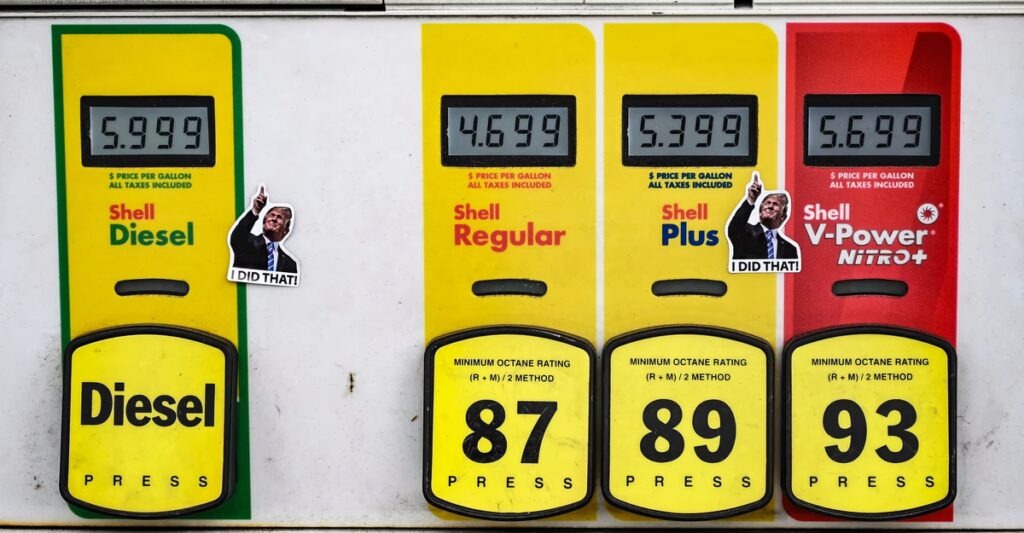
Traders are already responding—Brent crude, the global benchmark for oil futures, fell almost 7 percent after Trump’s social-media post this past weekend and jumped back up about 4 percent after news of the strikes broke on Monday evening. But prices are still far from normal. Brent crude is trading at about $95 a barrel, up $25 since the start of the war, and the average price of gas in the U.S. is nearly $4.50 a gallon. Robin Brooks, a senior fellow at the Brookings Institution, told me that should a “credible peace deal” come through today and oil prices decline, he’d expect that to affect gas prices within two to three weeks. The sheer number of variables here has led different experts to come up with very different guesses about what might happen to the oil market once the war ends. One CNN analyst recently suggested that gas won’t return to the prewar national average of $3 a gallon until 2032.
The war is now approaching its fourth month; even Trump is tired of it. But because neither side’s representations have exactly proved credible, seafarers may not know how to proceed if and when a deal is announced. Whatever they decide, they’ll be moving carefully—and slowly.
Related:
Here are four new stories from The Atlantic:
- The pope grasps the limits of AI.
- A frustrated president can’t get the deal done.
- John Cornyn lost with his boots off, Jonathan Chait writes.
- Read these books by the time you graduate.
Today’s News
- President Trump said that Iran would not be able to “outwait” him in negotiations to end the war, dismissing concerns about the political impact of the war ahead of the midterms. “I don’t care about the midterms,” he said during today’s Cabinet meeting.
- Texas Attorney General Ken Paxton defeated Senator John Cornyn in a Republican-primary runoff last night, marking another victory for Trump, who endorsed Paxton last week.
- Former President Biden sued the Justice Department to block the release of roughly 70 hours of audio recordings tied to former Special Counsel Robert Hur’s classified-documents investigation, arguing that making them public would be unlawful. The recordings, made during conversations Biden had with the author of his memoir, became the subject of a Freedom of Information Act request from the Heritage Foundation.
Evening Read

America Is Missing Out on the Ultimate Mosquito Weapon
By Ross Andersen
The announcement of the new “air defense” system was issued from Changzhou. A company called Photon Matrix Lab claimed to have developed a new technology for identifying and eliminating deadly threats mid-flight. A video on Indiegogo showed potential buyers how it works: After detecting a mosquito, the device fires off what looks like a blue-violet lightning bolt. When struck, the insect does not just fall straight down, no—it is more satisfying than that: Its body somersaults and tumbles out of the frame, bringing its career of vampiric air raids to a sudden end …
The bugs seem to have a primal knowledge of my whereabouts, and a craving for my blood that goes beyond mere thirst. In a span of minutes, they will perforate my skin 10 times with the dirty needles that protrude from their faces, and each micropuncture will swell up into an insomnia-inducing welt the size of a silver dollar.
We are a secret society, those of us who attract this torment. When we meet one another at a barbecue, we bond over our shared longing for the mosquito’s extinction. On behalf of my fellow victims, I decided to look into this new laser to see whether it might really deliver us from misery. I reached out to Photon Matrix Lab to arrange a call.
More From The Atlantic
- Why Iran’s leaders think they’ve won
- The largest undocumented disparity in maternal health
- The pope doubles down on the beautiful struggle.
- The gas-tax reckoning
- The David Frum Show: Has Trump corrupted the military?
- Alexandra Petri: Does Donald Trump know men are also allowed to leave his Cabinet?
Culture Break

Explore. A new class of toys has a very susceptible target audience: the parent with lots and lots of screen-time guilt, Ellen Cushing writes.
Reminisce. The tenor saxophonist Sonny Rollins, who died this week, was the embodiment of jazz itself, David A. Graham writes.
Explore all of our newsletters here.
Rafaela Jinich contributed to this newsletter.
When you buy a book using a link in this newsletter, we receive a commission. Thank you for supporting The Atlantic.
The post The Lag Between an Iran Deal and Lower Oil Prices appeared first on The Atlantic.