For a decade, Donald Trump’s rallies were intertwined with his political identity. His big crowds were how he first got the media and the Republican Party to take him seriously, and they provided real-time feedback. Those who followed him closely could watch his positions take shape from one rally to the next—an offhand comment that got a strong reaction would become a talking point at the next rally, and then a core part of his pitch. And he took notice when the crowd got bored, pivoting to the lines that would fire them back up.
Although Trump hated being on the road, the travel took him out of the Manhattan skyscraper emblazoned with his name in gold and into many struggling, disgruntled communities. Before and after rallies, he would meet with local officials, law-enforcement officers, and activists, as well as supporters who’d paid to get a photo with the candidate. Sometimes he visited local businesses or ordered takeout. The people Trump met clued him in to the issues his supporters cared about, and in a few cases, they became part of new stories he told (some so confounding—with cries of “sir” and tears allegedly running down faces—that his critics questioned if these people even existed).
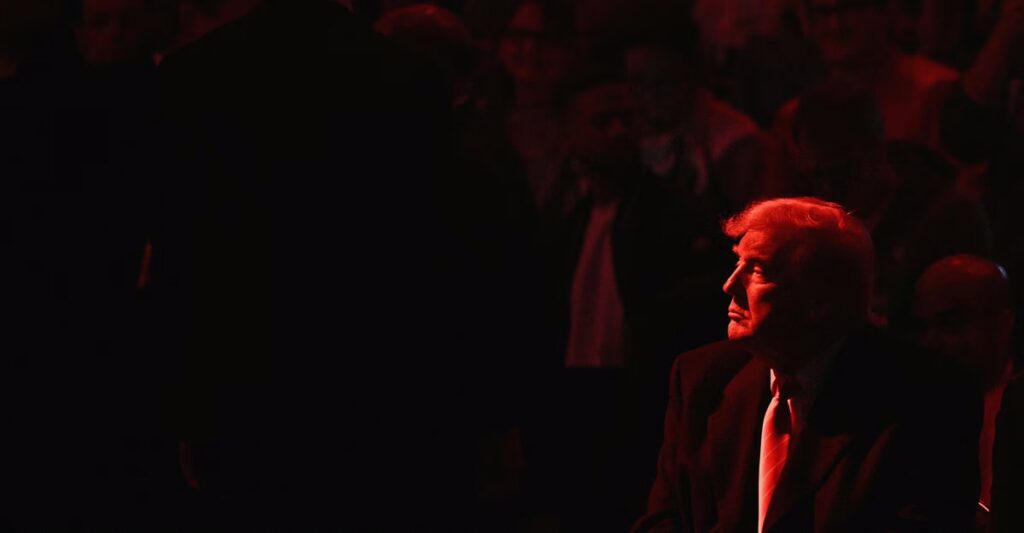
But it has been many months since Trump hosted a full-on campaign-style rally. He has opted instead to travel abroad, golf at his private clubs, and dine with wealthy friends, business leaders, and major donors. Beyond the rallies, Trump has dramatically scaled back speeches, public events, and domestic travel compared with the first year of his initial term. And that lack of regular voter contact has contributed to a growing fear among Republicans and White House allies: that Trump is too isolated, and has become out of touch with what the public wants from its president.
Every president, of course, deals with being in a bubble, distanced by the demands on his time and the extraordinary security concerns that come with the office. But in his return to the presidency this year, Trump has seldom ventured across the country to anywhere other than his own clubs. He also inhabits something of a news silo, watching far-right cable channels such as One America News and Newsmax along with Fox News. Even his social-media consumption has become narrower: Instead of being on the app formerly known as Twitter, where he’d occasionally encounter contrary views, he now posts solely on Truth Social, which he owns and where he is surrounded by sycophants. And his own White House staff, this time largely populated by true believers and yes-men (and a few yes-women), only adds to the echo chamber.
[Read: ‘I run the country and the world’]
Everyone around Trump, and everything he is seeing on TV and on his phone, is telling him that he’s right. But poll after poll suggests that Americans believe Trump is now getting it wrong and has lost focus on what got him elected.
“People voted for him to lower prices, to bring manufacturing back, to stand up to those taking advantage of them,” a close Trump ally told me on the condition of anonymity so as not to antagonize the president. “They didn’t vote for him to build a damn gilded ballroom. He’s not hearing them.”
He’s not hearing them, perhaps, because he’s not seeing them. I looked at Trump’s travel schedule from the fall of 2017, the first year of his initial term, to compare it with this fall’s, and I was surprised by the drop-off. Back then, he traveled into the country more than a dozen times from September to November to talk with energy workers in North Dakota, rally support in Alabama for a Senate candidate, and explain his agenda directly to his supporters. During that same stretch this year, he barely traveled at all. This fall, he’s ventured beyond the Washington, D.C., metro area; his New Jersey golf club; and Florida, the home of Mar-a-Lago, only five times. Four of those domestic trips were to New York, including three to hang out with rich friends in luxury boxes at sporting events. The other was to attend United Nations meetings, but he stayed only one night, compared with five in 2017. The fifth trip was to Arizona, to attend Charlie Kirk’s memorial service.
Even the one realm where Trump expanded his travel took him away from Americans; this fall, he made three international trips, as opposed to just one eight autumns ago. Some of his most loyal MAGA supporters, such as Laura Loomer and Steven Bannon, urged him to curb the globe-trotting and instead focus on issues at home. Marjorie Taylor Greene said she “would like to see Air Force One parked and staying at home” (she later renounced her support of Trump and announced her resignation from Congress). Trump’s lack of travel across the United States, some allies fear, has knocked his political antenna askew.
There had been tentative plans this summer to get Trump back out on the road. Republicans had just passed the One Big Beautiful Bill Act, but polls showed that a majority of Americans didn’t like how it favored the ultrarich. White House aides hoped to have Trump tour the country to emphasize that the bill’s tax cuts and deregulation would benefit his supporters. But it never happened, because Trump got distracted. He turned his attention overseas and, desperate for a Nobel Peace Prize, scheduled a summit in Alaska with Russia’s Vladimir Putin, while pushing for a cease-fire in Gaza. And, just weeks after Trump presided over the tax legislation’s July 4 signing ceremony, his White House was consumed by the return of the Jeffrey Epstein scandal. The last thing Trump wanted was to face members of his base who might have questions about his ties to the disgraced pedophile.
As summer turned to fall, Republicans wondered if Trump would show up in New Jersey or Virginia to campaign for candidates for governor, and tell his supporters to vote in the year’s most closely watched bellwether races. Instead the president attended only a pair of virtual rallies for the candidates—the exact sort of low-energy move for which Trump used to mock Joe Biden—which drove far less media coverage than a Trump arena rally would have and were less likely to motivate those who weren’t already planning to vote.
After both Republican candidates lost, a number of GOP leaders urged the president publicly and privately to reconnect with his supporters. They have quietly complained to one another—and at times to West Wing officials—that, in the past two months, Trump has squared his attention on a (faltering) retribution campaign against political foes; a potential war with Venezuela; masked ICE raids that have terrorized immigrant communities; and the demolishing of the White House’s East Wing to construct an opulent ballroom to better entertain wealthy donors. None of those issues, Republicans said, was high on voters’ minds.
But the weeks since have brought little sign that Trump has changed his focus. Although his administration has hosted a couple of White House events meant to demonstrate that Trump is intent on lowering prices, the president himself has shown little willingness to acknowledge the problem, instead calling the affordability crisis a “hoax” and a “con job.” That worries Republicans, who are well aware that Democrats feel that the issue could be their path back to power in next year’s midterm elections.
The Republicans want Trump, even with low poll numbers, back on the road in 2026 to persuade the voters who tend to turn out only for him to support other Republicans. (The GOP took heavy losses in Trump’s first midterms, in 2018.) Trump is deeply concerned about the midterms; he knows that if the Democrats capture a house of Congress, they would be armed with the power of the subpoena and would paralyze his administration with investigations. But the role he will play in next year’s campaigns remains unknown.
White House Press Secretary Karoline Leavitt told me that even when Trump has traveled overseas, his “focus has been on securing deals for Americans back home.” And she added that he plans to “be out there actively campaigning for Republican candidates ahead of their victories in the midterms next fall.”
Since 2015, Trump says he has held more than 900 rallies, making them the signature events of this era of American politics. He even kept doing them at the height of the pandemic, in 2020, and in the aftermath of last July’s assassination attempt at a rally in Butler, Pennsylvania. His last campaign rally was held in Grand Rapids, Michigan, in the early-morning hours of Election Day. There, Trump turned to a few close aides and said, with a mixture of sadness and relief, that he thought it would be his final one, a person who heard the remarks told me. A few months later, in April, Trump hosted a smaller rally-like event, also in Michigan, to celebrate 100 days in office. But the bombastic rallies he is known for have come to a halt.
It’s not the only way he has isolated himself. This term, there are very few voices inside the White House to tell him no or get him back on track. And that’s by design. At the start of his first term, Trump filled his team with a mix of veterans of past Republican administrations and figures from the GOP establishment, who moderated some of his more extreme impulses. But Trump chafed at those roadblocks. In 2025, he has surrounded himself with enablers—not figures such as John Kelly, Rex Tillerson, and James Mattis. Trump trusts his own instincts and points to his historic reelection as proof that he provides his own best counsel. His chief of staff, Susie Wiles, has made clear that she doesn’t see her role as constraining the president. Moreover, there isn’t a Republican leader on the other end of Pennsylvania Avenue to play the role of Mitch McConnell and check Trump’s power.
And although Trump still calls his old friends back in New York, he does it less frequently than during his first term, someone familiar with the calls told me, depriving the president of candid feedback from people who have known him for decades and may not agree with him on every issue. Instead, his focus has been on the business titans and billionaires with whom he has frequently dined at the White House and at Mar-a-Lago, who want something from him and tell him what he wants to hear.
Trump remains in the MAGA echo chamber even when he’s alone in the White House residence or the private dining room off the Oval Office. Yes, he occasionally checks MSNOW or CNN, but his TVs are almost always tuned to Fox News, OAN, and Newsmax, which practically never run negative stories about the president. (Fox did not even carry the recent news conference featuring Epstein victims.) Same with his phone: Truth Social provides a stream of praise from adoring disciples, as well as AI slop and other provocative posts that play to the president’s basest political instincts.
Not even two weeks ago, Trump amplified a post that read “HANG THEM GEORGE WASHINGTON WOULD !!” as he pushed for sedition charges to be filed against six Democratic lawmakers who’d created a video urging members of the military to ignore unlawful orders. A few moments later, Trump posted his own call for the lawmakers’ execution. Once more, Republicans’ hopes that Trump would focus on the issues voters care about went unheeded.
Marie-Rose Sheinerman contributed to this report.
The post Trump Has Never Been More Isolated appeared first on The Atlantic.