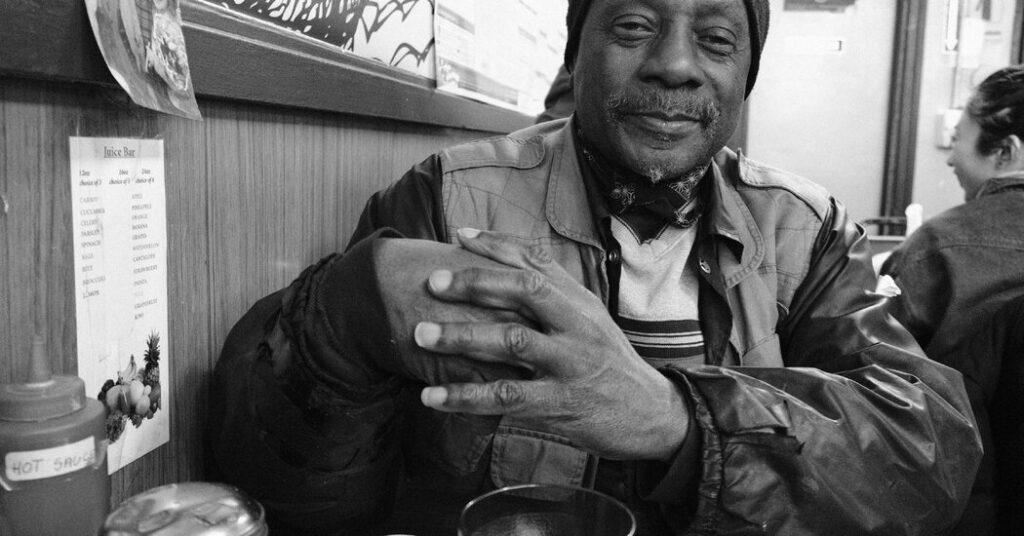
David Henderson, a poet who rose to prominence with the pathbreaking Black Arts Movement in the 1960s and went on to write a best-selling biography of Jimi Hendrix that changed the way many interpreted Hendrix’s life, music and untimely end, died on May 14 in Lincoln Park, N.J. He was 83.
His death, at a nursing home, was caused by complications of dementia, his daughter, Najuma Henderson, said.
In 1962, the Harlem-born Mr. Henderson was a central figure in the founding of the Society of Umbra, a pioneering Black literary collective based in the East Village section of Manhattan. Like Calvin Hernton, Tom Dent, Lorenzo Thomas, Askia Touré, Steve Cannon and others associated with the group, he sought to forge a new, distinctly Black aesthetic sensibility, unmoored from white Western artistic ideals.
“We were shut out of the discourse,” Mr. Henderson recalled of the era in a 2009 interview with Africultures, a French news and culture website. “That exclusion is what Richard Wright, Ralph Ellison, Langston Hughes, Gwendolyn Brooks, Robert Hayden, James Baldwin, were fighting.”
Umbra became a foundation for the broader Black Arts Movement, which emerged in the mid-1960s, spearheaded by fiery writers like LeRoi Jones (later Amiri Baraka), Lawrence Neal and Mr. Touré, and which also included figures from the visual arts, theater, dance and music.
“We were the revolutionaries,” Ishmael Reed, the celebrated poet, playwright and provocateur, said in an interview. No longer, Mr. Reed added, did Black writers find it necessary to follow the narrative conventions of an Ernest Hemingway or Henry James.
“We broke with that,” he said. “We went to folklore, and to the street.”
Mr. Henderson’s “experiential montages,” as Kirkus Reviews described his work, channeled both the hope and rage of the civil rights era, drawing from Black oral traditions and the rhythms of rock ’n’ roll, Motown and jazz.
As he wrote in the title poem of his 1970 collection “De Mayor of Harlem”:
silent natives screaming thru western guns swords axes tall tenor saxophones blaring black trumpet pages of swords.
Mr. Henderson was born on Sept. 19, 1942, the elder of two sons of Raymond Henderson, a chief petty officer in the Coast Guard, and Myrtle (Brown) Henderson, a telephone operator.
As a teenager, he left home and moved downtown to the East Village to pursue poetry. “This was the early 1960s,” Mr. Henderson later recalled. “Change was happening before our eyes, but I’m not certain I saw it.”
He began mingling with New York’s Black creative scene, including jazz artists like the saxophonist Archie Shepp, the pianist Cecil Taylor and the surrealist band leader Sun Ra, with whom he would later collaborate.
In the early 1970s, he was hired to teach at the University of California, Berkeley, the first of several academic positions he held over the years. With him was his wife, Barbara T. Christian, who went on to become a professor of African American studies at Berkeley and a prominent authority on contemporary American literary feminism.
His marriage to Ms. Christian ended in divorce in 2000, after a 20-year separation. In addition to his daughter, with Ms. Christian, Mr. Henderson is survived by a son, Imetai Henderson, from another relationship, and four grandchildren.
Soon after arriving in California, Mr. Henderson embarked on a five-year journey to complete a book on Hendrix, who died in London on Sept. 18, 1970, at 27.
Mr. Henderson was far from a music journalist, but had written about a 1968 Hendrix concert for the rock magazine Crawdaddy.
“I had gotten to know Hendrix a little bit in the clubs in Manhattan, hanging out,” Mr. Henderson once recalled in a video interview, “and I told him I was going to write something about him.”
His friendship with Hendrix helped open doors, spurring many who had been close to the guitar legend to open up, including his father, Al Hendrix. Mr. Henderson also gained access to Hendrix’s personal diaries, private correspondence and home recordings.
“Jimi Hendrix: Voodoo Child of the Aquarian Age” was published in 1978. (It was later expanded and retitled “’Scuse Me While I Kiss the Sky: Jimi Hendrix: Voodoo Child.”)
The first major biography of Hendrix, the book was, according to the rock writer Greil Marcus, “surely the most serious attempt yet to make sense of the life of a Sixties icon.”
Mr. Reed once described it as “part thriller and part lament for some tragic lives who enlivened an exciting decade.”
The book stood out among rock biographies for its New Journalism-style narrative approach, which included flowery poetic passages and — to the chagrin of some critics — recreated inner monologues and other devices reminiscent of fiction.
Most striking, however, were its conclusions about Hendrix’s death. The book fiercely disputed the widely accepted account, first advanced by his girlfriend Monika Dannemann and later repeated in biographies, like Charles R. Cross’s acclaimed “Room Full of Mirrors” (2005), that Hendrix had taken a large number of powerful sleeping pills at her hotel and choked on his own vomit.
“As a result,” Mr. Henderson wrote, “millions of people all over the world thought that Hendrix had died the typical rock star death: drug overdose amid fame, blondes, opulence, sex.”
Based on unearthed legal documents, along with interviews with hospital and ambulance attendants and others present during those final days, Mr. Henderson concluded that Hendrix “did not die of a drug overdose. He was drowned.”
The updated version of the book posited that Hendrix had been suffocated with an “impossible” amount of red wine — to the point that it was matted on his clothes and hair and flowing out of his nose and mouth, even after his death, despite his relatively low blood-alcohol content.
And, Mr. Henderson wrote, various shadowy forces had motives to harm Hendrix, including organized crime and federal agencies seeking to do damage to the far-left counterculture.
To fans, particularly white ones, Hendrix was long seen as a towering figure of the psychedelic era who, with his ur-hippie persona and starring role at Woodstock, transcended race.
That was false, Mr. Henderson argued. To him, Hendrix was a distinctly Black artist whose music was deeply grounded in the blues and honed on the Southern chitlin circuit, a network of venues that catered to Black performers in segregated cities.
Far from being colorblind, as many white rock writers portrayed him, Hendrix came to embrace Black power every bit as much as flower power — to the point that his growing support for the Black Panthers had put him in the cross hairs of the Federal Bureau of Investigation.
“Jimi Hendrix was a classic Black ghetto ‘smoothie,’” Mr. Henderson wrote, “whose genius was electric guitar. He achieved an unmatched virtuoso style and became a musician’s musician, a player’s player, and a priest of the new age in Afro-American ceremonial music.”
Alex Williams is a Times reporter on the Obituaries desk.
The post David Henderson, Innovative Poet and Hendrix Biographer, Dies at 83 appeared first on New York Times.