When is a cease-fire no longer a cease-fire? This week, American warplanes launched a new round of strikes in Iran, prompting Iran to swiftly threaten counterattacks — and yet, as of yesterday, both sides say that negotiations are still ongoing and the cease-fire is holding.
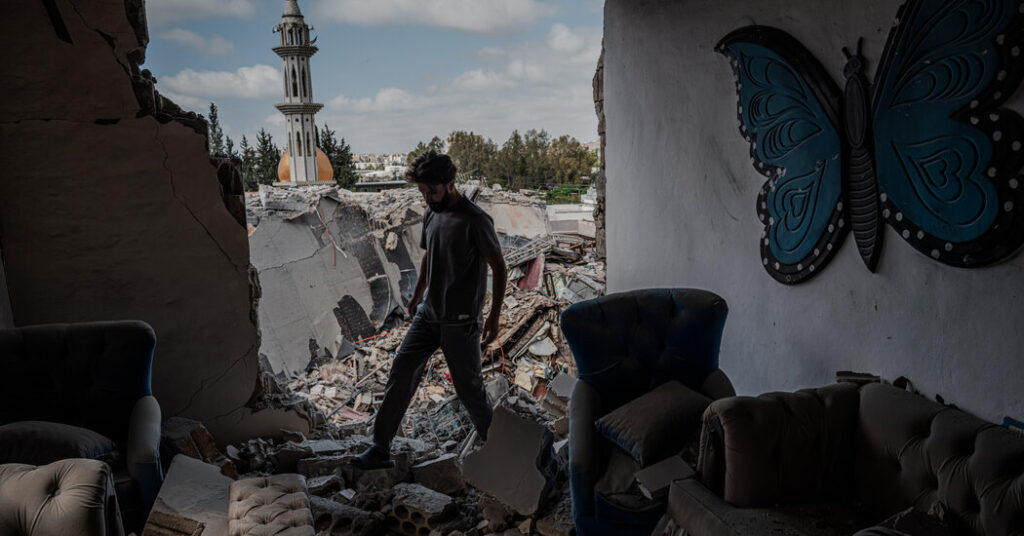
There’s a cease-fire in Lebanon, too, in theory, but Israel has just significantly intensified its campaign against Hezbollah. There’s a cease-fire in Gaza — but hundreds of Palestinians have been killed since it began in October.
It’s remarkable how much firing a cease-fire can take without crossing the threshold from “fragile” into “broken.” Today I write about why.
Why a cease-fire can look a lot like war
This week marked the second time that the United States and Iran exchanged serious fire since they agreed to a cease-fire seven weeks ago.
The first time, in early May, was during a short-lived effort by the U.S. Navy to guide stranded ships through the Strait of Hormuz. Who acted first is in dispute — the U.S. said that Iran had launched missiles and drones on three U.S. warships transiting the strait, and toward its Gulf neighbors, while Iran said that U.S. forces had struck Iranian ships and targets along the Iranian coast.
This time, the U.S. struck targets in southern Iran and sank two Iranian speedboats it said were trying to place mines in the strait. Iran said it had downed an American drone, which the U.S. denied.
For a time, it wasn’t clear where things were going to go. But so far, the two parties seem to still be occupying that strange middle ground of not quite peace, not quite war.
The term “cease-fire” has been stretched to encompass a wide range of situations these days — the ongoing strikes in Gaza, the barely-short-of-all-out war in Lebanon, the skirmishes in Iran. (Ukraine and Russia agreed to a three-day cease-fire recently, during which the fighting at the front lines effectively never stopped at all.)
Taken together, what all these highlight is that a “cease-fire” has very little to do with whether the guns have actually gone silent. A cease-fire is a cease-fire as long as the various parties involved in a war say that it is — no matter how much fire gets exchanged, or how many people are killed as a result.
Sending a message
The term seems straightforward. It’s a cease-fire. The firing that once constituted a war? That’s ceased. Right?
In reality, that’s almost never the case. I spoke to Laurie Nathan, a professor at Notre Dame who has been a U.N. senior mediation adviser and a mediator in cease-fire negotiations. He told me that cease-fires were pretty much always violated.
“A cease-fire is assumed to be a complete absence of hostilities by lay people,” Nathan said. “But that’s not the reality in just about any conflict I can think of.”
Cease-fires are violated for a variety of reasons, he said. Sometimes it’s accidental — a lower level commander who didn’t get the memo, for example. Sometimes it’s deliberate — a leader who wants to send a message of strength, either to the enemy or to hard-liners in their own camp.
The question of whether a cease-fire is in place sounds like a technical, or a military one, but ultimately it’s political, said Govinda Clayton, who has spent more than a decade studying cease-fires and advising parties in cease-fire negotiations. In other words, the durability of a cease-fire — and the reality of what that cease-fire actually looks like — comes down to what the various parties believe will get them closer to their objectives.
We can see this playing out in different ways in Iran, Lebanon and Gaza.
Despite exchanging fire, Iran and the U.S. are still in a cease-fire because they both want to be. A resumption of full-scale war would be extremely costly for both, Nathan said. And so the cease-fire violations should be seen as part of the negotiation process, not a will to escalate.
In Lebanon, where, as my colleague Euan Ward recently put it, the “cease-fire exists mostly on paper,” the situation is different. Prime Minister Benjamin Netanyahu of Israel reluctantly agreed to a cease-fire only under pressure from President Trump, my colleagues say, and probably wouldn’t regret its collapse.
Israel ramped up its offensive against Hezbollah this week, launching hundreds of airstrikes across Lebanon and issuing sweeping evacuation orders for major cities in the country’s south. The campaign might well strain the cease-fire to the breaking point.
The dynamic in Gaza is similar in one sense. Israel was pushed into a cease-fire it didn’t particularly want. The result is an agreement that is “weak by design,” Nathan said, one under which Israel retains a lot of scope to act.
Life in the gray zone
My colleague Linda Kinstler wrote last year about the rise in cease-fires that stop short of full peace agreements. They’re a reflection of a pessimistic age, she writes. In place of attempts at difficult political compromise, these agreements instead promise the bare minimum — a stop to the killing, and an absence of violence. The problem is that without the compromises, sometimes you don’t even get that.
What those actually living through these conflicts-on-pause are left with is a sense of being in a gray zone. As our Jerusalem bureau chief, David Halbfinger, put it in our sister newsletter The Morning this month, “In Israel and Gaza, it’s hard to talk about cease-fires with a straight face, or at least without an ironic tone.” The worst of the fighting has stopped — but many live with the fear that could change any time. “I’m sure everyone prefers this to whatever a war would be by comparison,” he said. “But it ain’t peace, either.”
The latest: Iranian state TV released a 14-point draft deal to end the war, which the White House dismissed as a “complete fabrication.” According to the reported draft, Iran would reopen the Strait of Hormuz in return for the U.S. lifting its naval blockade.
OTHER NEWS
-
Uganda closed its border with the Democratic Republic of Congo after seven Ebola cases were confirmed in the capital, Kampala.
-
Russia is stepping up attacks on Kyiv, Ukraine’s capital, as its forces on the front lines appear to have stalled.
-
Divers found five people alive who had been trapped in a flooded Laos cave for a week, but a treacherous rescue remains.
-
A Trump-backed Republican beat a four-term senator in a primary runoff in Texas, which could change the landscape of the midterm elections.
-
Albert Manifold, the ousted chair of BP, vowed to fight the company’s “false narrative” that he had been dismissed for “governance oversight and conduct issues.”
-
Secretary of State Marco Rubio visited India this week to reassure the country of its importance to the U.S. Analysts don’t think it helped much.
WHAT ELSE IS HAPPENING
-
Matthew Perry’s personal assistant, who injected the actor with the ketamine that killed him, was sentenced to more than three years in prison.
TOP OF THE WORLD
The most clicked link in your newsletter yesterday was about Iceland weighing whether to join the E.U.
SPORTS
World Cup: FIFA confirmed that the Iranian national team officially moved its training camp from the U.S. to Mexico.
Tennis: Novak Djokovic defeated Valentin Royer in four grueling sets at the French Open. Follow our Day 4 updates.
NUMBER OF THE DAY
2.4 trillion
This is the number of cigarettes sold each year in China, accounting for half the global total by one estimate. China’s cigarette consumption rose by nearly 40 percent from 2003 to 2023, even as it fell 26 percent in the rest of the world.
MORNING READ
Three years ago, riots tore apart Manipur, a remote state in eastern India. Hundreds were killed in ethnic clashes. Paramilitary troops suppressed the fighting by dividing the state into jagged sections.
Our reporters recently visited the region and found broad no-go zones between barbed-wire fences. They met people who felt their lives had been ruined by unrelenting division. Read more about what our team saw.
AROUND THE WORLD
His cheesecake will go on
Nearly 40 years ago in San Sebastián, the Basque Country foodie paradise in northern Spain, the chef Santiago Rivera was tinkering with a recipe for New York-style cheesecake. He stripped off the bottom crust and cooked it at higher heat to save time and counter space. The result was a blockbuster dessert: the burnt Basque cheesecake.
Despite having no local roots, it became one of the region’s culinary calling cards. It has also inspired imitators as far away as Turkey, Malaysia and Australia. (Rivera, who never kept his recipe a secret, considers modern riffs with flavorings and toppings to be abominations.)
Next week, he plans to retire and hand his dessert empire over to his two children. Read more about how his cake unexpectedly conquered the world.
RECOMMENDATIONS
Groove: This playlist features something old (from the Rolling Stones), something new (from Olivia Rodrigo) and more.
Test yourself: Can you match the places where these authors lived with the settings in their books? Take our quiz.
Cope: Is it normal to drool in your sleep? Experts explain why it happens.
Bike: A river boat serves as the base for this cycling trip through Dutch tulip country.
WHERE IS THIS?
Where is this temple?
TIME TO PLAY
Here are today’s Spelling Bee, Mini Crossword, Wordle and Sudoku. Find all our games here.
That’s it for today. See you tomorrow! — Katrin
We welcome your feedback. Send us your suggestions at [email protected].
Katrin Bennhold is the host of The World, the flagship global newsletter of The New York Times.
The post Cease-Fires, but No Peace appeared first on New York Times.