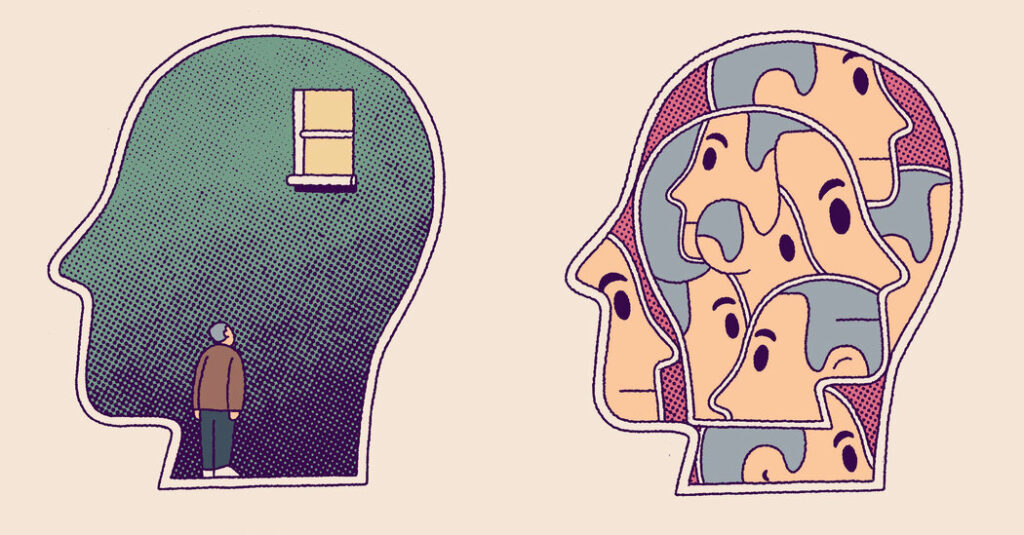
Alzheimer’s disease is the most commonly diagnosed form of dementia, but it’s far from the only one. In fact, most people who have dementia (including Alzheimer’s) show signs of several different types of neurodegenerative disease in their brains.
That can include the amyloid plaques and tau tangles that are hallmarks of Alzheimer’s; damage to the brain’s blood vessels, which is indicative of vascular dementia; and clumps of assorted other toxic proteins that cause Lewy body dementia, frontotemporal dementia and LATE.
“If you look at the old people with dementia, what do they have? Well, they have a little bit of everything,” said Dr. Costantino Iadecola, a professor of neurology at Weill Cornell Medicine.
A person’s diagnosis largely depends on their main symptoms and what neurologists can see in their brain. While there aren’t treatments yet to stop or reverse the progression of any form of dementia, experts say that getting an accurate diagnosis is important to help manage symptoms and know what to expect as the disease progresses.
Here’s an explainer on the other primary types, including how they affect the brain and their symptoms.
Vascular Dementia
Vascular dementia is the second most common kind of dementia. It can arise after a stroke, either one large one or several smaller ones, but more typically stems from long-term wear and tear on the brain’s smaller blood vessels. Damage often occurs to the brain’s white matter — the insulated nerve fibers that carry signals from one neuron to the next. Those fibers are the last stop for the smaller blood vessels, so if blood flow is occluded, it’s the white matter that suffers first.
When blood flow to the brain is disrupted, the brain cells are deprived of oxygen and nutrients, said Silvia Fossati, a professor of neural sciences at Temple University’s Lewis Katz School of Medicine.
One of the most common symptoms of vascular dementia is general cognitive and physical slowing. This likely occurs because the signals in the brain aren’t moving as efficiently through the impaired white matter, Dr. Iadecola said. Other symptoms may include difficulty with decision making, problem solving and task execution.
Poor cardiovascular health, particularly high blood pressure, is the biggest risk factor. In fact, an important clue that someone has vascular dementia is a history of heart attack, stroke or high blood pressure. An M.R.I. can help confirm the diagnosis by revealing the white matter damage.
As with any type of neurodegenerative disease, once brain cells are damaged, the symptoms are largely irreversible. But vascular dementia is more preventable than other forms of dementia.
“Let’s try to keep the blood vessels healthy,” Dr. Iadecola said. “That’s the best thing we can do right now. We know how to do that better than we know how to fight neurodegeneration.”
Lewy Body Dementia
This type can cause a constellation of symptoms involving the whole body. That’s because it’s “not just something that affects the brain, it affects the nervous system in the periphery as well,” said Dr. Sudha Seshadri, the founding director of the Glenn Biggs Institute for Alzheimer’s and Neurodegenerative Diseases at the University of Texas Health Science Center at San Antonio.
Some people experience classic cognitive impairment, like problems with executive functioning, though memory loss is less common. Others have visual-spatial difficulties; for example, struggling to locate items in a pantry or judge distances. People may also have striking visual hallucinations.
Physical issues can include constipation, difficulty urinating, lightheadedness when standing up and, in men, erectile dysfunction. Parkinson’s disease symptoms can also occur, such as tremor, muscle rigidity and difficulty with balance.
The overlap with Parkinson’s makes sense because the two conditions are caused by the same dysfunctional protein, alpha-synuclein. The protein clumps into so-called “Lewy bodies” inside neurons, damaging and ultimately killing the cells. A person’s symptoms depend on which areas of the brain are affected first and how the toxic proteins spread.
Doctors tend to rely on a person’s symptoms to make a diagnosis, but that can be difficult because “they’re so different in different patients, and are not always easy to recognize,” said Dr. David Irwin, an associate professor of neurology at Penn Medicine. As a result, Lewy body dementia is thought to be underdiagnosed.
Frontotemporal Dementia
This type of dementia is rarer than the other forms, and it tends to emerge earlier in life, with people typically first experiencing symptoms in their 40s, 50s or 60s.
The brain’s frontal lobe, as the name suggests, is one of the areas most affected. Cognitive symptoms often include difficulty with executive functioning, planning or organizing. Those problems may become apparent if someone has trouble managing their finances or planning a trip, Dr. Irwin said.
Dramatic personality changes can also occur. Some people become uninhibited and impulsive; they may approach strangers or make rude or inappropriate comments. People can also become apathetic and unmotivated, or emotionally cold and distant.
As a result, frontotemporal dementia, or FTD, is often initially misdiagnosed as a psychiatric condition, said Dr. Winston Chiong, a professor of neurology at the University of California, San Francisco. A lot of the core symptoms “get attributed to depression or mood or addiction or life events that cause people to behave differently,” he said.
Some people with FTD also experience primary progressive aphasia, or difficulty with speaking and comprehending language.
In the brain, there are two main proteins that become dysfunctional and are associated with FTD. One is TDP-43, which is also involved in LATE and amyotrophic lateral sclerosis, or A.L.S. The other is tau, but different forms of tau than the one implicated in Alzheimer’s.
LATE
LATE, or limbic-predominant age-related TDP-43 encephalopathy, is a relatively new dementia diagnosis. It first came to light roughly 20 years ago, after scientists observed that many people who died with Alzheimer’s symptoms had toxic clusters of the protein TDP-43 in their brains (sometimes in lieu of amyloid and tau, and sometimes in addition to them).
As the acronym suggests, LATE is most common in the later decades. Dr. Peter Nelson, a professor of pathology at the University of Kentucky College of Medicine, said that roughly a third of people in their 80s and 90s have signs of the disease in their brains.
As with Alzheimer’s, the part of the brain most affected is the hippocampus, and memory loss is the most common symptom. On its own, LATE progresses slowly and “is relatively benign,” Dr. Nelson said. But people often have both LATE and Alzheimer’s concurrently, which results in “a more swift and severe clinical course,” including anxiety, depression, hallucinations and delusions.
There isn’t a blood test for TDP-43, so doctors can only make a diagnosis based on a person’s symptoms and by ruling out other forms of dementia. The disease is most commonly discovered during an autopsy. The first clinical trial for a treatment for LATE is currently underway.
Dana G. Smith is a Times reporter covering personal health, particularly aging and brain health.
The post Dementia Comes in Many Forms. Alzheimer’s Is Just One. appeared first on New York Times.