“You were the voice of my childhood” is a phrase that actor Larry Brantley hears often when meeting fans at pop culture conventions.
“I take it very seriously, because that statement alone tells you what an impact a show you did at the beginning of your career still has on people today,” he says earnestly during a recent interview.
His voice performance that marked a generation was as the titular canine in “Wishbone,” an ambitious PBS show that debuted in the fall of 1995.
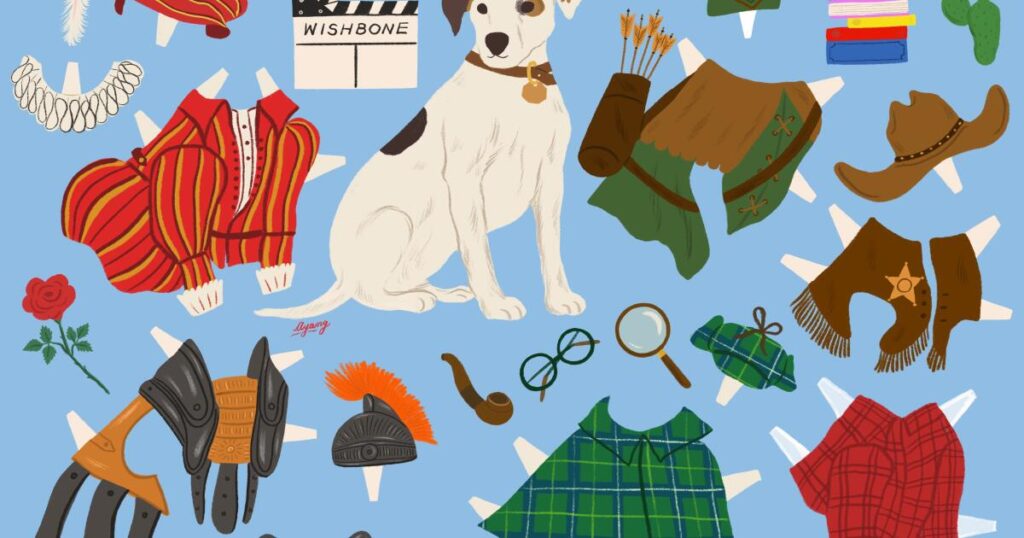
Brantley performed the humorous inner monologue of an impossibly charming Jack Russell terrier who imagines himself the hero in some of the most timeless tales of classic literature, from “Romeo and Juliet” and “Oliver Twist” to “Don Quixote” and “Frankenstein.”
The goal for “Wishbone” was to make these stories accessible for children, paying homage to the source material, while aiming to instill young viewers with the interest to pick up the books themselves. Plenty of millennials who are now adults will attest to its success.
“The words I get from people are so sincere and so heartfelt, they’re not just fanboying or fangirling,” Brantley adds. “They really want to talk to me about the impact that show made on them as kids, turning them into lifelong readers. They’re trying to pass that on to their kids now.”
Those who remember Wishbone and his many adventures can now dive into the incredible behind-the-scenes feat that producing the show entailed in the new comprehensive documentary “What’s the Story, Wishbone?” from director Joey Stewart.
The film will air on public television stations beginning Wednesday through June 9, with PBS SoCal airing it on June 8 and 9, and it will be available on digital platforms June 10.
For Stewart, who worked as first assistant director on “Wishbone,” the show never truly went away. No matter where his career has taken him in the years since (including “Walker, Texas Ranger”), “Wishbone” is the one project people want to talk to him about.
“When I say ‘Wishbone,’ the eyes get big, and everybody gets excited and it brings back a time in their life that maybe they didn’t remember,” Stewart says over a video call. “And then I’m just peppered with question after question: ‘What was the dog like to work with?’ ‘Oh, you shot it in Dallas. You’re kidding! I thought that was Hollywood.’ That’s been constant my whole career for 30 years.”
About 10 years ago, Stewart and Betty A. Buckley, who was a producer on “Wishbone,” found themselves reminiscing about their time on that show with the unforgettable dog. “We said, ‘That was the best thing we’ve ever done. How could we do this again?’” Stewart recalls.
They explored the idea of trying to resurrect the show for a new generation of viewers, but when that undertaking became too challenging and unviable, they thought about revisiting that precious era of their professional lives via a documentary.
“We realized we’ve been friends with this cast and crew for decades. We still are in contact with them. We know the story behind it. Why don’t we make a documentary? The fans have been asking for it for years. They have questions. That was the inception,” Stewart explains.
Stewart and Buckley pitched the project to studios and production companies, but ultimately opted for maintaining control even if that meant less resources. “I didn’t want anybody else to tell it,” Stewart says. “It should come from us.”
Their limited funds only allowed for a two-day shoot to bank all the interviews. “If some people couldn’t make the day, we couldn’t include them. But we feel like we covered pretty much every aspect,” says Stewart. Notably absent from the doc are the child actors who were a part of the main cast on “Wishbone,” including Jordan Wall, Christie Abbott and Adam Springfield.
Through first-hand accounts and archival material, “What’s the Story, Wishbone?” chronicles how the show’s creator, Rick Duffield, and a band of young artists managed to bring to life numerous time periods under extremely tight turnarounds while filming in a backlot in Allen, Texas. They produced 40 episodes for PBS over the course of a single year.
“Because we were doing it in our own backyard, if you will, we had the luxury to fail, which meant we had the opportunity to do something extraordinary,” says Duffield over the phone. “We didn’t have the constraints of producing something in Los Angeles or New York. We had a strong confidence we could figure this out. And we were given the freedom to do that.”
By the end, in 1998, they had completed a total of 50 episodes and one TV movie, “Wishbone’s Dog Days of the West.” Testament to its accomplished production, “Wishbone” received a Peabody Award as well as four Daytime Emmy Awards.
One of Duffield’s artistic tenets for “Wishbone,” as a believer in quality children’s programming, was that it had to be shot on film and conceived to feel cinematic, rather than as a proscenium three-camera shoot, even if they could only spend five days on each “little movie” (that included building and creating period-appropriate sets and costumes).
“Cinema takes you out of the space of a studio and puts you out in the world where the kids live, in the neighborhood with all their friends, and it feels more present, I think,” says Duffield. “That was a non-starter.”
Duffield, who grew up an only child, has always felt a strong bond with dogs. For “Wishbone,” he thought about following in the footsteps of previous screen canines like Lassie or Benji. “Dogs connect with kids in a way that many animals don’t,” says Duffield. “And it just seemed like the perfect vehicle and like it would be fun for this dog to imagine himself in these stories. The dog was the best part, for me anyway.”
Duffield and Buckley found Soccer, the Jack Russell terrier who played Wishbone, during a trip to Los Angeles when they initially thought they would only get to make five episodes. Dog trainers presented them with multiple candidates, but when Soccer did his signature flip (seen often on the show), Duffield was instantly taken by him and his captivating eyes.
“[Soccer] seemed like he was feeling something. I can’t describe it, but anybody that worked on the show can understand what I’m saying,” says Duffield. “There was something inside that dog that was very connected to human beings, and it was amazing.”
As for Wishbone’s voice, Brantley admits that at the time of his audition, he was the “least experienced voice actor in that room by a country mile.” Inexperience, he thinks, helped him not overthink the assignment. “I wasn’t trying to capture the voice of the dog,” Brantley says. “What I was trying to do was to capture the personality of the dog.”
“Larry had a youthful, maybe childish exuberance in the way he voiced the character, and I wanted the character to connect with kids,” adds Duffield.
During production, Brantley was on set with a microphone and a monitor so that he could see what the camera was shooting. Through a speaker, the actors could hear him as Wishbone and he could hear them back. “That’s how we played scenes together. The ability to do that made everyone step their game up a little bit because now I was acting with other actors, and they were not having to just listen to a script supervisor,” Brantley says.
Brantley also served as part of the casting team when “Wishbone” was being dubbed into other languages. “We would get these cassette tapes from these voice actors in German, Norwegian, Finnish, Korean. And some of them were not trying to emulate my pitch and tone at all. They were creating their own character,” he says.
“The guy who sounded exactly like me or very close to me, was the guy who ended up dubbing ‘Wishbone’ in Korean. That dude was spot on!” Brantley adds.
There were very “hard and fast” rules on set about Soccer, Brantley says. No one could pet him while he was working. Soccer had to remain focused. “Normally between takes you’re joking around, but we really kept that part to a minimum when Soccer was on set,” he says.
To promote “Wishbone,” Brantley and Soccer (and his trainers) went on a tour around the country. People would wait in line for hours just to get a glimpse of the adorable pup, he recalls. That’s when the actor realized the magnitude of the show’s impact.
“The audience’s response to that dog was amazing. When I traveled with him, we were two actors going on the road in support of the show,” says Brantley. “I will say the dog flew first class and I was back in steerage, but that’s fine. I’m not bitter about that at all.”
(Stewart feels bad anytime someone asks about Soccer’s whereabouts. The special pooch died in 2001 at 13. “It was like losing a family member,” Stewart says.)
And while parents appreciated the show’s help in getting children excited about reading, Duffield believes it was teachers and librarians who were the most enthusiastic about “Wishbone.” “They’re the ones I feel best about because they’re in the trenches every day and they’re wanting kids to appreciate the finer things in our culture, in our history,” says Duffield. “We were speaking for every librarian out there.”
Unfortunately, episodes of “Wishbone” aren’t available to stream, though low-resolution uploads of episodes can be found on YouTube, or you can buy used “Wishbone” VHS tapes or DVDs online. Rights to the show changed hands on multiple occasions over the years, says Stewart, and toymaker Mattel currently holds them.
“When I have friends or relatives with kids, I love handing them a flash drive with as many episodes as I’ve been able to acquire over the years and introducing the show to their kids even though the quality’s pretty poor,” says Stewart of his efforts to pass along the gift of “Wishbone.”
No one involved is confident a show like “Wishbone,” with its impressive production value and extreme timeline, could be made in today’s oversaturated television landscape, at least not how they did it back then.
“Maybe it was just a product of its time, but boy, I will tell you straight up, I would cheerfully have retired on that show,” Brantley says. “If they had said, ‘We’re going to do this for another 20 years,’ I ‘d have been on board in a heartbeat.”
Later this summer, Academy Award-winning director Christopher Nolan’s “The Odyssey” will hit theaters worldwide with Matt Damon as Odysseus. But for the record, Wishbone did it first.
“I love Chris Nolan so I’m going to withhold judgment until I see his version,” says Brantley. “But come on, man, a Jack Russell terrier on a raft? Does it get better than that? I don’t know.”
The post ‘What’s the Story, Wishbone?’ tells how a cute dog on TV brought literature to life for kids appeared first on Los Angeles Times.