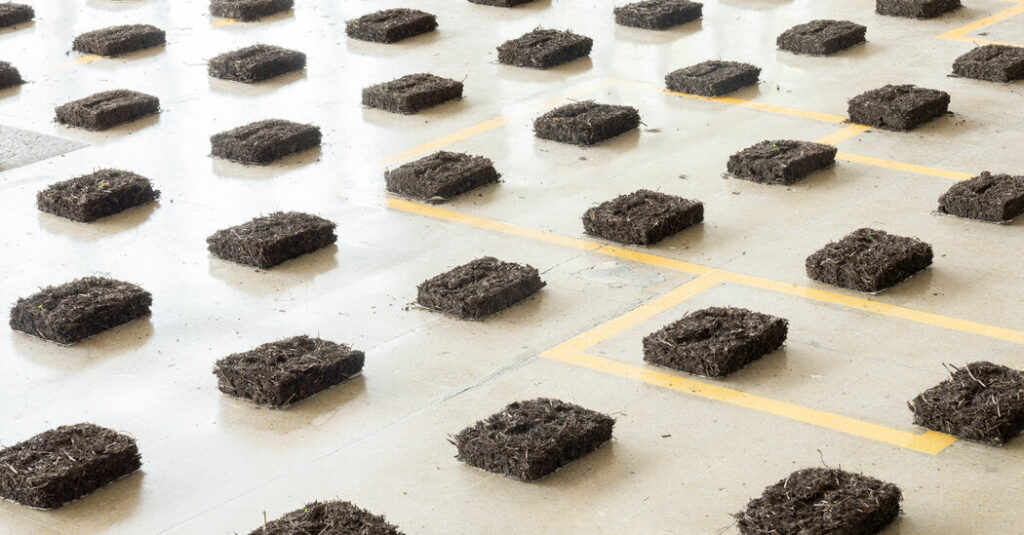
An installation made from 300 kilos of hippopotamus dung, arranged to look like seized cocaine. A 12-ton rock, carved into an Olmec head, crushing the roof of a Tesla car. The monstrous torso of a woman, molded from clay and then captured in a hyperrealistic oil portrait.
The painters, sculptors and assorted object-makers showing in the Artist Spotlight section at Untitled Art fair in Miami, running through Sunday, come with their own signature moves, building their reputations on work that could be considered over-the-top, even in an art world where the outrageous can be common.
This is the first year for the section, which will include 30 galleries, each showing one artist, and will focus on a new work the artists will unveil at the fair. The roster was curated by Petra Cortright, an American artist who built her own reputation partly through provocative videos delivered on a YouTube channel.
“My focus was on digital influences as well as outsider art,” she said in a text message, explaining how she chose the lineup. That strategy allowed her to look globally for artists making things that do not fit into traditional visual arts categories, or whose work might not immediately be considered commercial without the frame of an art fair with a clear focus on buying and selling.
That includes artists like Camilo Restrepo, from Medellín, Colombia, who will be featured in the booth of La Cometa Gallery. Restrepo was born in 1973, which means he grew up during an era of runaway violence as law enforcement wrangled with notorious Colombian drug lords like Pablo Escobar.
Escobar was killed in 1993, and Medellín is now a calmer city. But the trauma remains, and Restrepo’s work routinely delves into it. The aforementioned hippo piece, which he made for this year’s International Art Biennial of Antioquia and Medellín, is a good example.
One lavish way Escobar spent the billions he made through his dealings was by importing animals for a personal zoo. When he was killed, most were relocated, though four hippos wandered off toward a body of water. “One died, but from those three hippos, there are now 250,” Restrepo said during an interview in his studio. Their feces are polluting the water.
The hippos have become a national crisis, and efforts to eradicate them have failed. Restrepo sees it all as a metaphor for the odious emotional byproducts that remain in the psyche of residents who lived through that era.
For the biennial installation, he shaped hippo dung to resemble bricks of cocaine arranged like publicized police evidence from a drug bust. He is also cultivating the psychedelic mushrooms that grow naturally in the dung — a more tranquil drug than Escobar’s cocaine, he said, which hints at Colombia’s post-narcotics transformation to a more civil society.
That same thread of ruin, resilience and ridiculousness runs through the series of drawings he will exhibit in Miami. They are visually complicated works made with ink and wax pastels applied to small, single sheets of paper taped together to stretch as long as 12 feet.
Restrepo incorporates hundreds of overlapping images into the works: colorful, cartoonlike portraits of infamous drug dealers mingling with globally recognized pop culture figures like Spider-Man, the Road Runner and characters from Disney films and “The Simpsons.” They are connected by a thin line drawn to represent veins or intestines — the biological materials that hold us together, but also prove fragile in the face of violence. The drawings are vivid and playful, until you look closely.
“This is the inside of my head with all of that violence still there,” Restrepo said.
Social commentary is also central to the work of Chavis Mármol, who will show solo with Latinou, a gallery in Mexico City. That is particularly true with his 2024 work of an Olmec head, chiseled by Mármol, demolishing a Tesla — a symbolic act of defiance against big business and billionaires.
Photos of the piece, which now sits publicly in the side yard of the Colima 71 Casa de Arte Hotel, were shared worldwide. “A lot of people here in Mexico knew my work, but not internationally,” he said during an interview at Latinou. “Now, many people outside of Mexico know my work, too.”
Mármol fits well with Cortright’s idea of bringing attention to outsider artists whose careers can be difficult to define. He works equally across sculpture, painting, installation and performance, and his materials are as varied as stone, steel, resin and 3-D printed plastics.
His work is generally political in a broad, anti-establishment way, responding to current events. “I like to be aware of what’s going on in politics and geopolitics around the world, and to consume a lot of cultural products, such as movies and television,” he said.
He lets the concept drive his material choices, which allows multiple options for constructing new pieces, but it does not give him a signature style of work that makes it easy to sell. That is on purpose. “I don’t seek to create an aesthetic line where people can identify my work because I work with a certain material or color or theme,” Mármol said. Instead, he compares himself to a farmer who rotates crops to keep the soil fertile.
If there is a thread, it comes from the way he combines old art-making techniques with new technology, something visible in the Tesla piece, and in the different, newer works he will show in Miami. One of them, titled “Xiaomicoatl,” features a snake carved out of stone that is mounted on a robotic vacuum cleaner.
For Natalia Ocerin, a Spanish artist based in London who will show with Gallery Rosenfeld, arriving at her current style was a journey of self-expression. She began her art career as a photorealist painter, creating exacting scenes that captured the world around her with precision.
She was good at it, naturally detail-oriented and comfortable with that way of making pictures, though something was missing, she said during a video interview. Photorealism, by its nature, required painting the world on its surface, and she wanted to find a way to say things from a deeper, more personal and emotional perspective.
In 2020 during the coronavirus pandemic, she discovered Plasticine, or better, rediscovered it. She loved playing with the clay as a child, Ocerin said. She began creating elaborate scenes, like the facade of a multistory apartment building under lockdown with the activities of various residents visible on their balconies.
Then she did what she knew: She photographed her three-dimensional objects and painted them in the hyperrealistic, two-dimensional style she had already mastered. She has repeated the process, creating dioramas of bathers frolicking at pools and still lifes of colorful flowers.
Lately, she has been sculpting female figures, about a foot tall, that she recreates as large-scale paintings. It is a departure for her — the figures are horrifying in that they have distorted features and appear angry. She means them to be a comment on the social expectations women face for the way they look and act, she said. In Miami, she will show those pieces, plus newer pool works and flowers.
Working with the Plasticine, with its ability to “stretch and destroy and crack,” allows Ocarin to convey emotional ideas, she said. For her, it is a reflection on real life.
“How can you mold yourself? How can someone push or break you?” she said.
The post Hard-to-Define Artists Will Help Define This Year’s Untitled Art Fair appeared first on New York Times.