In August 1958, Esquire invited 58 jazz musicians to meet on a stoop in Harlem for a photo shoot. The resulting picture, now known as Harlem 1958, became legendary for collecting some of the genre’s greatest talents, stretching from the swing era (Count Basie, Gene Krupa) to the peaks of bebop (Charles Mingus, Dizzy Gillespie). The assembled musicians may not have realized that rock and roll was on the verge of taking over pop music, thus sweeping jazz to the margins—but the fact that it was made this photo a historic snapshot.
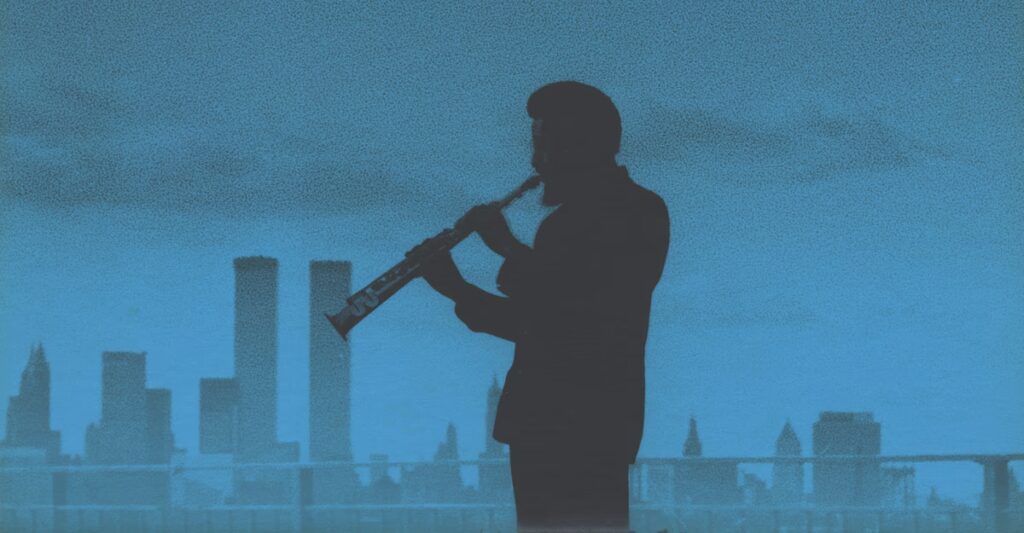
The last living participant of that shoot was the tenor saxophonist Sonny Rollins, who died on Monday at the age of 95. By the end of his life, no jazz musician of his importance was left—but then again, hardly anyone ever reached Rollins’s colossal stature. Rollins made his first recordings in 1949, when he was 18 years old, and over the next several decades he played with nearly every modern great: Charlie Parker, Miles Davis, Thelonious Monk, Coleman Hawkins, John Coltrane. Rollins didn’t just make some of the genre’s finest recordings; his muscular sound and intense intellect turned him into an embodiment of jazz itself. “He may be the greatest virtuoso that jazz has ever produced,” the influential critic Francis Davis once wrote.
A native New Yorker, Rollins emerged onto the local scene during the ’40s, which is commonly viewed as the moment when jazz went from mass entertainment to something resembling a finer art. To hear Rollins in a concert hall, as was typical late in his career, could feel torturous, because his music made you want to stand up and move. Unlike many modern jazz compositions, his were hummable earworms—the sleazy strut of “Doxy”; the syncopated, funky “Oleo.” His most famous piece, “St. Thomas,” is a calypso-influenced number that epitomizes jazz’s cosmopolitanism. Named for his mother’s home in the Virgin Islands, the tune comes from a Caribbean lullaby she sang him, which, in turn, was derived from an 18th-century English folk song.
Whether writing a song or soloing, Rollins always had swing, that tough-to-define but essential quality possessed by any good jazz musician—the way they find a rhythmic groove, pulling the music along and getting toes tapping. “He could play a solo using one pitch that would swing so violently you couldn’t believe it,” the trumpeter Wynton Marsalis said in Ken Burns’s Jazz—a statement I assumed he meant hyperbolically until years later, when I heard Rollins’s solo on “Sonnymoon for Two,” from 1958’s A Night at the Village Vanguard. That record demonstrated that Rollins didn’t even need a full trio backing him to swing: He often played with just a bassist and a drummer, which placed more burden on him to fill the space, but also meant he wasn’t bound to follow someone else’s chords.
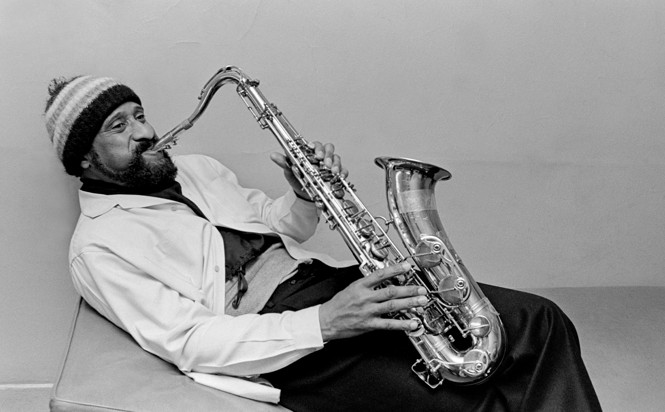
Rollins was a playful improviser, a master of referencing other songs when performing a solo. When he really got going, he could shred as hard as any metal guitarist, playing for 10 or 20 minutes at a time. During a 1986 concert taped for a documentary, Rollins—then in his mid-50s—leapt from a stage during an unaccompanied solo and broke his heel, then lay on his back and resumed playing. He sported a mohawk in the ’60s, long before the look was fashionable, and guested on the Rolling Stones’s 1981 album Tattoo You. As it gets going, his solo on the Stones’s “Neighbours” demonstrates an easy proficiency with honking rock idioms before careening in a weirder direction; Rollins was dismissive of the record but recounted hearing it at a supermarket and being intrigued by the horn work before realizing he was listening to himself.
[Read: Sonny Rollins at sixty-eight]
But Rollins wasn’t just a great soloist. He was a serious and introspective musician, which made him able to relate to old-school jazzmen and upstart avant-gardists alike. Rollins was cocky enough to name a record Saxophone Colossus when he was just 27 years old but humble enough to leave the scene two years later, feeling that he had fallen behind newer players such as Coltrane on the New York scene. During this self-exile, he practiced for as many as 15 hours a day on the Williamsburg Bridge in all types of weather. (For years, the jazz fan Jeff Caltabiano has pushed to rename the bridge for Rollins. That didn’t happen in his lifetime, but it’s never too late.)
When Rollins returned to the scene in 1961, musicians were hotly debating new styles, including Ornette Coleman’s “free jazz,” which discarded the complicated harmonies of bebop. Many of Rollins’s older peers dismissed Coleman’s music as crude, but Rollins embraced it, recruiting members of Coleman’s group to play with him. That commitment to exploration didn’t dim with age. A half century later, at Rollins’s birthday celebration in 2010, he announced that a guest would join him. When Coleman ambled onstage, the audience gasped and broke into applause. The men began a friendly saxophone joust—their first and only performance together—and Rollins demonstrated that even at 80, he could play as far out as anyone.
He was eventually forced to quit performing altogether in 2014 because of respiratory issues, but he came to a surprisingly zen conclusion about giving up an instrument he’d played for some 70 years. “When I had to stop playing it was quite traumatic,” he said in 2020. “But I realized that instead of lamenting and crying, I should be grateful for the fact that I was able to do music all of my life.”
After his retirement, he continued delivering wisdom—now through his words, rather than his music. A frequent topic in those conversations was reincarnation, of which Rollins was sure. “I don’t believe in reincarnation, I accept reincarnation,” he told the journalist Justin Joffe. “I don’t believe, I know.” When someone so towering dies, we’re accustomed to saying that we won’t see their like again. But who are we to second-guess Sonny Rollins?
The post The Last of the Jazz Titans appeared first on The Atlantic.