The election interference case against President Trump in Georgia was dismissed last week, but the ghosts of the 2020 election are still looming over the state as next year’s midterms approach.
Mr. Trump’s Justice Department has been investigating Fani T. Willis, the district attorney in Atlanta who brought criminal charges against him. Though the full contours of the investigation are unclear, The New York Times has learned that several dozen subpoenas have already been issued, according to a copy of one of them and interviews with veterans of the U.S. attorney’s office for the Northern District of Georgia.
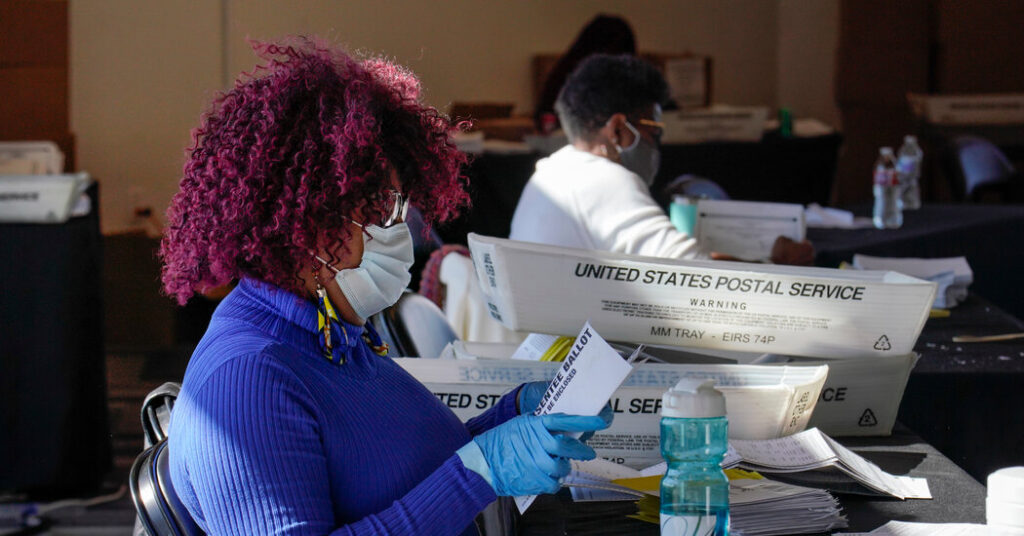
Federal prosecutors are separately trying to obtain copies of tens of thousands of ballots that were cast in Georgia in 2020. And races for governor and other statewide offices feature candidates who actively helped or resisted the president’s efforts to cling to power after he lost in 2020.
The dismissal last week of the election interference case against Mr. Trump came at the request of a state prosecutor who had taken it over. Ms. Willis was removed from the case amid revelations that she had been romantically involved with the lawyer she hired to run the Trump prosecution.
Mr. Trump had pressured Republican officials in Georgia to help reverse his 2020 loss there. In one phone call, he tried to persuade the state’s then-speaker of the House to call a special session of the legislature to overturn his loss. In another, Mr. Trump pushed Georgia’s secretary of state, Brad Raffensperger, to help overturn the state’s election results, citing debunked claims of election fraud.
Some of Mr. Trump’s co-defendants in the case were accused of lying to Georgia lawmakers, creating a slate of fake pro-Trump electors and illegally accessing voter equipment and data. Four of the defendants pleaded guilty in the months after the August 2023 indictment.
Following the dismissal of the case, Mr. Trump called it an “illegal, unconstitutional, and unAmerican hoax,” adding that “we have to hold responsible those who attempted to destroy our Legal System.”
To that end, the president has reconfigured the Justice Department to pursue retribution against a number of his perceived enemies. The Times previously reported that federal investigators were scrutinizing a trip that Ms. Willis took to the Bahamas last year, during which she attended management training sessions. But the trip appears to be only one focus of a wider inquiry. A person with knowledge of the investigation said that F.B.I. agents have begun interviewing witnesses.
Theodore Hertzberg, the U.S. attorney for the Northern District of Georgia, is leading the investigation. While several prosecutors appointed by Mr. Trump have recently had their appointments successfully contested in court, Mr. Hertzberg is a veteran of the Atlanta office whose appointment has been affirmed by local federal judges.
Beyond the Willis inquiry, the Justice Department is investigating Mr. Trump’s false claims that the 2020 election “was rigged and stolen,” as he put it in a social media posting last week.
The department’s attempt to seize and inspect ballots from Fulton County is the latest development in a nearly five-year crusade that started with a flurry of lawsuits from local election skeptics, followed more recently by subpoenas issued by Trump allies on the State Election Board.
Edward R. Martin Jr., who heads the “Weaponization Working Group” established within the Justice Department to go after Mr. Trump’s opponents, has championed the ballot requisition effort. In August, he wrote to another Fulton County judge who has overseen election-related cases, Robert C.I. McBurney, that “a review of the ballots and envelopes is imperative.”
The letter, which Mr. Martin reposted on social media, demanded access to 148,000 absentee ballots from 2020. But it appears to have been emailed to an incorrect address.
Fulton County officials have received a similar letter from another Justice Department official, Harmeet K. Dhillon, who runs the civil rights division, and who sought the same records subpoenaed by the state board. The county has rebuffed efforts to seize its old ballots; Judge McBurney is reviewing the matter.
Stephen K. Bannon, the podcaster who briefly served as the White House chief strategist in the first Trump term, recently asked Mr. Martin on his show why the administration didn’t just “deputize some U.S. marshals and go down and seize” the ballots.
Mr. Martin replied: “We’ve got to get them,” though he added, “I think they’re long ago shredded and destroyed, but that’s just my own opinion, we’ll see.” No evidence has emerged to support that claim.
Some discrepancies in Fulton County’s recount process did emerge after the 2020 election, but the state’s Republican leadership affirmed Joseph R. Biden Jr.’s win there after multiple counts. Democrats fear that a new inspection of 2020 ballots may be used to stoke suspicions of ballot fraud if the 2026 elections do not go Republicans’ way.
“I really don’t know what their end goal is, truly, because the purported angle is to identify whether there were irregularities in the 2020 election,” said Sara Tindall Ghazal, the sole member of the five-member State Election Board who was nominated by the Democratic Party. “But we’re talking about an election that was counted three times.”
Regardless, the chaotic aftermath of the 2020 election in Georgia will echo in 2026 contests that were already sure to be a referendum on the president, and on Trumpism. The fight over that election still divides Republicans.
The front-runner in the governor’s race on the Republican side, Lt. Gov. Burt Jones, is a staunch Trump ally who served as a fake elector for him after the 2020 campaign. Mr. Jones has been attacking some of his Republican primary rivals for not supporting the president’s election fraud claims.
One of them is Mr. Raffensperger, the secretary of state, who famously resisted Mr. Trump’s request to “find” enough votes to reverse Mr. Trump’s loss. Mr. Jones, in one political ad, has labeled Mr. Raffensperger and another primary opponent who has been criticized by the president, Attorney General Chris Carr, as “Team Never Trump.”
Geoff Duncan, a former lieutenant governor, is among the Democratic candidates for governor. He left the Republican Party after resisting efforts to reverse the state’s 2020 election results. He has called the president “a direct threat to democracy” who was willing to “lie cheat and steal to try to overturn the 2020 election.”
Further down the ballot, Gabriel Sterling, who worked in the secretary of state’s office, is now running to fill the seat his old boss is vacating. Mr. Sterling was one of the most prominent Republicans in the state to push back on claims by Mr. Trump and his allies that the 2020 election was stolen.
He criticized the president at the time for failing to condemn threats against people overseeing the voting system. “Someone’s going to get killed,” Mr. Sterling said in public remarks a few weeks after the 2020 election.
The president won Georgia in 2016, and again in 2024, but he continues to fulminate over his 2020 loss. Last month, after the Justice Department announced a high-profile sports betting scandal, Mr. Trump posted on social media that “the 2020 Presidential Election, being Rigged and Stolen, is a far bigger scandal,” adding that “I hope the DOJ pursues this with as much ‘gusto’ as befitting the biggest scandal in American history!”
His focus on the past comes amid ominous signs for Republicans in the state. Democrats ousted two of the five Republican members of Georgia’s utility board in the election this month, tapping into anger over rising electric bills. No Democrat has served on the commission since 2007.
Danny Hakim is a reporter on the Investigations team at The Times, focused primarily on politics.
The post Fight Over 2020 Election in Georgia Persists as Midterms Approach appeared first on New York Times.