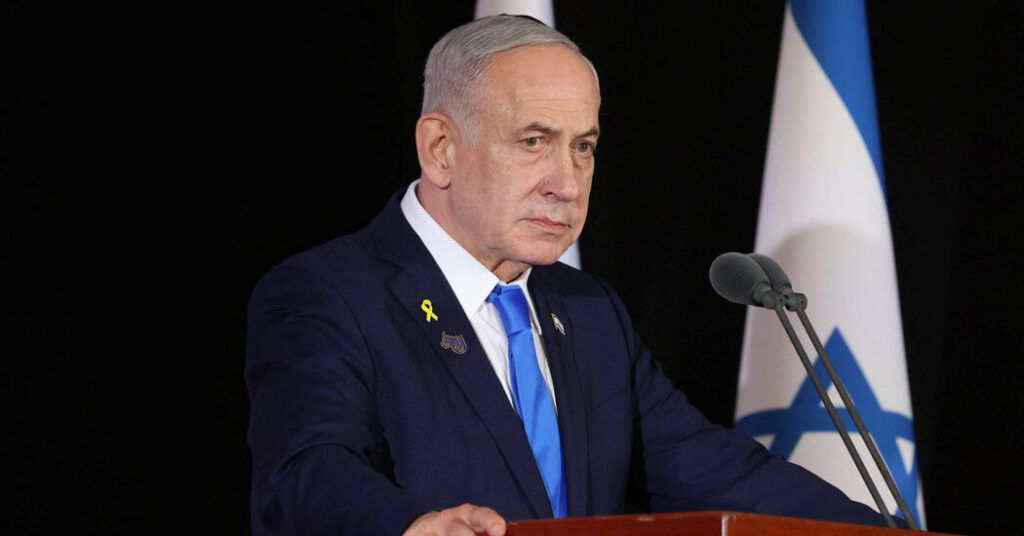
Prime Minister Benjamin Netanyahu’s request on Sunday for a pardon that would short-circuit his long-running corruption trial was made in the dryly polite terms of a legal brief, not in the provocative language of a social-media post.
In its sheer audacity, however, it seemed ripped from the playbook of another leader who did not let multiple felony charges, or even a conviction, stop him from seeking power: President Trump.
Mr. Netanyahu’s petition to the president of Israel, Isaac Herzog, admitted nothing and expressed no contrition. In a one-page letter that he himself signed, he did not use the word “pardon,” instead stiffly requesting an “end of the trial.” It came a little over two weeks after President Trump sent a letter to Mr. Herzog urging him to pardon Mr. Netanyahu.
Mr. Netanyahu’s lawyers, in a 111-page filing, assailed the way he had been investigated, the timing of his indictment and the substance of the charges against him, and insisted that he would be acquitted in the end.
There, too, were many similarities in the filing to tactics favored by Mr. Trump, including demonizing the law enforcement system, portraying Mr. Netanyahu as a victim and appearing to hint at the prospect of retribution.
The lawyers argued that for the good of Israel, its leader should be freed from wasting valuable time defending himself in court. (No matter that Mr. Netanyahu had rejected calls when he was indicted in 2019 that he step down to face trial rather than be distracted from running the country.)
The pardon request immediately hijacked the Israeli political conversation. That had been dominated by criticism of the Netanyahu government’s highly unpopular bill to exempt many members of the ultra-Orthodox community from military service and of his efforts to sidestep a national commission of inquiry into the Oct. 7, 2023, Hamas-led attack.
Opposition leaders had been assailing Mr. Netanyahu on those issues, on which polls show that the government is out of step with the public. Now they were forced to pivot and react to Mr. Netanyahu’s pardon request, arguing that it could not be granted without steep concessions from the Israeli prime minister.
Naftali Bennett, who served a year as prime minister in 2021 and is planning a comeback in the next election, supported a pardon as long as it came with Mr. Netanyahu’s “respectful retirement from political life.” And Yair Lapid, leader of the opposition, declared that the Israeli president could not legally pardon Mr. Netanyahu “without an admission of guilt, an expression of remorse and an immediate retirement from political life.”
Reuven Hazan, a political science professor at the Hebrew University of Jerusalem, referring to Mr. Netanyahu’s request, said, “He threw this out there to have us do what we’re doing right now, which is talk about this and not those other issues.”
“He moves the agenda,” Professor Hazan added. “And there’s no one in Israeli politics that can do it as well as he can.”
There also may be no one in Israeli politics with as much chutzpah.
In a video statement released with the pardon request, Mr. Netanyahu portrayed his gambit to escape trial as a public-minded sacrifice. “My personal interest was to continue the process to its end, until full acquittal on all charges,” he said. “But the security and political reality, the national interest — these require otherwise.”
He also warned that going ahead with his trial “tears us apart from within, fuels fierce disputes and deepens rifts.”
Mitchell Barak, an Israeli pollster who worked for Mr. Netanyahu in the 1990s, called the reference to societal rifts laughable. “He’s the one that caused the divisiveness, and he continues to cause it,” Mr. Barak said.
Professor Hazan saw the move as a brilliant ploy: If Mr. Netanyahu’s petition works, he escapes criminal liability. If it does not, and his trial proceeds, he has a new issue to run on in next year’s election: the supposed witch hunt against him.
“The whole letter is written in a way that allows him to campaign on this if he’s not given a pardon,” Professor Hazan said.
David M. Halbfinger is the Jerusalem bureau chief, leading coverage of Israel, Gaza and the West Bank. He also held that post from 2017 to 2021. He was the Politics editor of The Times from 2021 to 2025.
The post Netanyahu, Seeking a Pardon, Borrows From a Familiar Playbook appeared first on New York Times.