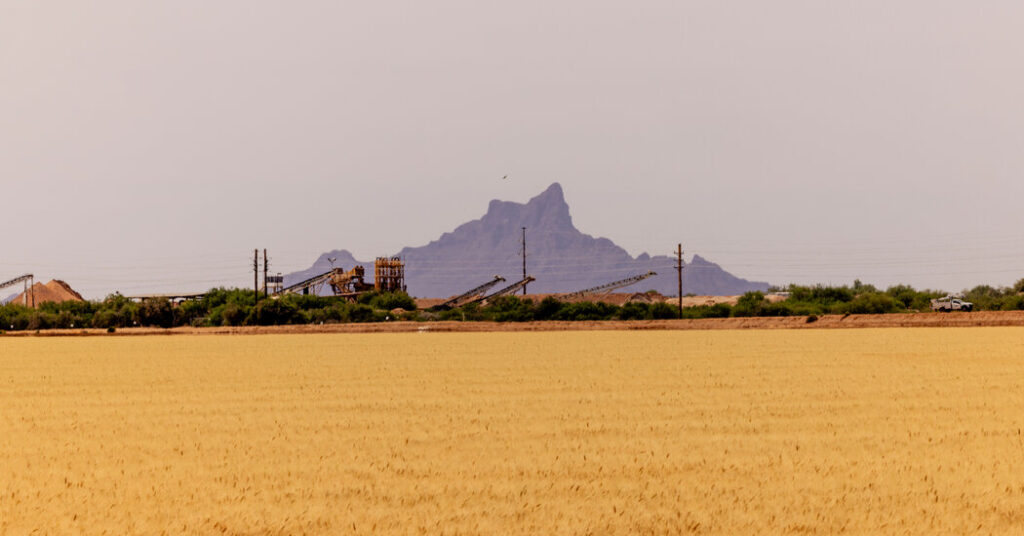
Among the cotton fields and mesquite stands of southern Arizona, two of the nation’s most contentious political issues — immigration detention and data centers — are converging in a sleepy farm town nestled in a swing House district that will help determine control of Congress in November.
On the north side of the town, Marana, a community of 60,000 outside Tucson, a sprawling A.I. data center will soon rise from fallow agricultural land. A few miles away, an Immigration and Customs Enforcement detention facility is poised to open at the site of a defunct state prison.
The projects have convulsed a place that also happens to sit squarely inside the district of Representative Juan Ciscomani, a Republican near the top of the Democrats’ target list in the midterm elections.
“It really feels like it’s just one shoe dropping after another,” said Sue Ritz, a 64-year-old retired mining engineer who has lived in Marana for 20 years. “Detention centers, data centers, what’s next?”
Marana, long used to placid local politics, has become a microcosm of the fractious national moment. The two projects are separate, but residents trying to derail them see both as the results of outside forces intervening in their town.
The detention facility has mostly outraged liberals, who see it as a moral stain on the community. The data center, however, has disrupted the usual divides; some of Marana’s conservatives are standing shoulder to shoulder with progressive environmentalists to denounce it, while unions and chambers of commerce are its champions.
“We knock on doors and the first thing people say is, ‘What do you think about this stupid data center?’” said Jackie McGuire, who, with Ms. Ritz, is part of a slate of candidates running for town council on an anti-data center platform. “It’s a bigger issue for people than their parties.”
The politics around data centers are evolving quickly. Once the object of generous tax breaks, they have become deeply unpopular. Arizona, one of the country’s data center capitals, has been dangling incentives for years, but state officials have changed their tune.
For local leaders, the projects still have appeal.
Marana has more than quadrupled in population since 2000, leaving its rural roots in the Sonoran Desert dust. But the local economy has not kept up.
“We need jobs,” said Jon Post, the town’s mayor. “We want to let people know that Marana is open for business.”
Beale Infrastructure, a data center developer managed by the private credit firm Blue Owl Capital, pitched its $5 billion Marana project at town meetings, promising nearly $150 million in tax revenue over the next decade, along with investments in infrastructure upgrades and job training.
The 600-acre project’s first phase would create more than 4,000 construction jobs and around 400 permanent positions, the company said. Beale’s representatives pledged their project’s air-cooling systems would not use any local water.
But the center could require up to 1.5 gigawatts of energy — more generating capacity than most power plants in Arizona. The project will get its energy from two different utilities, and the company said it would cover the cost of system updates and new transmission lines.
Leery opponents, who packed the public meetings, still worried about rising energy costs and strain on the grid, about noise, heat radiation and air pollution from the building’s backup generators. They booed when the town council unanimously approved the project.
In an interview, Tony Burkart, Beale’s senior vice president of public affairs, acknowledged that “large-scale development is potentially scary.”
“The questions and concerns that people are raising are valid and, candidly, if those questions haven’t been addressed, then we need to do a better job of making sure that they hear about the project’s benefits,” Mr. Burkart said.
But he added that the opposition voices had drowned out union workers, firefighters and others who “want the job creation.”
“They want the tax revenue and they want the project,” he said.
Clay Parsons, whose family runs the Marana Stockyards near the project site, has watched as the farmland around his town has been swallowed up by new subdivisions. He had heard ominous warnings about data centers, but once he learned the project would use little local water, he was all in. At least it wasn’t more tract housing.
“Jobs, not rooftops, is better for this area,” he said over a chorus of moos as he prepared for a cattle auction.
“Do we need all this technology?” Mr. Parsons asked, holding up his smartphone. “Apparently so. I don’t know, I don’t use it. But I know that the world uses it. And I would rather us be in control of it than somebody else.”
The divisions have turned the July 21 town council elections into a de facto referendum on the project and the leaders who have supported it.
Marana’s other hot-button development, the detention center, will also be on voters’ minds.
The town’s leaders say they can do nothing to stop ICE from contracting with the private prison operator that owns the facility, which has sat empty since the state closed it in 2023.
The firm, Utah-based Management and Training Corporation, said in a statement that its agreement with ICE is not yet final, but that it would focus on “operating the facility with high standards of safety, professionalism and dignity.”
As both projects have progressed, they have become intertwined for those opposing them. Vivek Bharathan, a member of No Desert Data Center Coalition, a local activist group, has argued that the data centers powering the A.I. boom facilitate the increased surveillance of immigrants, who are then detained in ICE facilities.
“These big projects are extractive, take profits elsewhere and leave us with crumbs, all in service of the cruelty industry,” said Mr. Bharathan, who is also the data center fellow at MediaJustice, an advocacy group.
Activists like Mr. Bharathan have urged the town council to pass a resolution condemning the proposed detention center, just as Marana’s county, Pima, and neighboring cities have done. But town leaders have said that only would lead to more division.
“We’re not going to get in the middle of this national debate about ICE and ICE detention and ICE enforcement,” Terry Rozema, the town manager, said.
Mr. Rozema added that he’d rather the state reopen the prison and put inmates to work cleaning Marana’s roads and freeways, but the town has no say.
“It’s not going to be a monastery. It’s not going to be a school. It’s going to be a detention center,” he said.
Frustrated Marana residents say they just want to be heard.
“We just want to feel like they’re listening and trying to do the right thing,” Mary Ann Adams, 77, said after a recent town council meeting where she displayed a sign that read “Pima Resists ICE.”
Mr. Ciscomani has avoided talking about the developments, and his spokesman did not respond to requests to discuss them.
But JoAnna Mendoza, the Democrat challenging Mr. Ciscomani, said the larger themes behind the two fights — fears over President Trump’s immigration crackdown and anxiety about A.I. and energy costs — are big concerns in the district.
“This administration has not improved the quality of life, and, sadly, you have representatives like Juan Ciscomani who are complicit because they’ve said absolutely nothing,” said Ms. Mendoza, a first-time candidate.
Jarvis Gutter, whose family owns a Marana barbecue sauce company, described himself as “an independent Republican.” He voted for Mr. Trump in 2024, but remains undecided on the midterms. Mr. Ciscomani, he said, had done nothing to win his support. Mr. Gutter had a couple of suggestions.
“I don’t want a data center,” he said. “And I definitely don’t want a prison.”
Reis Thebault is a Phoenix-based reporter for The Times, covering the American Southwest.
The post Two of America’s Thorniest Political Issues Are Dividing an Arizona Town appeared first on New York Times.