You’re reading Red Tape, a weekly newsletter. Click here to get it in your inbox.
John Schochet is a lawyer in New York and writes the People vs. the Machine Substack, where a version of this essay first appeared.
As city projects go in New York, installing two drinking fountains seemed simple enough.
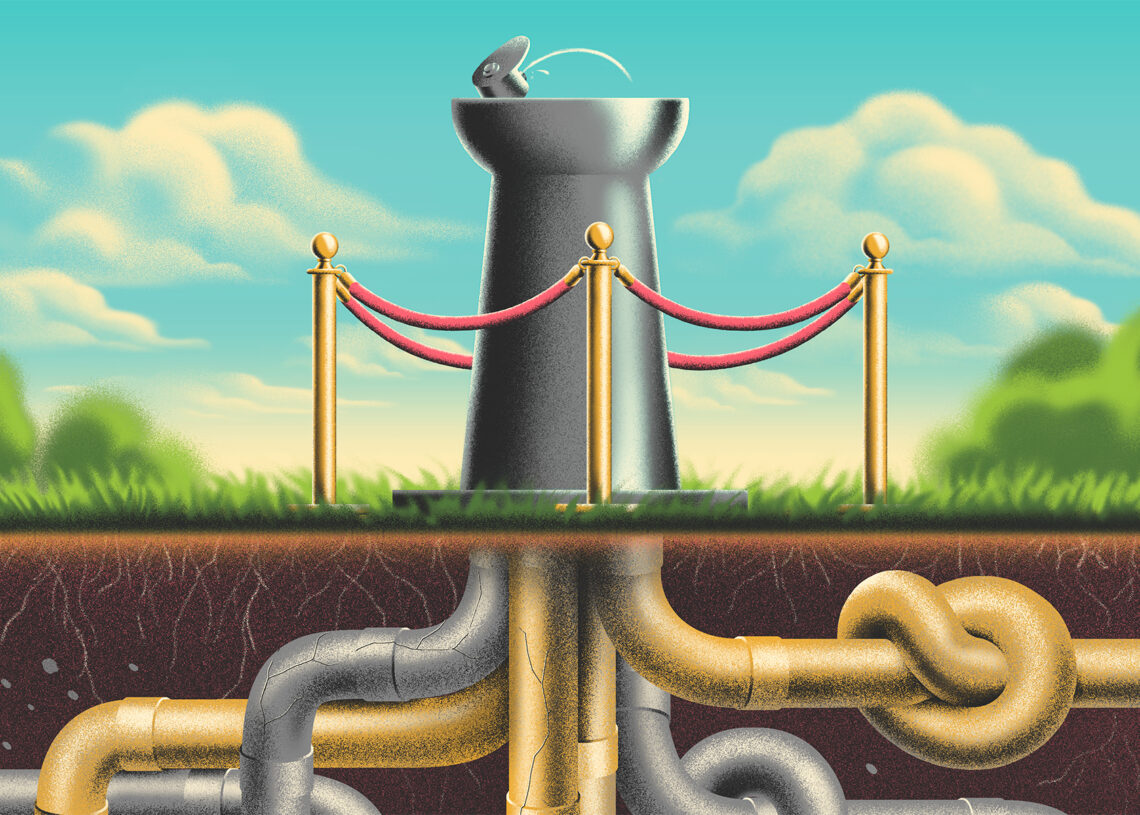
Last year I was appointed to Manhattan Community Board 7, which serves the city’s Upper West Side. At a parks and environment committee meeting in October, a project manager from the parks department presented 23 slides about plans to replace two drinking fountains in Riverside Park. The presentation covered flood zones, tree roots, backflow prevention and a new water line. The budget? $375,000.
I sat there wondering how two water fountains could cost more than a four-bedroom house in a Kansas City suburb. But I’ve spent enough time in the public sector to understand how we got there. Before moving to New York, I was a lawyer for the city of Seattle for more than a decade. I advised mayors and council members, worked on the city’s $15 minimum wage law, and served as in-house counsel for agencies handling everything from animal control to fair housing. Watching government work from the inside taught me that the story I’m about to tell extends beyond one big-city parks department.
Each requirement for the drinking fountain project has its own logic. Backflow prevention protects the water supply. Parks directives require replacing older water service pipes when making new connections. Since the parks department chose to rebuild one of the fountains exactly where an old one stood and has no records of where the original line ran, the city will need to dig a new trench. Digging the trench means doing a tree root survey. Procurement rules are intended to prevent corruption. The project manager presenting the slides was professional and thorough, checking every box. All of this led to the nearly $400,000 price tag.
It’s actually worse than that. In 2024, the city’s participatory budgeting process allocated $375,000 for five new hydration stations with bottle fillers throughout Riverside Park. The plan that emerged from the parks department had been whittled down to replacing two fountains with code-compliant versions of what had been there for decades. No new locations, no bottle fillers. And the fountains won’t even be installed until 2027.
The dynamic that makes two fountains cost $375,000 scales. Individually reasonable requirements add up to unreasonable outcomes. This is why a mile of new subway in New York City costs $2.5 billion, roughly 8 to 12 times what comparable projects cost in Spain and Italy. It is why President Joe Biden’s $7.5 billion federal program to build electric vehicle chargers, passed in 2021, had produced only 57 operational stations across 15 states by the time he left office. The TransWest Express transmission line spent 18 years getting permitted despite being “fast-tracked” by the Obama administration in 2011.
The system feels broken because in many ways it is, and the establishment hasn’t found good answers for fixing it. Populists on the right and the left fill the void, blaming coastal elites, billionaires, big businesses or immigrants. They share an approach: name villains, promise consequences and insist the consequences will fix things. The grievances are real, but populism conflates symptoms with causes. No combination of tariffs, wealth taxes, mass deportation or antitrust enforcement will address what’s producing the symptoms. The populists’ villains may get their comeuppance, but housing remains unaffordable.
The mainstream center-left — liberals, centrist wonks, heterodox independents — needs to be better at getting mad. They have every right to be as fed up with the status quo as the populists are. But their anger needs to be constructive, directed at what’s actually broken rather than convenient villains. The populist right and the populist left know how to name adversaries and tell compelling stories. However good the center-left may be at policy and analysis, it hasn’t learned to explain what went wrong and how to fix it in a way that resonates with the disenchanted voters who have every reason to be skeptical of establishment promises.
Here’s how I’d explain it: The thing breaking America isn’t a person, a party or a conspiracy. It’s a self-perpetuating system, built over decades by well-meaning people making individually rational decisions that added up to something no one would build on purpose. Call it the Machine. People may run its individual components, but no one operates or entirely understands its full scope.
The Machine narrative dovetails with “Abundance,” the idea Derek Thompson and Ezra Klein popularized last year with their best-selling book. Abundance names the goal: more housing, more energy, more state capacity, more of the things that make life affordable and government functional. The Machine names the adversary standing between the public and the goal.
The Machine operates everywhere. In red states it stokes culture-war fights that distract leaders from serious governance. In blue states, the Machine teaches politicians to measure success in dollars appropriated rather than results delivered. Where coalitions are built around institutions that receive public money, more spending is the path of least resistance. New York City’s two most recent mayors both trumpeted their affordable housing plans by emphasizing big dollar figures. Zohran Mamdani campaigned on spending $100 billion over 10 years to build 200,000 “publicly subsidized, permanently affordable, union-built, rent-stabilized homes” — about $500,000, or nearly three drinking fountains, per home. Blue-state political cultures teach elected officials and their staffs to spend more so they can trumpet bigger numbers, exactly the wrong approach when what they need is to get the most out of every taxpayer dollar.
Milan’s driverless M4 metro line, fully underground through a dense historic city, opened between 2022 and 2024 for $200 million to $235 million per mile. Italy is not a low-wage country; according to NYU’s Marron Institute, the differences between Milan’s approach and American transit agencies are procurement, project management and what contractors call “the agency factor” — the premium they add to their bids just to cover the cost of dealing with a transit agency’s red tape. In 2023, Pennsylvania Gov. Josh Shapiro (D) reopened a collapsed section of Interstate 95 in just 12 days. Neither Milan nor Pennsylvania subverted democracy or delivered substandard results. Raising expectations and empowering institutions can get the job done.
The Machine is a way of operating, not a class of people. Unions, corporations, bureaucrats, billionaires, consultants, elected officials and concerned citizens have all built parts of it, and the Machine hurts them all. Fighting the Machine and making the system work require asking everyone — ourselves included — to change how we operate.
Scapegoating and arguing about who’s to blame is not a path to problem-solving. Organizing against the Machine is more a matter of function versus dysfunction and doers versus blockers than it is about left versus right or pitting one group or class against another. This would mean asking uncomfortable questions of institutions you might normally support — unions, public agencies, advocacy groups — and judging them by what they deliver rather than what they stand for.
Replacing two drinking fountains in Riverside Park costs $375,000 and takes three years from funding to completion, with the system working as designed. This is an institutional culture problem, not something a statutory fix or department reorg can easily solve. The parks department should be able to deliver the five hydration stations the community voted for, on budget and in less than three years. To get there, agencies should judge success by what they deliver, not by how many boxes they checked. And we — community board members like me and everyone else who cares about making things work — need to start asking the question the Machine has trained us not to bother with: Are we getting what we’re paying for?
The post What is really breaking America? Two drinking fountains for $375,000. appeared first on Washington Post.