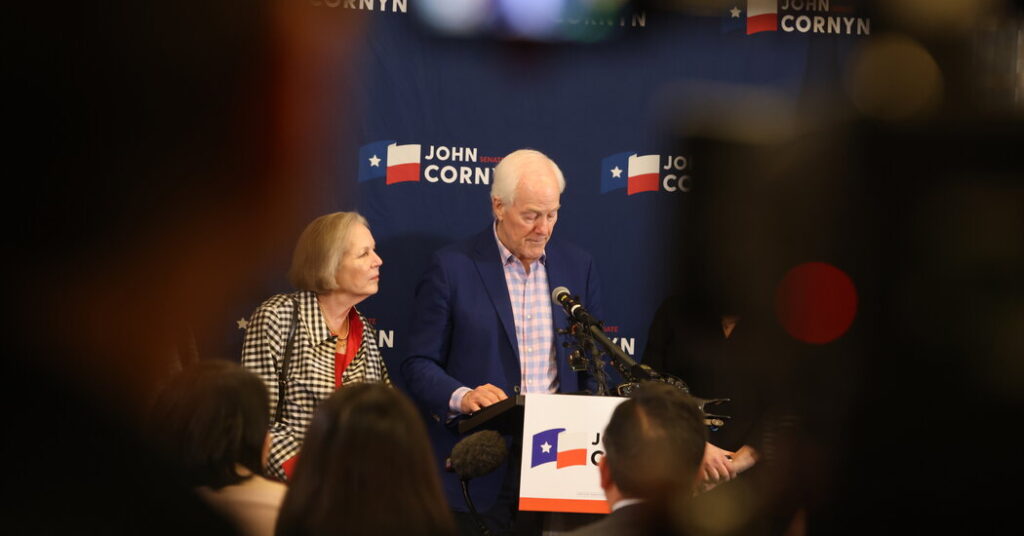
Senator John Cornyn’s resounding primary defeat in Texas on Tuesday has sharpened tensions between President Trump and Senate Republicans, and threatens to imperil the president’s agenda as allies who have stayed in lock step with him see his actions increasingly diverging from their interests.
Mr. Cornyn, who just last year came within a handful of votes of becoming the Republican leader, was a popular and respected senator as well as a prolific fund-raiser, a dependable conservative vote and an able floor debater. His colleagues saw the president’s last-minute endorsement of his scandal-mired opponent as a move to punish a senator whom Mr. Trump deemed insufficiently loyal, an insult to the institution and a self-serving political mistake that put his party’s hold on the Senate at risk.
“It is very sad and unsettling, and not good for the Senate,” said Senator Susan Collins, the Maine Republican facing her own difficult re-election race who worked closely with Mr. Cornyn when he was the No. 2 Republican for six years ending in 2019.
Republicans found Mr. Trump’s decision to back Attorney General Ken Paxton over Mr. Cornyn especially perplexing given that Mr. Cornyn was far from a never-Trump rebel.
He did not vote to convict Mr. Trump on impeachment charges, as did Senator Bill Cassidy, the Louisiana Republican who lost his primary earlier this month after being attacked regularly by the president. Nor had he broken from the party on select issues, as has Senator Thom Tillis, the North Carolinian who decided not to seek re-election after coming under fire from Mr. Trump.
In 2023, Mr. Cornyn did question Mr. Trump’s electability after the ignominious end to the president’s first term, but after Mr. Trump’s primary win in New Hampshire in January 2024, Mr. Cornyn quickly endorsed him.
Despite Mr. Cornyn’s defeat, Senate Republican leaders do not expect him to suddenly diverge much from the party line as Mr. Cassidy did immediately after his loss by joining with Democrats in challenging the president’s authority to wage war with Iran. Given Mr. Cornyn’s record and leadership tenure, a sudden turn to the left wouldn’t seem to be in the cards, despite any resentment toward the president he may feel.
But his situation adds to the ranks of G.O.P. incumbents done in by their own president with little remaining incentive to give him the benefit of the doubt. And it could influence how other Senate Republicans operate in the critical coming months before the midterm elections. Already, it has become clear that they are questioning why they should bend constantly to Mr. Trump on issues on which they might think differently given the political choices he has made.
Even before Mr. Cornyn’s loss, the anger at the president had been reflected in Senate Republicans’ opposition to money for his ballroom project and resistance to a fund for those who the president believes were victims of overzealous federal prosecutors — both White House priorities that senators see as putting them in political jeopardy. Resolving those differences could now be further complicated by the defeat in Texas.
In his concession speech, Mr. Cornyn noted that he still had time left in the Senate.
“Over the next seven months of my service in the United States Senate, I intend to continue my work to help make this nation a better place for all Texans and all Americans,” he said.
From a policy perspective, his differences with the president were mainly a difference of style over substance. The more diplomatic Mr. Cornyn never engaged much in the MAGA bombast that Mr. Trump often rewards. He was instead a steady conservative institutionalist, one who sided with Mr. Trump on big issues like tough border enforcement in his home state.
He was also instrumental on the Judiciary Committee in helping to deliver the president’s judicial picks and sided with the White House on most policy questions. He was an architect of a criminal justice overhaul endorsed by conservatives and cited by the president as a chief accomplishment in his first term.
Yet Mr. Trump apparently could never forgive Mr. Cornyn’s 2023 electoral analysis that “President Trump’s time has passed him by.” He set out to unseat an incumbent of his own party despite the real risk of losing the seat in November with Mr. Paxton as the candidate given multiple investigations into his conduct and public accusations of marital infidelity. The president’s strong declaration of support appeared to play a significant role in Mr. Cornyn’s overwhelming defeat after he managed to defy expectations and place first in the initial voting, prompting Tuesday’s runoff.
On Wednesday, Mr. Trump tried to strike a conciliatory tone in a social media post, congratulating Mr. Paxton on his “tremendous win” while praising Mr. Cornyn “for having run a strong and powerful race but, more importantly, having had a truly great career.”
“John will remain my friend for a long time to come, as we both watch Ken become a fantastic, common sense Senator, one who is respected by all,” Mr. Trump wrote.
Defeating incumbent senators in party primaries is difficult, and losses are relatively rare. The combination of Mr. Cornyn’s and Mr. Cassidy’s defeats represents the most primary losses by Senate incumbents since 2010. Not since Franklin Delano Roosevelt in 1938 has a president sought so aggressively to topple members of his own party he saw as insufficiently loyal.
After spending almost $100 million to defend Mr. Cornyn, Senate Republicans now fear that they and the party will have to divert tens of millions of dollars from other tough races to reliably red Texas to prop up Mr. Paxton, who some Senate Republicans have called ethically challenged and unworthy of serving in the chamber.
Most Republican senators issued no immediate reaction to the outcome, staying silent while a statement from the National Republican Senatorial Committee, which did not name Mr. Cornyn or Mr. Paxton, ridiculed the idea of Democrats winning the state. But fearing a credible Democratic challenge, some Senate Republicans quickly endorsed Mr. Paxton on Tuesday night as the only alternative to the Democrat James Talarico, who won his party’s nomination outright in the initial primary.
Senator John Barrasso of Wyoming, the No. 2 Senate Republican, said on social media that a vote for Mr. Paxton “in November is a vote for a safer, stronger, and more prosperous America. He has my endorsement and support.”
Elected in 2002, Mr. Cornyn displayed ambition in the Senate from the start. He was recognized by his colleagues as a political force when they chose him to head the National Republican Senatorial Committee, responsible for protecting incumbents and electing new Republicans during the 2010 and 2012 cycles.
While Republicans were not able to capture the majority in those elections, they began building to that outcome in 2014, and Mr. Cornyn proved to be one of the party’s most formidable fund-raisers. His advisers estimate he has generated $400 million for Republicans of all stripes since leading the campaign committee.
In 2014, he took over as the party whip, serving as chief lieutenant to Senator Mitch McConnell of Kentucky, then the majority leader. He helped hold Republicans together against Democrats in the final two years of President Barack Obama’s administration and then delivered Republican wins in Mr. Trump’s first term on tax cuts and judicial nominations. He was forced out of leadership by term limits but ran a competitive campaign for party leader after the 2024 elections against Senator John Thune, the South Dakota Republican who ultimately prevailed by five votes.
The last time multiple Senate incumbents lost their primaries was in 2010, when three of them — the Republicans Robert Bennett of Utah and Lisa Murkowski of Alaska and the Democrat Arlen Specter of Pennsylvania — were defeated by intraparty challengers.
But those situations were unusual. Mr. Specter was a party switcher running for the first time as a Democrat. Ms. Murkowski ultimately won as a write-in candidate.
Carl Hulse is the chief Washington correspondent for The Times, primarily writing about Congress and national political races and issues. He has nearly four decades of experience reporting in the nation’s capital.
The post Cornyn’s Defeat Fuels Tensions With President Trump in Senate G.O.P. appeared first on New York Times.