BEIRUT — His presence here is being heralded by billboards, celebrated on LED screens and honored by folk performers who giddily danced for him in the rain. Blind children sang to him; emotional nuns kissed his hand. Muslim women in hijabs joined thousands of Christian families, lining roadsides to greet him while waving the white and yellow flag of the Vatican.
After a subdued 3½ days in 99 percent Muslim Turkey for a largely ceremonial visit, Pope Leo XIV’s second and last leg of his foreign debut — in Lebanon — finally feels like a papal trip. Every bell in every church in every village of Lebanon sounded as his chartered Airbus 320 landed in Beirut, escorted by Lebanese military jets. Many Lebanese are voicing impossibly high expectations for a man some of them see as a harbinger of something this war-weary nation is desperate for: peace.
Leo’s arrival — after his plane required a technical repair in Turkey — comes as Lebanon, locked in a relentless cycle of violence, is again living under the shadow of war. Worried talk over tea at shisha bars and on TV talk shows is of a collapsing ceasefire between Israel and the Iranian-backed militant group Hezbollah that could bring the resumption of full-scale hostilities.
Israeli bombs targeting a Hezbollah commander fell in the southern suburbs of the Lebanese capital as recently as a week ago. In a very real sense, many residents of Beirut see Leo’s physical presence as a temporary shield, believing further attacks near the capital unlikely while the spiritual leader of 1.4 billion Catholics remains in the vicinity.
“This visit is historic; the visit is definitely religious but also political,” said Hisham Nohra, a 55-year-old Christian from southeast Lebanon who is traveling to the capital to attend the largest event of the first U.S.-born pope’s inaugural foreign trip: a Tuesday Mass on the Beirut waterfront projected to draw more than 100,000 in a country of 5.8 million. “I hope the peace we will have for these three days during the pope’s visit will last for a lifetime, not just these three days.”
En route to Lebanon from Turkey, Leo, in comments to journalists aboard his flight, restated the Vatican’s long-held hope for a two-state solution in Israel. Acknowledging Israel’s opposition to the idea, he suggested the Vatican could serve as a mediator. On the ground at the Presidential Palace, he offered himself as a peacemaker, too, for Lebanon, a bastion of Christianity in the Middle East, where the number of Catholics is dwindling.
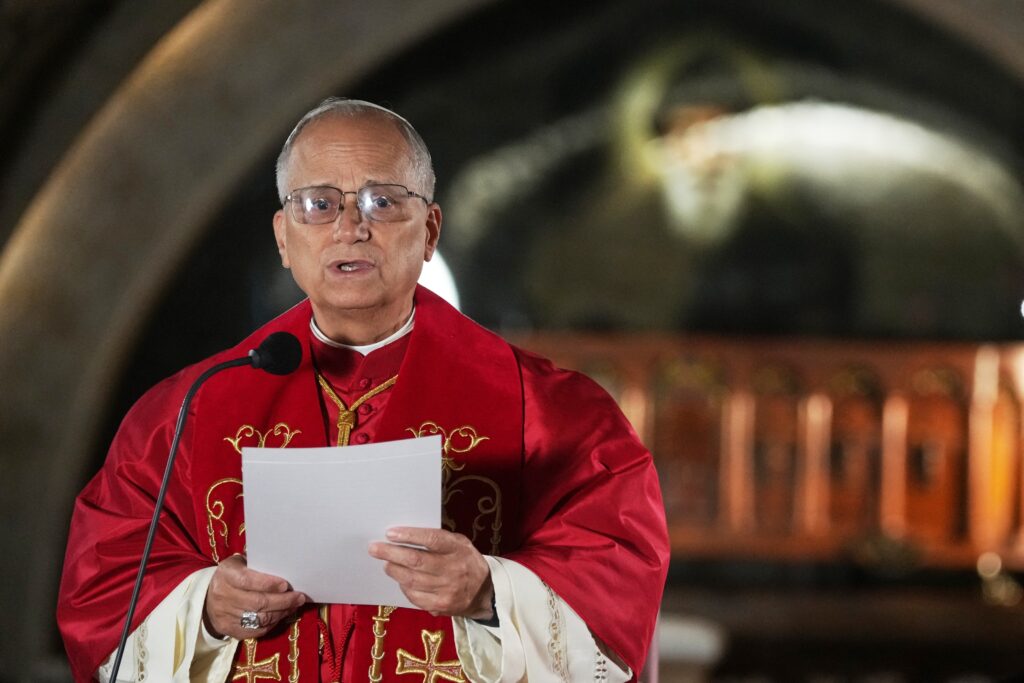
“It is a great joy for me to meet with you and to visit this land where peace is much more than just a word, for here peace is a desire and a vocation; it is a gift and a work in progress,” Leo said in an address to Lebanese officials after landing.
The influence of popes has waned over the decades and centuries, but Leo’s trip here suggests they can still serve to galvanize hope, even if fleeting. For three days, he is being seen by many as a balm for what ails Lebanon, which not just the threat of more violence.
Most depositors here remain locked out of their savings six years after Lebanon’s financial crisis. The country has seen little accountability following the 2020 blast at the port of Beirut that killed more than 200, left thousands injured and destroyed wide swaths of the city. Internal struggles abound as the government gingerly seeks to disarm Hezbollah — not nearly fast enough for Israel and the United States.
“The power popes have is not transactional,” said Austen Ivereigh, a journalist and longtime Vatican watcher. “In that sense, they are powerless. But as papacies have shown time and again, they have the capacity to create new horizons of hope.”
Leo’s trip, many Lebanese say, can highlight their suffering and focus attention on a country that desperately wants more global support to end an exhausting cycle of chaos.
“What is striking is that many Lebanese view the pope’s visit as potentially offering a reprieve from Israel’s continued attacks on Lebanon,” said David Wood, a senior Lebanon analyst at the International Crisis Group. “The visit of the pope has done more to inspire hope in people that Israel might reduce its attacks than anything that the Lebanese government has been able to do since the ceasefire came into effect.”
Rafic Shlalla, chief media officer to Lebanon’s Christian president, Joseph Aoun, said that “the visit of the pope is a hope for a new horizon to reach a solution at a time when tension is mounting and fear of a new war is waving its way in the country.”
But papal trips can also be leveraged — and in Lebanon, that is happening, too. As the pope’s motorcade left the airport, it passed through the Hezbollah-heavy southern suburbs of Beirut on Sunday afternoon. Some in the throng of greeters clutched images of the group’s slain leader Hasan Nasrallah and waved the militant group’s flag. Some cried “Free Palestine.”
In a neighborhood damaged in the war with Israel, two women waited for the pope in a partially destroyed building. Some residents said they felt “seen” by the pope’s decision to travel that route, rather than take one that could have avoided Hezbollah territory.
Hezbollah dispatched its boy scout group — the Imam al-Mahdi Scouts — to welcome the pope in a decision that some observers saw as part of an concerted effort by the militant group to use the pope’s trip to project an image of moderation.
“What we are doing today here is normal for us, and it’s expected of the Mahdi Scouts because we are the people of this area, and because the southern suburbs are shared by everyone,” said Abdelriddah Halam, a Mahdi Scoutleader. “There are churches, there are mosques, and everyone lives together.”
In a country desperate for peace, papal trips have become touchstones. In 1997, when Lebanon was under heavy Syrian influence and still licking its wounds from an Israeli bombardment a year earlier, Pope John Paul II drew 300,000 worshipers to the Beirut waterfront for a Mass that was described at the time as the largest single gathering of Lebanese since at least the end of the 1975 civil war. He trod somewhat lightly during the trip but still noted “the presence of non-Lebanese forces” and the “impression among some that their rights are thwarted,” reports at the time said.
John Paul also backed a solution in Lebanon that included “rights for all,” calling for reconciliation between Christians and Muslims.
During Pope Benedict XVI’s trip here in 2012, he drew a crowd that some estimates say may have topped John Paul’s. But as Lebanon’s Catholic population shrinks and new measures are put in place for crowd control, organizers are estimating the audience for Leo’s main event — the waterfront Mass on Tuesday — to be between 100,000 and 150,000.
During his visit, Leo has engaged with dignitaries at the presidential palace, symbolically watering a sapling Cedar, Lebanon’s national tree. He spoke to nuns Sunday evening and met Monday morning with clerics and pastoral workers at the Shrine of Our Lady of Harissa, a major pilgrimage site. He was scheduled to host an interfaith dialogue in Beirut’s Martyrs’ Square, followed by an encounter with Lebanese youths in front of the Maronite Patriarchate of Antioch in Bkerké, a mountain town north of the capital.
The post In war-weary Lebanon, many look to Pope Leo for peace appeared first on Washington Post.