From the outside, the grocery-store-size facility that sits off a highway a short drive from Baltimore looks like a Costco store.
Inside is the equipment for one of the funeral industry’s fastest-growing trends: human composting.
Earth Funeral, a company with offices in San Francisco and New York, describes the process as “soil transformation.” For about $6,000, a body is placed in a “vessel” with wood chips, mulch and wildflowers. After about a month, it turns into 200 to 250 pounds of compost that can be returned to families to be spread beneath a tree, placed in a memorial garden or donated to a land conservation program.
The company opened its facility in Elkridge, Maryland, in early May, adding to an expanding menu of eco-friendly after-death options that includes water cremation, biodegradable caskets and reef burials.
Tom Harries, Earth Funeral’s chief executive and co-founder, said the composting process is “true to science” and similar to what would happen on a forest floor — only accelerated, “gently transforming bodies into nutritionally rich soil.”
“It looks like soil you’d buy at a gardening center,” he said. “It’s taking something functional and making something beautiful. It returns you to nature.”
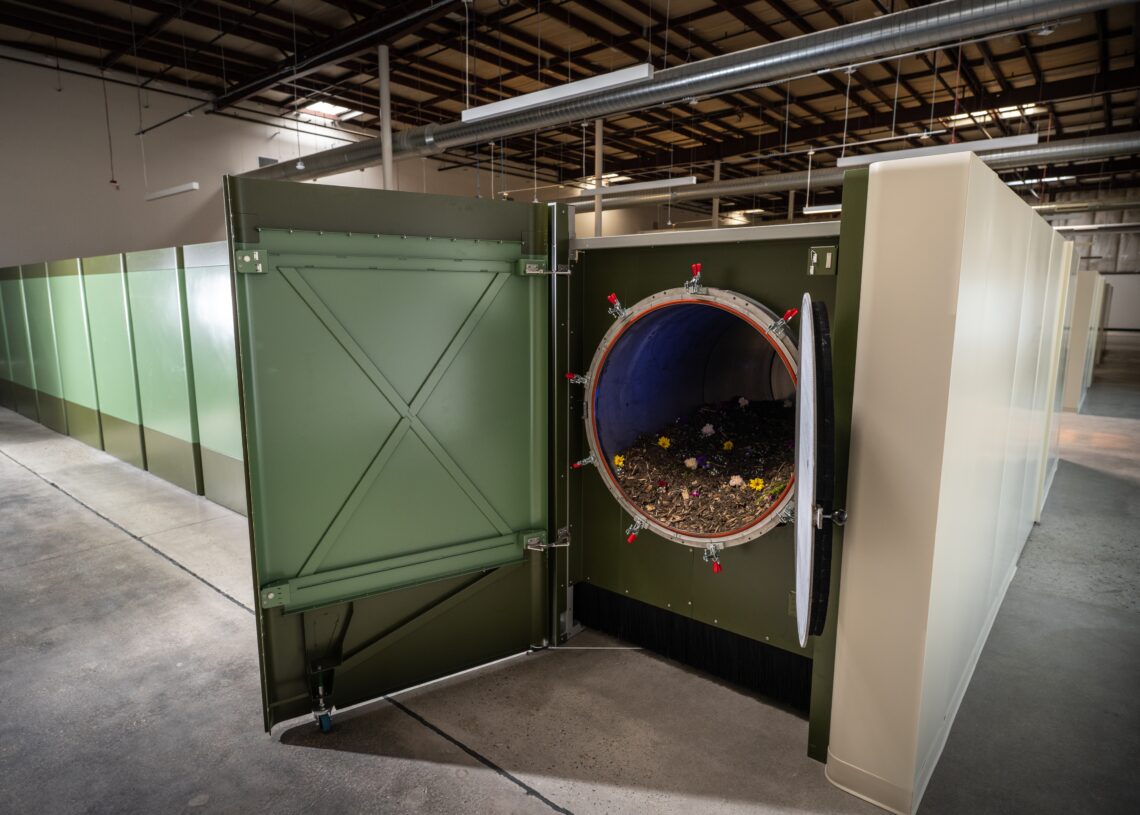
The company’s 37,000-square-foot facility features a large room that can fit up to 126 capsule-like vessels where bodies are placed and eventually turned into soil. Nearby, another room allows families to view their loved ones and say a final goodbye.
A body is wrapped in a biodegradable shroud and placed with 100 pounds of organic mulch, wood chips and wildflowers inside a sealed, stainless-steel vessel, where for 30 to 45 days controlled temperature, moisture and oxygen levels help microbes break it down. Temperatures exceeding 131 degrees ensure that pathogens are killed. As the body gives off carbon and the wood chip mix provides nitrogen, “microbes break everything down on the molecular level, producing a nutrient-rich soil,” Earth Funeral says on its website.
The output: compost.
For those with artificial joints, metal rods or plates, or dental fillings, Harries said, the materials are removed at the end of the composting process and recycled.
Once dominated by conventional, inground burials, the funeral industry has undergone major shifts in recent years. Nearly 64 percent of Americans were expected to be cremated in 2025, while 32 percent were buried, and a small share donated their bodies to science, according to the National Funeral Directors Association.
Conventional burials are facing increased scrutiny because they often involve embalming chemicals, metal caskets and concrete vaults, and cemeteries require large amounts of land. Cremation, meanwhile, relies on fossil fuels and releases pollutants.
As more people adopt greener lifestyles that reduce their carbon footprint — changing the cars they drive and the way they power their homes and manage waste — many are also choosing more eco-friendly funeral options, industry experts said. A survey by the funeral directors group found that 61 percent of people in the United States are interested in exploring more natural, “green” funeral options.
Eco-friendly burials can also cost less.
A conventional funeral averages about $8,300 before cemetery and other burial costs, which can add thousands of dollars to the expense. Cremation averages about $6,300, according to the association.
Being turned into soil appealed to Dave Buermeyer after he read an article about the process.
Buermeyer, 84, said he signed up himself and his wife in February to be turned into compost at Earth Funeral’s new Maryland facility.
“I’d never heard of it, so I did a little research on it, and the more I learned, the more I liked the idea,” said Buermeyer, who lives in Reston, Virginia.
At first, he admitted, “it took a little getting used to.” But after he listened to an Earth Funeral webinar, he became convinced.
“It was a simple, honest and natural way” to handle death, Buermeyer said. “I liked the notion of returning to Earth in a useful way.”
A retired Air Force colonel, he said he hopes his composted body can someday be spread in a designated “green” area at Arlington National Cemetery, though spreading human compost is not permitted there now. Otherwise, Beurmeyer said, he’s comfortable with his compost remains being scattered with his wife’s in a garden or forested area.
Earth Funeral opened its first location in a Seattle suburb in 2020 after Washington state became the first to legalize human composting. The business is tightly regulated in the U.S. and requires legislative approval. As of September, human composting is legal in 14 states, including Delaware, Maryland and New Jersey, according to the National Funeral Directors Association.
Maryland Gov. Wes Moore (D) signed the Green Death Care Options Act in May 2024. The law, which took effect that October, legalized both human composting and alkaline hydrolysis — a process sometimes called “water cremation.”
For funeral directors, keeping up with the changing industry has been challenging.
John O. “Jack” Mitchell IV, a former president of the National Funeral Directors Association, said funeral homes want to meet changing demand, but investing in eco-friendly equipment can be expensive and risky. Some funeral homes, he said, partner with companies such as Earth Funeral and help transport bodies to states where human composting is legal.
Mitchell said he’s seeing more Gen Z customers leaning toward environmentally friendly burials.
“People are less inclined to have a traditional burial with an open casket anymore,” said Mitchell, a sixth-generation funeral director at Mitchell-Wiedefeld Funeral Home in Baltimore. “Many families today prefer more of a celebration of life. More people also want to make choices that are good for the environment. … With this, you can be green one last time.”
Some critics of human composting, however, argue that the practice still carries a carbon footprint because bodies often must be transported by vehicle or plane to states where it is permitted. They instead advocate for simple natural burials in which bodies are wrapped in linen or cotton, and then put in containers made of pine or bamboo that can decompose naturally.
“No embalming, no metal caskets, no concrete vaults. Just the body in a linen cloth,” said Lee Webster, a former president of the Green Burial Council, a nonprofit group. “We’re letting nature do what it’s intended to do.”
For Hal Perez and his wife, Tammi Stauffer, having their bodies become compost after death fits with their outdoorsy lifestyle of biking, kayaking, hiking and skiing.
They stored instructions on their phones — and on their grown children’s devices — about what to do if they die while traveling overseas. The first directive: Don’t embalm, which prevents human composting.
The Baltimore couple said they switched from planning cremation to human composting after seeing an Earth Funeral ad on Facebook and attending one of the company’s webinars.
“We liked the idea of not taking up a piece of real estate for perpetuity,” said Perez, 61, an automotive software performance manager.
Stauffer, 60, a photographer and avid gardener, said she tries to live in line with her environmental values.
“Polluting the environment is not part of that,” she said. She avoids planting invasive species and using harmful pesticides in her yard, and she said she sees composting her body as “part of being good stewards to this Earth.”
The post Human composting turns bodies to soil — and the trend is growing appeared first on Washington Post.