The sun burned brightly in Farmville, Virginia, last week. Family and friends gathered outside a historic church there, slowly filing into cars for the long funeral procession to my aunt’s final resting place. This solemn rite is a common sight in the rural South, so the locals extended a little grace to the mourning mass, creating a midday traffic jam on the town’s Main Street. Rain was in the forecast, but the heat felt comforting — the afterglow of a life well-lived.
Just then, a high-end pickup truck with tinted windows arrived at the intersection, engine rumbling. Those of us from out of town were easy to spot — our eyes immediately fixed on its Confederate battle flag decal. The drive to First Baptist Church, where the Rev. Martin Luther King Jr. once rallied residents, took us into the heart of the Old South, about an hour west of the Confederacy’s capital in Richmond. We readied ourselves when the passenger-side window rolled down. An older White woman appeared: “Our condolences,” she said, in a drawl. “May God comfort y’all in ya time of need.”
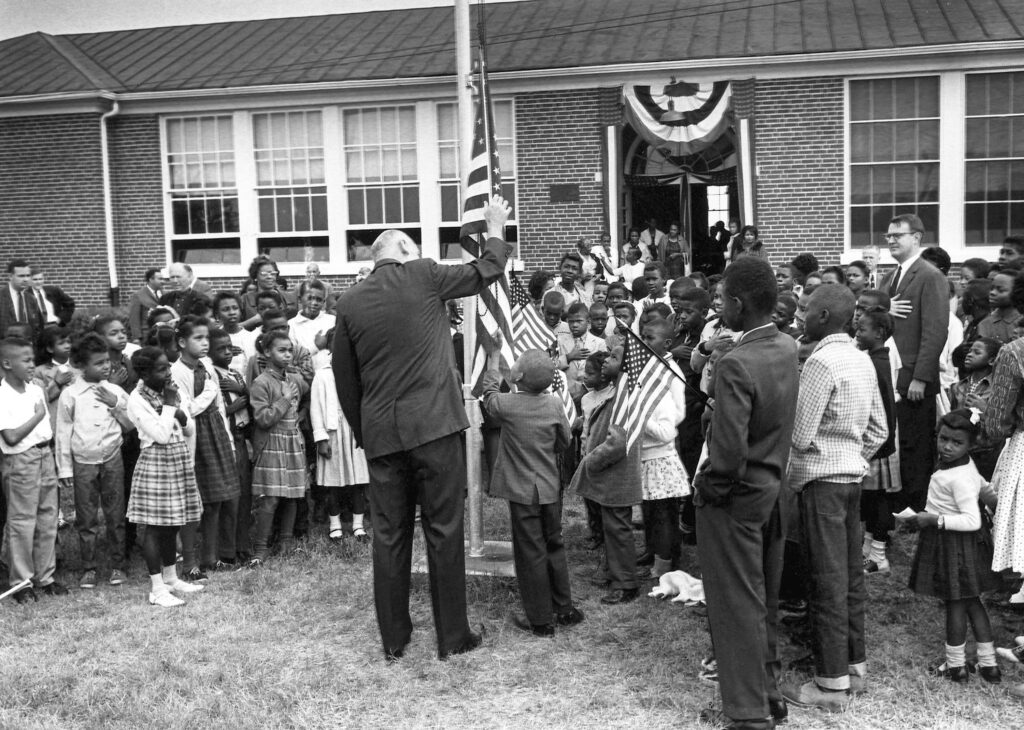
Farmville was long a hub for harvesting and transporting tobacco. Before the Civil War, most of its Black population was enslaved; after the war, racial segregation and voter disenfranchisement ruled the day. It reached a boiling point in the 1950s when Black teens staged a strike, complaining their high school had no gym or cafeteria, no bathrooms for teachers and unsuitable classrooms that passersby mistook for chicken coops; students had to hold umbrellas at their desks due to leaky roofs. Civil rights activists sued the school system, and the case was consolidated into the landmark Supreme Court case Brown v. Board of Education in 1954. But Prince Edward County employed a strategy of noncompliance termed Massive Resistance, devised by elected segregationists. And in 1959, after courts ruled that shutting campuses down was unconstitutional, the county was the only jurisdiction in the nation to close its schools rather than integrate.
My aunt was an educator there for more than 30 years, beginning work a few years after the Supreme Court ordered the schools reopened in 1964’s Griffin v. School Board of Prince Edward County. She taught middle school English, served as an adviser to the student council and earned a teacher of the year award. She was also a religious leader — at both the church where the funeral was held and at the one 30 miles west where she was to be laid to rest.
The caravan escorting her stretched for dozens of cars, wending its way through the countryside with hazard lights blinking. The flags and license plates, bumper stickers and yard signs we passed made clear that our procession — filled with the children and grandchildren of the civil rights movement — was traveling through a place shaped by support for Lost Cause Confederate myths and their echoes in today’s politics. Without fail, though, every vehicle gave way — a deference to law or custom that couldn’t be expected when King visited the church where my aunt was eulogized. Drivers sat reverently at intersections through light changes or moved to the side of the road out of respect. Today, fundamental disagreements about America likely put the people in the scene at odds on any number of issues, but they all paused for the ritual, honoring one of their own who’d fought the good fight.
Even the heat seemed to yield. The sun finally let up just as our stream of cars exited the highway near Appomattox onto Confederate Boulevard. One side of town came to a virtual standstill as we snaked through traffic lights and lane changes — as likely to see an American flag as a Confederate or bright yellow “Don’t Tread on Me” one that Jan. 6 rioters brandished at the Capitol. A breeze picked up once we’d finally arrived at the small church off Promise Land Road, a community founded by newly freed Black Virginians at the end of the Civil War. The service was beautiful and befitting a woman who left the world better than she found it.
With the weather perfect, we lingered outside the church for a little while afterward. But the breeze brought storm clouds and, before long, the parking lot emptied as people started their trips home. Leaving felt a little like the end of an era, a farewell to a previous time. My aunt’s elegy and eulogy, each delivered by a sibling, shared that she was a proud sharecropper’s daughter, raised in a world that didn’t give way to people like her. It did last week, though, in the heart of the Old South.
I took the scenic route out of town to see the historic courthouse in Appomattox. The Main Street there was flying American flags on every block, seemingly an ode to the nation’s 250th anniversary this year. The rain arrived just as the courthouse appeared in the clearing. Visiting the towns where the Confederacy and Jim Crow both surrendered felt like a fitting end to the day. Then, on the drive home, a few minutes before reaching the major interstate, a massive Confederate flag appeared on the horizon, waving at the drivers passing by.
The post The heart of the Old South pauses for a funeral procession appeared first on Washington Post.