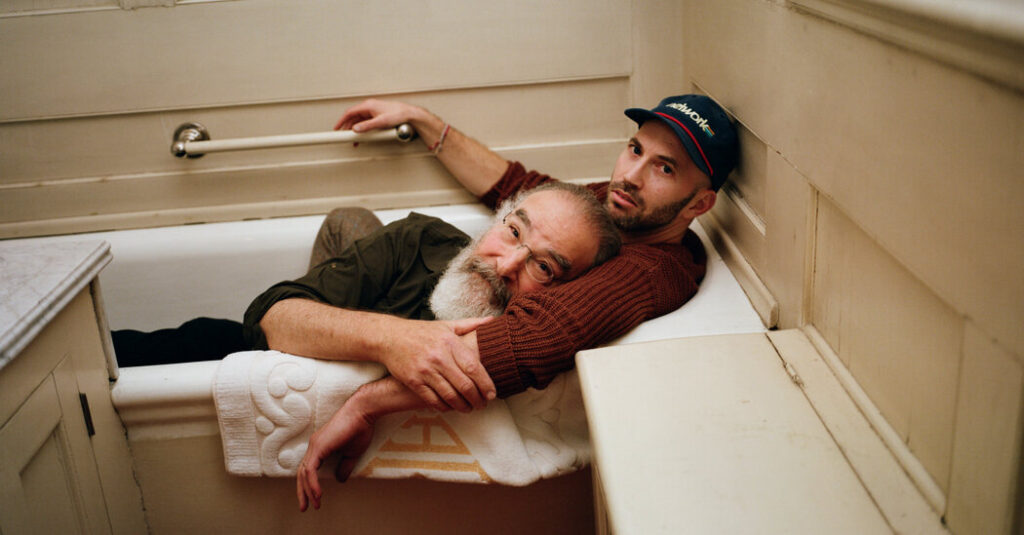
Mandy Patinkin always seems to be thinking about music, even when he is discussing a part that never required a note from his celebrated tenor. While other actors might need to feel a certain chemistry before committing to a role, he has to hear an inner melody.
“Can I sing with him?” Patinkin, who is 73, said last month. He was recalling what he asked himself when he met Aram Rappaport, the 38-year-old writer and director who was sitting next to him in the drawing room of the Hill-Stead Museum in Farmington, Conn., an art-filled 1901 Colonial Revival mansion. “Meaning, can he be my piano player? Meaning, can we make music together?”
Patinkin decided they could, and the resulting series, while not a musical, could easily be described as operatic in its passions and power plays. Created by Rappaport, that show is “The Artist,” a six-part historical drama that premiered last week on the Network, a free ad-supported streaming service Rappaport founded last year. Its cast includes not only Patinkin but also Hank Azaria, Danny Huston, Janet McTeer, Patti LuPone and other stage and screen luminaries.
Set in Rhode Island in 1906, “The Artist” stars Patinkin as Norman Henry, a secretly sentimental robber baron whose acquaintances include real historical figures like Thomas Edison (Azaria) and Edgar Degas (Huston), as well as the actress and model Evelyn Nesbit (Ever Anderson), who was the lover of the architect Stanford White. (The show also features Nesbit’s troubled husband, Harry Thaw, played by Clark Gregg, who murdered White.)
The beleaguered Norman is at the end of his wealth, his rope and, as it happens, his life. This isn’t a spoiler: Viewers learn immediately that he has gone to his grave — or, in his case, an unceremonious pyre — on the grounds of his own mansion (Hill-Stead stars in this role).
On the surface, “The Artist” is a whodunit. But the series also poses another mystery: How did Rappaport, a writer and director who is not yet 40, attract such a high-power cast to a show on a fledgling platform that, to date, has only six other original productions, a small selection of licensed films and series and almost no brand recognition?
For Patinkin, the answer boiled down to artistic ambition and a kind of rebellious energy, themes that drive the entire series.
“If I got two choices in front of me, and one is the really great, tried-and-true director who’s in his 50s, 60s, 70s, has all kinds of awards, and then there’s this kid who just is trying to get it going, has one thing to show me, then I want the kid,” Patinkin said. “Because that’s the hungry guy, that’s the guy that’s going to work really with everything he’s got, not try to repeat anything.”
Set mostly in the week before Norman’s murder, “The Artist” makes clear that just about all of his associates could have wanted him dead. Marian Henry bitterly resents her husband’s dismissal of her intellect and her dreams. Edison wants Norman to invest in his latest invention but accidentally receives a knockout punch. Lilith (Ana Mulvoy-Ten), a young French ballerina, longs to perform in Paris but is stuck on Norman’s estate as his personal entertainment.
And then there’s the artist. The Henrys don’t realize initially that the down-on-his-luck, partly blind painter from whom Norman has commissioned a work is actually Degas, who growls at Norman, “If you do not pay me, I will slit your throat.” He sounds as if he means it.
“I knew that I wanted to write something that was like historical fiction, where a bunch of different artists came together in a period,” Rappaport said. He and Patinkin agreed that everyone in the story was, in some sense, an artist, and although the series often plays like a rapid-fire farce, the characters are all engaged in a serious struggle to create.
“The murder mystery is the selling point and the entertainment factor,” Patinkin said. But what drew him to Rappaport’s script, he added, were “the layers of reality, in terms of human connection, human beings, human success and suffering, human longing.”
Rappaport said he had conceived the show during the writer and actor strikes of 2023, when the studio heads often reminded him of robber barons. It intrigued him to pit a fictional mogul like Norman, who thinks there is even an art to melting scrap metal, against a real artist like Degas.
“The Impressionists were the insurgency of the art world at the time,” he said, “and it just felt like we could pull a lot of innovation into one room.”
The lavish space in which Rappaport and Patinkin spoke has its own historic innovations. Monet’s “Grainstacks, White Frost Effect” (1889) hangs over the mantel, not far from that artist’s “Grainstacks, in Bright Sunlight” (1890). Other walls display works by giants including Cassatt, Manet, Whistler and, yes, Degas.
While Rappaport’s proposal to film at the museum excited Anna Swinbourne, its executive director and chief executive, it also worried her. As shooting began, she said, she told the cast and crew that she didn’t want to scare the living daylights out of them — she cheerfully used a term more vulgar than “living daylights” — but, in another way, she did.
“Everything here is priceless and irreplaceable,” she announced. “No pressure.”
Hill-Stead emerged largely unscathed. (A food truck knocked over a lamppost, which wasn’t antique.) The artworks remained untouched, and while they play no direct role in the plot, they bring texture, Rappaport said, as well as inspiration.
“You just feel like you’re being watched by the gods,” Patinkin said. That’s a powerful feeling, he added, “and if you don’t allow it in, you’re the dumbest person on the planet.”
His fellow actors let it in. In later video interviews, McTeer and Huston recalled long periods gazing at certain works. For McTeer, it was the Degas pastel “Dancers in Pink” (circa 1876). The environment also reminded her of the house’s formerly unacknowledged female architect — Theodate Pope Riddle, the daughter of the iron magnate and art collector Alfred Atmore Pope — and Marian’s own plight.
“There are some incredible women who’ve done incredible things,” she said from London, where she was shooting HBO’s Harry Potter series. But, she added, “No one knows about them because men took the credit, or because it was forgotten.” For Marian, “I think that’s her story in this.”
Huston found himself lingering in front of “The Tub” (1886), a Degas pastel portraying a female bather, trying to let what that Impressionist called “premeditated instantaneousness” seep into his pores. “I suppose there haven’t been many interpretations of Degas,” Huston said. “Like, if it was van Gogh or something, it’d be a different thing, or Gauguin. I had the luxury of that.”
Rappaport allowed himself comparable freedom in developing the series’s atmosphere. His characters curse like New York cabbies, and Norman once responds to Degas with “yada, yada, yada.” As Marian’s sister, LuPone delivers Bronx cheers, and Marian once scornfully describes Nesbit’s mother as “lobotomized.” (Lobotomies weren’t performed before the 1930s.)
The anachronisms are intentional, Rappaport said. “We didn’t want to go into this making another version of ‘The Gilded Age,’” he said, referring to the HBO period drama in which “everything is pristine and so flawless.”
“The Artist,” he added, had to be “a little sloppy and messy” to feel like real life.
What influenced Rappaport most, he said, was the 2018 movie “The Favourite,” Yorgos Lanthimos’s whimsically vicious comedy about sexual and political machinations in Queen Anne’s 18th-century English court. Its grittiness is reflected in his own show’s subtitle, “An Allegory of a Prostitute.”
So who is the prostitute? Nearly everyone. Degas, who really did experience a late-in-life decline in fortunes, is reduced to painting the Henrys’ poodles. Edison, who was sometimes accused of appropriating others’ ideas, appears here as a desperate schemer.
“Let’s say that the line between where he was just genius creator and very opportunistic was pretty blurry,” Azaria said. He added that he liked what the script had to say about “people we make icons out of and fame itself — that these are just human beings who are really flawed.”
In the end, Rappaport said, once he locked down his Norman, building the cast was relatively easy. He said he had always envisioned Patinkin for the role; after that actor said yes, the others weren’t hard to persuade.
Rappaport knew LuPone was Patinkin’s friend and offered to write a part for her. McTeer learned about “The Artist” from her friend the actor and comedian John Leguizamo, who owns a small stake in the Network. (Leguizamo executive produced and starred in the streaming service’s first original series, “The Green Veil,” which Rappaport created and directed.)
The Network joins ad-supported streamers that have proliferated in recent years and, like Peacock and Hulu, it offers an ad-free subscription for a monthly fee; unlike those other platforms, its ad-supported version is still free.
Rappaport, who said he financed the Network with income from the Boathouse, the advertising agency he founded in 2013, has big but narrowly focused ambitions for the service. His plan for 2026 is to release only one new original production per month.
Patinkin said he admired Rappaport’s initiative: If there’s “something you want to make better in this world, or do it the way you imagine it, don’t give up.”
This is also a theme Patinkin sees in “The Artist.” The characters struggle, fight and suffer, but they persevere.
He added that while he did not encourage suffering, “I really do encourage anytime something difficult or a mistake happens, look at it as a gift because that’s where you get to find” — and here Patinkin threw out his arms toward the Monet on the mantel — “the light.”
Video camera operator: Rhys Scarabosio.
The post ‘The Artist’ Blends Degas and Dollars, Murder and Mandy Patinkin appeared first on New York Times.