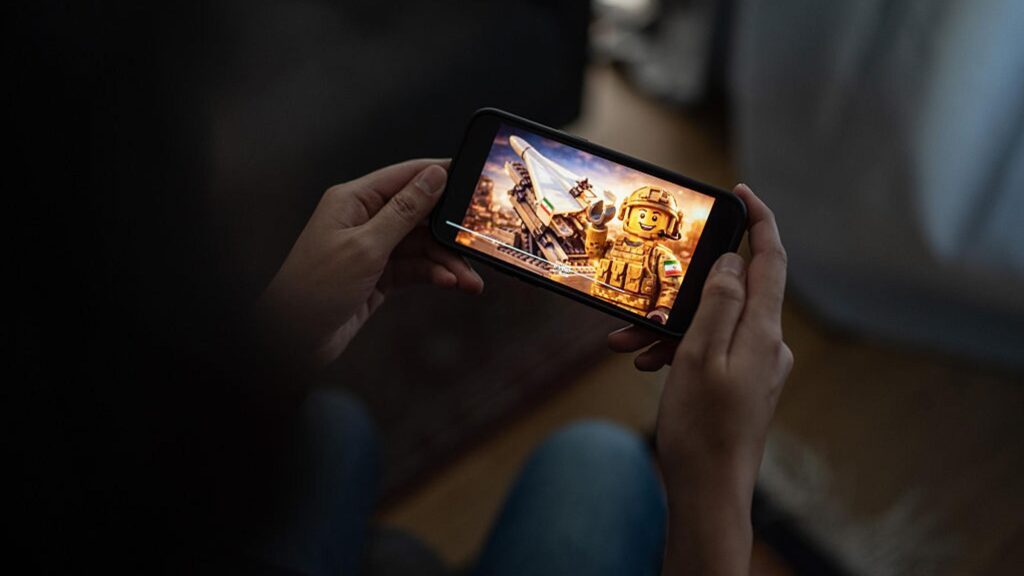
A panicked Lego Donald Trump flips through a folder marked “Llrey Epstein File.” A cackling Lego Benjamin Netanyahu eggs him on, and a Lego Satan looks on pleased. Then Lego Trump fires a missile. It hits a girls’ school, rendered as a pair of pink shoes and a small backpack left in the debris.
This is a vignette from “Narrative of Victory,” an AI-generated short broadcast by Iranian state media on Mar. 10. It has been viewed millions of times on social media, and has been written about, with mounting awe, by analysts in Washington, London and Tel Aviv. The Islamic Republic, we are told, has discovered something new: a state weapon disguised as a provocation, a viral artifact the United States and Israel cannot match.
There is a chorus of singing this tune. The Wall Street Journal, CNBC, The Nation, New Lines, PBS NewsHour, France 24 and The Hill have all published variations of the same theme. The Institute for Strategic Dialogue supplied the headline statistic: in the first 50 days of the war, posts from Iranian embassies and officials drew roughly 900 million views and 22 million likes, a 30-fold jump in engagement.
Iran, we are being encouraged to believe, has won the meme war. The numbers are real. The videos are good. The Iranian embassy in Zimbabwe, mocking Trump with the line “we’ve lost the keys” to the Strait of Hormuz, is funnier than any American diplomatic account has been in years.
But let us not get carried away. The Islamic Republic has not invented a new weapon. Its social-media strategy borrows from a playbook written by someone else. And far from winning, the plagiarists are doomed to fail because they are not as good at this, in the literal and metaphorical senses, as the originators. The playbook is Ukraine’s.
From the first hours of Russia’s invasion of Ukraine in February 2022, Kyiv set about doing in pixels what it could not yet do on the battlefield. Consider Volodymyr Zelensky in his drab-olive T-shirt, filming himself in the streets of his capital; the @Ukraine and @DefenceU accounts trolling Russian bloggers in three languages; the Saint Javelin meme economy; the Snake Island postage stamp; the North Atlantic Fella Organization, a leaderless army of Shiba Inu avatars that a recent study at Nottingham Trent University called “a form of soft power in warfare.”
The Ukrainians used humor to puncture Russian disinformation and to tell the world their side of the story. That campaign worked. It moved Western public opinion, it moved Western parliaments, and it kept the Javelins and the HIMARS coming.
Tehran has clearly been taking notes. The underdog framing, the embassy accounts running wild on X, the cultural-reference dunking on a bloated American president—these are Ukrainian moves, transposed to a different war. The mimicry is so close it almost qualifies as flattery. But the Ukrainian playbook worked for two reasons that have no Iranian equivalent.
The first is that Ukraine, in February 2022, was largely unknown to the average Western viewer. Most could not have named its president. Most did not realize it was a raucous democracy with elections, a free press, and a thriving stand-up comedy scene. The memes introduced that Ukraine to the world, filling an information vacuum. As Olga Tokariuk, a researcher and journalist, argued in a Reuters Institute paper, Ukrainian humor worked as a “gateway to a deeper understanding of Ukraine’s history and culture.”
The second reason is more important: the Ukrainian memes were consistent with the underlying reality. The witty, defiant, democratic Ukraine of the embassy accounts was the same Ukraine that journalists and diplomats and refugees and weapons inspectors all found on the ground. The propaganda did not have to overcome the truth; it only had to surface it.
Iran has neither advantage. The Islamic Republic is not obscure; it is among the most-covered, most-analyzed, most-sanctioned regimes on earth, and the public record of its 47 years in power is thick and damning. The mass executions of political prisoners in 1988 are well documented—including the fact that some young women among them were first raped by their guards, on the theologically dubious premise that virgins could not be executed.
The pattern of violence has persisted through the decades since: Supreme Leader Ali Khamenei’s thugs clubbing students into submission at Tehran’s Sharif University in 1999; the crushing of the Green Movement in 2009; the slaughter of anti-regime protesters in 2019, 2022, and late last year. Add it all up, and the regime in Tehran has far more innocent Iranian blood on its hands than any of its adversaries in the current war. Beyond Iran’s borders, Tehran’s militias and proxies have run up an Arab body count in the tens of thousands, from Aleppo to Sanaa.
The Lego videos are not surfacing some hidden, virtuous Islamic Republic; they are asking the world to forget the Iran it already knows. Those who dislike Trump and his war—and they are legion—may get a chuckle out of a plastic President squirming. But almost none of them will conclude, on the basis of an animated short, that Tehran is the side worth rooting for.
For that conclusion to take hold, a second proposition would also have to be proven: that Trump’s America is Putin’s Russia. That America kills children abroad and silences criticism at home. That it cannot be trusted to investigate its own crimes.
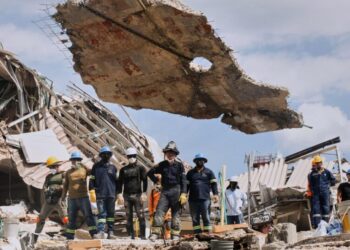
But consider what has happened in the US in the weeks since the Minab strike. The Pentagon initially said nothing. The President, asked by a reporter at Doral on Mar. 7, claimed the strike had been carried out by Iran—a self-serving fiction that did not even survive the weekend. By Mar. 11, Bellingcat, the New York Times, CNN, the BBC, the Associated Press and CBC had independently used open-source forensic analysis to conclude that the missile was an American Tomahawk.
The Pentagon’s own preliminary inquiry found that US Central Command had targeted the school using outdated Defense Intelligence Agency data that identified the building as part of a neighboring military base. Republican Senator John Kennedy—no liberal—told CNN it was “a terrible, terrible mistake.” A group of Senate Democrats, led by Tammy Baldwin of Wisconsin, sent the Pentagon a formal letter demanding answers. And on the North Lawn of the White House, CNN’s Kristen Holmes put the question directly to the man who had ordered the war: “As commander-in-chief, do you take responsibility for that?” Trump, briefly cornered, replied: “I don’t know about it.” Ten weeks after the strike, the President was still being asked for an explanation.
This is what an open society looks like when its military has dropped a bomb on children. The president obfuscates or lies; the press contradicts him; the Pentagon’s own investigators find against him; senators of both parties demand answers; and the polls turn against the war. An Ipsos survey cited by France 24 in late March found 58% of Americans disapproved of the strikes and 78% opposed to ground troops. None of this required a single Lego video.
This is an open society that the Islamic Republic of Iran is structurally incapable of being. There is no Iranian Kristen Holmes asking President Masoud Pezeshkian about the protesters killed in the streets of Mahabad. There is no Iranian Ipsos publishing polls on the regime’s wars in Syria and Yemen. There is no Iranian Tammy Baldwin writing letters demanding answers about the internet shutdowns the regime imposes whenever its own people get restive. The animators of “Narrative of Victory” know this perfectly well, but so does their target audience.
The memory of the schoolgirls of Minab has not been, and indeed, cannot be, erased by the Trump Administration. But nor will the world forget Neda Agha-Soltan, the young woman shot dead in the street for protesting a stolen election, or Mahsa Amini, the young woman tortured and murdered by the morality police in Tehran, or Narges Mohammadi, the Nobel Peace Prize laureate dragged by her hair by Iranian security forces late last year.
We do not need them rendered in Lego to remember them or to recognize the Iranian state for what it really is.
The post Iran Did Not Win the Meme War appeared first on TIME.