Republicans in Texas began uniting behind a slate of hard-line candidates elected on Tuesday, looking beyond their bruising and protracted primaries and toward a November showdown against newly energized Democrats.
They did so with President Trump’s hand firmly on the controls of the party in the nation’s most powerful conservative state.
Ken Paxton’s resounding victory in the Republican runoff for U.S. Senate solidified Mr. Trump’s iron grip. And candidates backed by Mr. Trump also won in U.S. House primaries around Houston and San Antonio, where the president’s influence was pitted against that of state leaders, including Gov. Greg Abbott.
In choosing Mr. Paxton, and several other MAGA-aligned candidates, Republican primary voters in Texas made a familiar bet: that the state is conservative enough that any Republican, even the most conservative, can beat a Democrat in the fall, and keep the state red.
For some Republican consultants, Tuesday’s results demonstrated the increasing power of the Trump-aligned, far right of the party, which has long battled the party’s institutionalists in Texas.
“The activist wing of the party flexes its muscles in the face of the establishment,” Anthony Holm, a former consultant for Mr. Paxton, said in an interview at Mr. Paxton’s election night watch party. He believed the party would come together quickly, “because the alternative is James Talarico,” Mr. Holm said, referring to the Democratic nominee for Senate.
For those like Senator John Cornyn, who was defeated by Mr. Paxton, the only choice now was to line up behind the ticket.
Democrats in Texas had hoped that the fractures would remain beyond the primary. But almost as soon as Mr. Cornyn conceded the race to Mr. Paxton, the state’s attorney general, Republicans urged each other to come together. “Governor Abbott calls for unity after Republican runoff elections,” read an email sent by the governor’s campaign Tuesday evening.
“A united Republican Party will drive victory,” Mr. Abbott said in the accompanying statement.
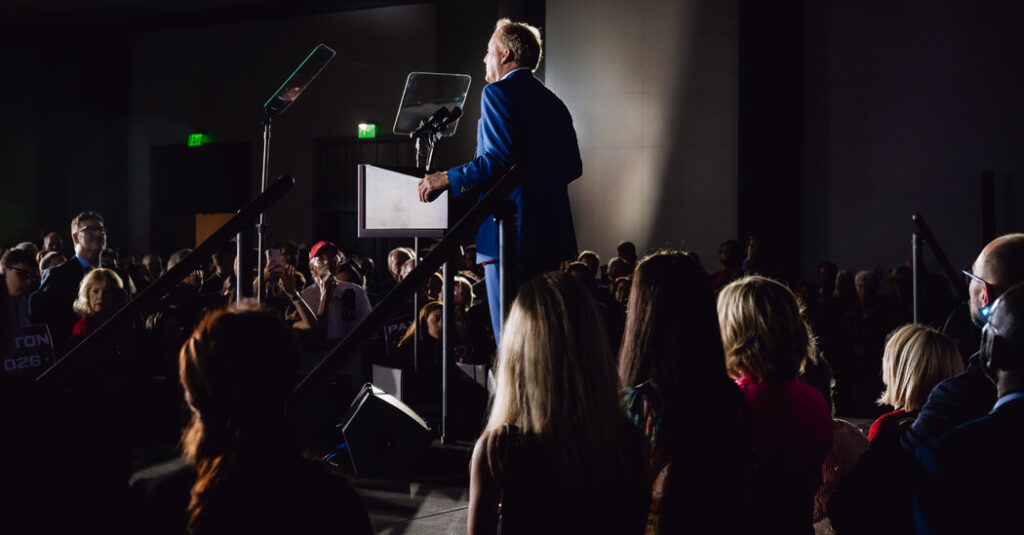
Not known as a uniter, Mr. Paxton also jumped into the role immediately on Tuesday, thanking Mr. Cornyn for his decades in office and describing Texas as the key bulwark for conservative power.
“This campaign is not about red versus blue. It’s about so much more,” Mr. Paxton said from the stage of his victory party in Plano, Texas, on Tuesday night. “If Republicans lose this state, we lose the country.”
Mr. Cornyn similarly expressed his desire to keep Texas red, though he didn’t mention by name the man who beat him.
“My hope is to keep my party in power for generations,” Mr. Cornyn said, addressing an Austin hotel meeting room filled with reporters but otherwise empty aside from his immediate family.
But after an expensive and, at times, deeply personal runoff, Republicans might have a difficult time finding their kumbaya moment.
In the Senate race, Mr. Paxton tore at Mr. Cornyn and the establishment wing of the party that he represents. Mr. Cornyn responded by drawing attention to his opponent’s ongoing divorce — which has included allegations of adultery — and releasing ads featuring an AI-generated Mr. Paxton and two faceless women who were not his wife.
Republicans began late Tuesday trying to repair whatever divisions had emerged, largely by focusing on Mr. Talarico in a stream of social media posts and in at least one new campaign video.
And with the general election set, Mr. Talarico also began his attacks with a video that called Mr. Paxton “the most corrupt politician in America.”
Primary elections in Texas are always rough-and-tumble affairs. Republicans, who have long controlled all levels of state government, treat the races as the only real fight in town — the place where the nastiest battles go down.
But this year’s primaries differed in sheer scale: More than $128 million was spent on advertising in the Senate race alone, with most supporting the ultimately doomed task of trying to save Mr. Cornyn. Millions more poured into the state attorney general race in its final days.
Republican candidates also engaged in new forms of name-calling, occasionally blending their insults with the party’s recent embrace of anti-Muslim rhetoric.
Mr. Paxton attacked his opponent as “Caliphate Cornyn” in an ad. Mayes Middleton, who won his race for attorney general, became “Mecca Mayes” in some mailers. The incumbent railroad commissioner, Jim Wright, was branded “Jihadi Jim” by Bo French, a former county party leader in Fort Worth known for extreme rhetoric.
“The name calling, it’s so beneath Republican politics,” said Chad Wilbanks, a Republican lobbyist and former executive director of the Republican Party of Texas. ”It’s so disheartening.”
Mr. Wilbanks, who supported Mr. Cornyn but did not have a role in his campaign, said that with Mr. Paxton at the top of the ticket, Republicans may need to spend more and campaign harder to win seats up and down the ballot in November.
“You have a lot of independents and women that, quite candidly, just do not like him. A lot of Republicans too, for that matter,” Mr. Wilbanks said. “Republicans won’t vote for James Talarico. But they may not vote in that race at all.”
J. David Goodman is the Texas bureau chief for The Times, based in Houston.
The post Texas Republicans Tore Themselves Apart. Can They Unite to Keep Texas Red? appeared first on New York Times.