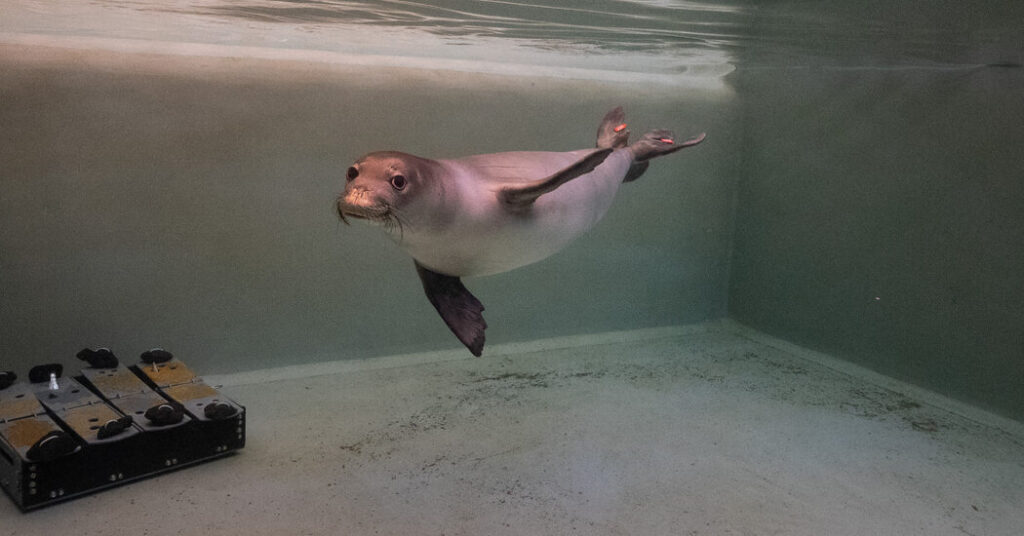
Two wild Hawaiian monk seals, an endangered species, have become the first of their kind to receive vaccines for bird flu, part of a new effort to protect the animals from a virus that has been ravaging marine mammal populations around the world.
The vaccinations represent the next phase of a small study that began this summer in northern elephant seals, which are not endangered. The vaccine appeared to be safe for elephant seals, the researchers found, and prompted the marine mammals to begin making antibodies against the virus, which is known as H5N1.
The quick move to include monk seals was also driven by the discovery that the virus had recently returned to Hawaii; the state’s remote location had previously helped protect the monk seals from the ongoing outbreak.
“This is a real, real threat to the population,” said Dr. Sophie Whoriskey, the associate director of Hawai’i Conservation Medicine at the Marine Mammal Center, which is leading the study in consultation with the National Oceanic and Atmospheric Administration.
Hawaiian monk seals, which were hunted nearly to extinction in the 19th century, face a variety of ongoing threats, including habitat loss, the risk of entanglement in fishing gear and a limited food supply. Over the last decade or so, the population has finally begun to rebound, thanks to intensive conservation efforts, but the species is still in a precarious position; just 1,600 Hawaiian monk seals remain in the wild.
“We’ve seen that population start to go up, but it’s in this really fragile state,” Dr. Whoriskey said. “This virus does have the potential to be catastrophic to that recovery effort.”
The Marine Mammal Center, which is based in Sausalito, Calif., also runs a monk seal hospital in Kailua-Kona, Hawaii. And before venturing out onto local beaches and administering a new vaccine in the wild, the researchers were hoping to test it on at least one of the seals that was at the hospital, where the animal could be closely monitored.
This fall, the hospital found itself with not one, but two good candidates. Both of the seals, young males born earlier this year, had been separated from their mothers when they were too young to fend for themselves. They had been malnourished when they were admitted, but had no other underlying medical conditions and had been steadily putting on weight during their time at the hospital. (“Treatment can be pretty simple,” Dr. Whoriskey said. “Mostly it’s just groceries.”)
Zoetis, a veterinary pharmaceutical company, donated some doses of its bird flu vaccine. In October, at four-months-old, the seal known as RU28 became the first monk seal to be vaccinated, receiving two shots spaced three weeks apart.
He did not seem to experience any serious side effects, Dr. Whoriskey said. In early November, researchers drew a sample of his blood, which will be tested for antibodies to bird flu, and gave him a physical exam, which revealed the young seal to be in good health. Late last month, after being outfitted with a satellite tracking tag, a Coast Guard plane flew RU28 back to his native island of Kauai and released him.
The second seal, known as RU99, was younger and thinner when he was admitted to the hospital, but received his first dose of the vaccine last month. He is scheduled to receive his second shot on Monday. When he is old enough and big enough, he, too, will be released back into the wild.
The Marine Mammal Center plans to track both seals using satellite tags and will also rely upon a network of partner organizations and trained volunteers to report sightings of the animals in the wild. But they may never have the chance to physically examine their study subjects again. “There’s no guarantee that we’ll ever have hands on them,” Dr. Whoriskey said.
If these first two seals continue to do well, and the antibody results are encouraging, the researchers may expand the vaccination effort. In the long run, Dr. Whoriskey said, the goal would be to vaccinate enough monk seals to stave off the sort of mass deaths that have been reported in southern elephant seals. Tens of thousands of southern elephant seals have already died from the virus, scientists estimate.
“This vaccine is a really important tool that we can potentially use to prevent that sort of catastrophic outbreak,” she said.
Emily Anthes is a science reporter, writing primarily about animal health and science. She also covered the coronavirus pandemic.
The post Inside the Bird-Flu Vaccine Trial for Monk Seals appeared first on New York Times.