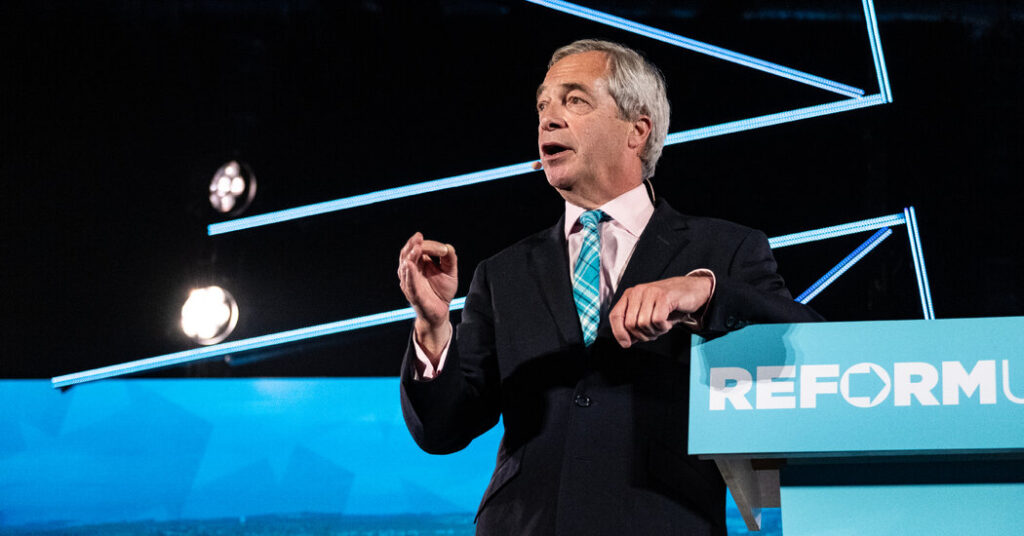
Until recently, Nigel Farage was the leader of small but loud political start-ups in Britain.
For decades, his anti-Europe parties sought to shift the country’s trajectory, using anti-immigrant and nationalist rhetoric to lead the Brexit campaign. But until 2024, Mr. Farage had never been elected to Parliament, and his movement remained on the fringe, unable to dislodge Britain’s two big political parties.
That is all changing.
In thousands of contests for municipal councils across England on May 7, Mr. Farage’s Reform U.K. Party surged past the Tories of Margaret Thatcher fame and grabbed control of councils from Prime Minister Keir Starmer’s Labour Party to become, arguably, the most successful political force in the country.
In just 15 hours on Election Day, Reform won 1,454 council races and surged to victories in the Scottish and Welsh Parliaments. Now, Mr. Farage presides over a national party with reasonable ambitions to take control of Parliament in the next general election, which must be held by 2029. That would make him Britain’s next prime minister.
“We have professionalized the party,” he boasted on May 8, calling the election results “a big, big day not just for our party but for a complete reshaping of British politics in every way.”
And yet, even people close to Reform acknowledge there are big challenges ahead. The party’s leadership is often accused of being better at sound bites than developing substantive policy. Reform has made few inroads in any of Britain’s large, metropolitan centers like London. This month, Mr. Farage was accused of breaking parliamentary rules by failing to declare a gift of about $6.7 million from Christopher Harborne, a cryptocurrency billionaire who lives in Thailand. Mr. Harborne has also given about $12.1 million to the Reform U.K. Party.
(Mr. Farage has said the $6.7 million from Mr. Harbone was made before he was a candidate for Parliament).
“So far, Reform hasn’t really made a coherent political case to the country,” said Ben Habib, a former top Reform official who broke with Mr. Farage in 2024. He said Reform would have to work harder to convince people that they can govern effectively if it wants to win more elections. “They can’t just assume the other two parties are going to lose.”
In the local elections this month, Reform’s candidates often won primarily because they were competing against multiple other parties. Overall, Reform won only about 26 percent of the vote, falling slightly short of earlier polling. About three-quarters of voters cast ballots for another party.
There’s also the issue of how far to the right the British public is willing to be dragged by Mr. Farage.
Opposition to immigration is the centerpiece of Reform’s political agenda, and the party’s success this month suggests it is resonating with many voters. Migrants in Britain are often cited as the second-biggest concern in polls, behind the rising cost of living, even as the level of immigration has fallen sharply under Mr. Starmer’s government.
Mr. Farage’s spokesman did not respond to requests for comment.
But Mr. Farage, who has vowed to deport every illegal immigrant, is also a polarizing figure in the country. In one poll, a third of Britons say they view him as an “extreme right” candidate. Some Reform allies say that will make it harder to expand the party’s support to win enough seats to take power.
“We have to do something to reassure middle England that we aren’t the Nazis,” said Tim Montgomerie, who was once an adviser to Boris Johnson, the former Tory prime minister, but defected to Reform after 33 years in the Conservative Party.
Beyond that, Mr. Montgomerie said, Reform needs to tap into voters’ frustration with traditional politicians. He pointed to an incident last week in which a British man repeatedly heckled Rachel Reeves, the chancellor, about taxes and the rise in prices during a media appearance.
“Reform have captured the anger in the country,” said Mr. Montgomerie, who worked to pass the Brexit referendum a decade ago. “The anger is extraordinary. It’s off the scale. People feel that the government just has no idea how hard their lives are.”
Nick Tyrone, a journalist who spent nearly two years interviewing Reform voters and activists for a coming book on the party, said that he was surprised that the anger cut across party lines, especially in places outside cities.
“I thought it would be like diving into a Facebook meme — ‘Christmas is being canceled,’ anti-vax and conspiracy theories about Soros,” he said, a reference to George Soros, the liberal billionaire who is often the target of right-wing critics. Instead, he said, he found “a lot of people from traditionally Labour backgrounds. Very working class. And they’re getting the most traction in the places that are most impoverished in Britain.”
As Reform’s reach has expanded, so have the controversies surrounding some of its representatives. One Reform council member who was elected in May was suspended by the party when it emerged that he had suggested in online posts in 2024 that the Nigerian population in his district should be melted down to “fill in potholes.” Another new member resigned his seat and was expelled by the party after allegedly describing white people as “the master race” and saying they have “larger brains.”
Associates of Mr. Farage acknowledge the problems. But they point out that when members of their party have made controversial comments, the leaders have been quick to suspend or expel them.
The next big test for Reform U.K. will come in a matter of weeks, when Andy Burnham, the Labour Party mayor of Greater Manchester, tries to win a special election in Makerfield for a seat in Parliament, a condition for his being eligible to challenge Mr. Starmer to become the Labour Party leader. Mr. Farage has already vowed to go all out to defeat Mr. Burnham and embarrass Labour.
Makerfield is a working-class community between Liverpool and Manchester, and Mr. Burnham is very popular there. But Reform trounced Labour candidates there in the May elections, sweeping all eight wards and getting almost twice the votes of the next closest party. Robert Kenyon, a plumber, is running for Reform against Mr. Burnham. Stopping Mr. Burnham’s political trajectory would send a powerful message.
“The stakes are high for us,” Mr. Montgomerie said. “If we can’t win in Makerfield, can we win anywhere? White, working class, not many graduates. It’s our kind of territory.”
Jonathan Brown, the founder of the right-leaning Centre for a Better Britain and the former chief operating officer for Reform, said he expects Mr. Burnham might be able to win in Makerfield because he is turning the race into a referendum on Mr. Starmer, who is deeply unpopular throughout the country.
“If there’s anything that unites the country at the moment, it’s that everyone hates Starmer,” Mr. Brown said. “It really is remarkable.”
He said that even if Reform loses that race, the party now has the money — helped by the millions in donations from Mr. Harborne — to make the changes necessary to compete on a national scale in the years to come. What was once a small band of true believers operating out of three rooms has expanded dramatically. Reform is now headquartered in the Millbank Tower, a nearly 400-foot skyscraper along the River Thames.
The party’s policy team is growing rapidly, Mr. Brown said, and consulting regularly with think tanks on developing the party’s agenda. Reform is adding a second floor in the building to accommodate its growing campaign and policy staff.
Mr. Farage has also begun building a team of advisers who would serve in his cabinet if he were ever to become prime minister. He made Robert Jenrick, a former conservative member of Parliament who joined Reform in January, his shadow chancellor, a designation that indicates he would become the top finance official in a Farage government.
Richard Tice, a Tory donor, and Suella Braverman, the former Conservative home secretary, who also defected to Reform, have been named shadow energy secretary and shadow education secretary, respectively.
The challenge now is whether Mr. Farage and his team can take advantage of the party’s political momentum so that Reform can be ready for the next general election.
Mr. Tyrone, the author, said his conversations with voters across the country suggested the momentum is deep and wide.
“There’s just whole parts of the country” supporting Mr. Farage and his party, he said. “There’s going to be whole parts of the Northwest of England that are going to go. There’s going to be whole swathes of the Midlands that are going to go Reform, no matter what.”
“When people are enthusiastic about someone, it’s usually Reform,” he added.
Michael D. Shear is the chief U.K. correspondent for The New York Times, covering British politics and culture and diplomacy around the world.
The post Can Nigel Farage’s Right-Wing Party Win It All in Britain? appeared first on New York Times.