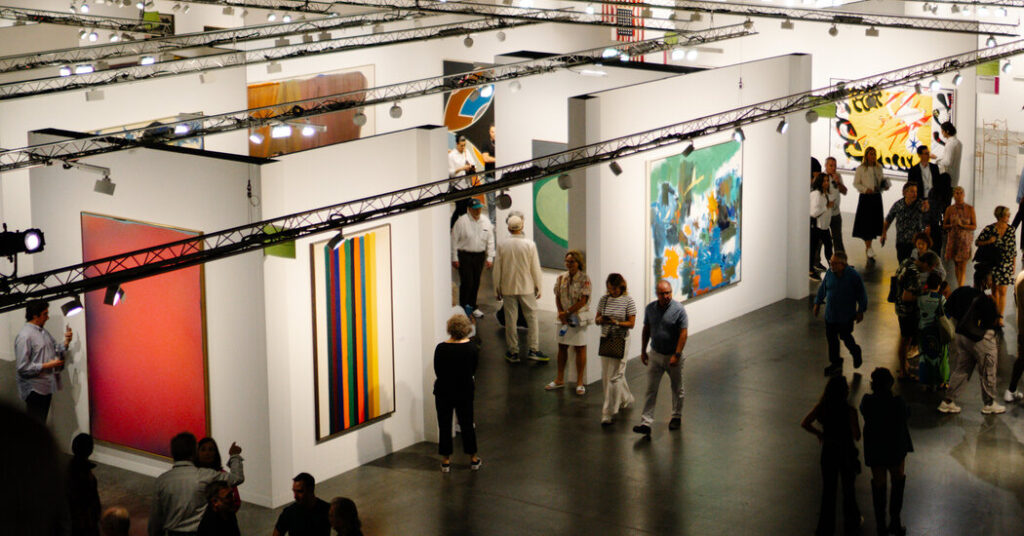
A foreboding air greets the 23rd edition of the Art Basel Miami Beach fair opening this week, capping a year of sluggish sales that were financially devastating for many galleries. As collectors, curators and dealers swoop into South Florida for Wednesday’s V.I.P. preview, some analysts have pointed to the $2.2 billion results at the marquee November art auctions in New York as evidence that the market has found its footing. But that is little comfort to the spate of pre-eminent galleries across the country that have already closed, including many thought to be blue chip and resilient to even a steep downturn.
The Basel fair itself has seen an unprecedented 14 of its originally announced 285 galleries withdraw from participating. Some shuttered their doors permanently, while others decided the often six-figure outlay to exhibit was now too risky a gamble. Another 12 galleries were subsequently tapped to fill those vacated slots.
One of the originally accepted dealers who pulled out, New York’s Miguel Abreu, told ArtNews, which reported eight gallery withdrawals in October, that after exhibiting at both Frieze and Art Basel Paris earlier that month, “Three fairs in the fall would be too much,” and “frankly, last year in Miami for us was less than stellar.”
Addressing that sentiment, which is one quietly echoed by employees at several other withdrawing galleries, Bridget Finn, the director of Art Basel Miami Beach, acknowledged that such reassessments were “exactly what we expect in a cycle like this.” She said the slump was already in the rearview mirror, pointing to “tremendous momentum” at Art Basel Paris and November’s auction results as proof of “renewed confidence at the top end of the market.” She added that this uplift was “very much carrying into Miami Beach.”
Art Basel, at the Miami Beach Convention Center, along with its surrounding sea of satellite fairs and special events referred to as Miami Art Week, has long served as a barometer for the health of the art market. That has been especially true for Miami’s local talent who have grown up in Basel’s backyard and basked in its cultural afterglow. Seven of the city’s galleries have been selected to exhibit at this year’s Basel — only 2 percent of the total, but still more than those representing any city in the United States besides New York and Los Angeles.
Miami’s status as a thriving art city is precisely what drew Julia and Max Voloshyn, the co-owners of the Voloshyn Gallery based in Kyiv, Ukraine, to open a second outpost here in 2022 rather than in New York. In the wake of Russia’s invasion of their country that year, making a dramatic global splash became as much a political imperative as a financial lifeline for their now-isolated artists — especially with the Russian president, Vladimir V. Putin, insisting there was no such thing as distinctly Ukrainian art. It was, like all of Ukraine’s culture, he claimed, simply part of Russia.
“We did eight fairs all around the world this past year,” Max Voloshyn said, sounding exhausted just by the memory. This December marks Voloshyn’s debut at Miami’s Art Basel, and they’ve chosen to showcase World War II-era work by the Ukrainian-American painter Janet Sobel, whose 1950s canvases are often credited as a direct inspiration for Jackson Pollock’s drip paintings.
These earlier pieces depict her homeland under siege using a poignant mix of folkloric icons, Yiddishkeit, and eerie figuration. “She was imagining what life was like from abroad,” Julia Voloshyn explained, “and while the invading soldiers were German and not Russian, it feels the same for us now.”
A similar desire to be in the creative thick of it, regardless of market shifts, is shared by Dennis Scholl, a former nonprofit arts executive turned artist, and one of the city’s veteran collectors for over 50 years. Art market crashes are as familiar as the city’s boom-bust real estate cycles, he said. In each instance the market eventually rebounded, but “you couldn’t figure out you were on the way back up again until after it was over.”
Scholl does believe the worst is over, and not only because his own history-minded assemblages are having their own time in the sun: Riffing on events from his ’60s childhood, such as the moon landing, they were exhibited at the Piero Atchugarry gallery (another of the seven in Miami at Basel) and are now showing at both Columbia University’s LeRoy Neiman Gallery and the Hollywood Art & Culture Center.
Other Miami artists are also having banner years. Last February, the Fredric Snitzer Gallery, the only local art space in every edition of Basel’s Miami fair, sold out its show of 13 of Ema Ri’s densely rendered and abstracted landscapes, at $15,000 each. Citing the sale of another 19 of Ri’s paintings since then, Snitzer dismissed the gloomy feelings other dealers were privately expressing as shortsighted.
“This is the 48th year of my gallery,” Snitzer said. “For 30 of those years I was dying, operating hand-to-mouth.” He added, “It depends on what you have to sell.” He cited a waiting list for Hernan Bas paintings — works that Snitzer will also be selling at his Basel booth for $225,000 — “at prices far higher than my first house.” What was unfolding in the gallery world coast-to-coast, he continued, was “a healthy, natural thinning of the herd in terms of quality,” brought on by a glut of dealers pushing often-forgettable work.
Surviving that weeding-out process is foremost on the minds of Miami’s younger galleries and alternative spaces, with some 13 exhibiting at the New Art Dealers Alliance and Untitled satellite fairs — the main feeders for dealers hoping to jump up to Basel and its top tier collectors.
Katia David Rosenthal, of KDR gallery, one of the busy newcomers, said the key was keeping her operation lean, with only a single employee. KDR’s current show spotlights the Miami painter Susan Kim Alvarez, whose swirlingly Day-Glo portraits split the difference between whimsical and monstrous. In addition to exhibiting at NADA, Rosenthal’s late 2023 move into a space in Allapattah — Miami’s newest art neighborhood — seemed ambitious, especially after she had spent the previous two years running a “renegade” gallery out of the tiny first floor of the rented cottage she called home in nearby Little Havana. But despite upsizing, she said she still counted the cost of every lightbulb.
“There’s a lot of galleries where people took outside money to play with,” Rosenthal said, noting the post-pandemic expansions many gallerists embarked on with new investors and dramatic architectural build-outs, racking up now-untenable expenses. “I built my gallery by myself with no funding from anyone,” she added, “and I still run my gallery that way. There’s no other voice except my own that is turning the page.”
Aurelio Aguiló and Mayra Mejia, the co-founders of Homework gallery in Little River, initially took Rosenthal’s philosophy to its extreme. Having previously worked at Manhattan galleries facing soaring rents, Aguiló said, “the tremendous overhead cost of having a brick and mortar space bred the idea of having a nomadic gallery that relies on participating in fairs to get their name out.”
Yet after four years of fairs and pop-up spaces, the appeal of sinking roots — and an art-friendly landlord willing to offer a rental below the neighborhood market rate starting around $24 per square foot — was just too great: Homework took the plunge this fall and signed a lease. In addition to showing intimate photographic slices of Black Miami by Roscoè B. Thické III at the Untitled fair, Homework’s new 2,000-square-foot space will have an installation by Ilsse Peredo, tracing her travels to Bhutan and elsewhere. Their market timing, however, would seem less than auspicious.
“We’re a gallery showing emerging artists,” Aguiló said. By their very definition, “there’s not an established market for them; uncertainty is with us all the time.” And if the overhead becomes unmanageable? Aguiló sounded unfazed: “The gallery won’t disappear. We’ll just pack it up, reassess and start doing pop-up shows again.”
Nina Johnson’s thinking is headed in the other direction. Her eponymously named Miami gallery opened in 2007, but this year marks her debut as an exhibitor at Art Basel. Even with a first-timers discount, she said her total expenses were roughly triple of what she was previously spending to show at NADA, where standard booths are about $14,000.
“I have always believed that when a lot of people are feeling timid, it’s a good opportunity to be bold,” Johnson said. Her Basel booth features relatively untested artists alongside well-established figures, including the acclaimed Miami filmmaker Dara Friedman, who is now taking a turn into beguiling sculpture.
Johnson’s gallery itself hosts “Acid Bath House,” a group show curated by the critic Jarrett Earnest. “It is rooted in what it means to be part of and making work inside a queer community,” Johnson explained. “It’s a show that would be beautiful in New York, but it takes on a new resonance when you open it in Florida, where books are being banned and we’re not allowed to say the word ‘gay’ in public schools,” she added, nodding to recently enacted state laws restricting classroom discussions.
Johnson’s own take on pre-Basel market jitters? “I don’t necessarily think of it as a dip, I think of it as a re-evaluation,” she said, leaving gallerists asking themselves: What matters to you as a dealer? Why have you chosen to show this particular work? “It can’t be purely economic, there’s more efficient and less stressful ways to make a buck,” she added with a laugh.
For Johnson, the answer is always about “helping buoy artists and their work. We think of fairs as being separate from that conversation and they’re not. Or they certainly shouldn’t be.”
The post On the Eve of Art Basel Miami Beach, a Case of the Jitters appeared first on New York Times.