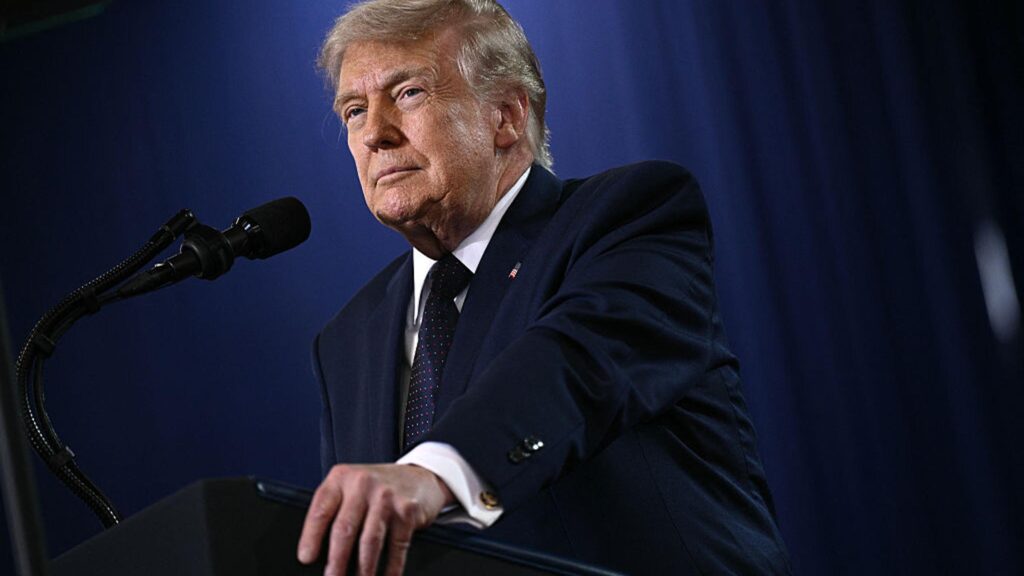
After visiting Walter Reed National Military Medical Center for a physical exam on Tuesday, President Donald Trump offered a succinct update to the public: “everything,” he said, “checked out PERFECTLY.”
It’s not yet clear what details from the visit will be shared with the American people.
Questions about Trump’s health have long swirled, and have only intensified in the months since the President, who will soon turn 80, returned to the White House last year after becoming the oldest person to be elected to the role.
Earlier this month, the White House said that Trump would soon have an annual preventive medical and dental check-up. Tuesday’s visit marked Trump’s fourth known medical exam during his second term.
Trump’s predecessor, former President Joe Biden, also confronted widespread speculation over his health—particularly in the final months of his term, when his disastrous performance in his presidential debate with Trump prompted a storm of scrutiny. Biden ultimately ended his reelection campaign amid growing concerns over his age.
In the face of such questions, it has been up to Trump, Biden, and other Presidents who came before them to decide how much, or how little, about their health to make public. And Trump will again be the one to determine what to share about his latest medical visit.
Here’s why.
Presidents aren’t legally required to release their health records
There is no constitutional or legal requirement for American Presidents to publicly share their medical records. And Presidents, like other Americans, are covered by medical privacy protections under the Health Insurance Portability and Accountability Act (HIPAA).
Any details that are made public are typically shared by the White House, with the President’s consent.
“At this point in time, what the law requires is for a President’s physician to respect a President’s confidentiality, and the President gets to choose what is disclosed,” says M. Sara Rosenthal, a professor of bioethics at the University of Kentucky.
The American people, she notes, may not be satisfied with that arrangement.
“I think the public feels that they have a right to know the health of their sitting President,” Rosenthal says.
Multiple Presidents have concealed significant health issues in the past, including Woodrow Wilson, whose Administration took pains not to reveal the severity of his condition to the public after he suffered a major stroke while in office.
Rosenthal says that concerns regarding Presidents’ health have grown in recent years.
“This has become an issue as the Presidents have aged,” she says. Former Presidents Bill Clinton, George W. Bush, and Barack Obama were all under the age of 65 on their last day in office, Rosenthal points out. In contrast, Biden was 82 years old when he left office in January 2025, and Trump is turning 80 next month.
The state of Biden’s health during his presidency and ill-fated reelection bid, and questions about how much he and his team may have been hiding about his ability to serve a potential second term, have remained a subject of fierce scrutiny long after the end of his time in the White House.
A bombshell book released last year, Original Sin: President Biden’s Decline, Its Cover-Up, and His Disastrous Choice to Run Again by Axios’ Alex Thompson and CNN’s Jake Tapper, included a litany of details about Biden’s alleged cognitive decline and efforts those around the former President made to accommodate him, fueling the ongoing questions and recriminations. And in the wake of Trump’s return to office, Republicans—who have accused Biden, his aides, and even reporters of covering up his alleged decline—have launched multiple investigations into the White House’s handling of Biden’s health.
Trump, for his part, rejected widespread calls to release his medical records on the campaign trail as questions were raised about his physical and mental fitness to serve at his age, and has remained tight-lipped about details pertaining to his health.
An Axios-Ipsos poll conducted last summer found that more than 70% of Americans believe that most politicians aren’t honest about their health, and nearly three-quarters support a legal requirement for the sitting President to release their medical records.
Recent polling shows public concern about Trump’s health
Trump and the White House have said that he is in excellent health. Before Tuesday’s visit, White House spokesperson Davis Ingle told The Associated Press that Trump “is the sharpest and most accessible President in American history,” adding that “he remains in excellent health.”
But polling shows that Americans are increasingly concerned about the state of the President’s health. About 59% of Americans said they don’t think Trump has the mental acuity to serve in office effectively, and 55% said they don’t believe that his physical health is strong enough, according to a Washington Post-ABC News-Ipsos poll released earlier this month. Those figures mark a slight increase from a similar survey in February, the Post noted, and a larger jump from one in September.
An Economist/YouGov poll released last month found that about 48% of U.S. adults believe that Trump is too old to be in the White House, in comparison to 40% who say he isn’t too old for the job. According to the same poll, more Americans think that Trump is experiencing some kind of cognitive or physical decline than those who don’t believe that. And a Reuters/Ipsos poll released in February found that 61% of participants said they believe that the President “has become erratic with age.”
Last summer, the White House said that Trump had been diagnosed with chronic venous insufficiency, after he noticed swelling in his legs. The condition, which is non-life-threatening, occurs when veins in the legs struggle to allow the flow of blood to the heart. Experts told TIME that the condition is common and not dangerous. The condition can lead to complications if left untreated, but Trump’s physician said last year that the President didn’t show signs of any issues.
The post Why Presidents’ Medical Information Isn’t a Matter of Public Record appeared first on TIME.