This article is part of Times Opinion’s 2025 Giving Guide.
On her 25th birthday last February, Mara Shapiro, a graduate student pursuing a master’s in public health at the University of Virginia, got food poisoning. For her, that meant more than nausea and stomach pain. Because she has Addison’s disease, a rare autoimmune disorder, what might have been a minor medical episode became a full-blown crisis, and she ended up barely conscious, hallucinating and unable to move. Had her father not discovered her in that state on the bathroom floor, she might have died.
Afterward, she told me, “I became terrified to go to sleep at night, to travel by myself.” What if she had another medical emergency and no one was near?
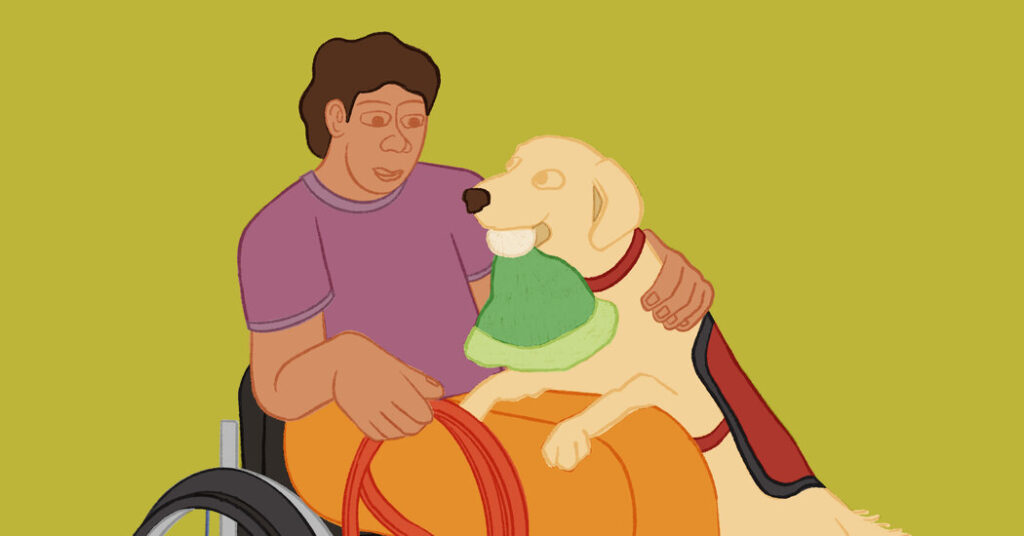
That fear doesn’t tyrannize Shapiro anymore. She found a savior — with blonde hair, big eyes and four legs. His name is Rooster. He’s a roughly 2-year-old mix of Labrador retriever and golden retriever. And he has been trained to recognize sudden changes in her hormone levels or other signs of physical distress and to alert her, sometimes by pressing his nose against her thigh, in time for her to take the right medication or get help.
Rooster was with her, curled up under the podium, when she presented some of her work at an early November meeting of fellow public health researchers and scholars in Washington, D.C. He was the reason she could be there, feel safe there. He’s why she can attend a similar meeting in Florida early this month.
Although they’ve been together for less than two months, she said, “It’s hard imagining my life without him.”
Rooster is a graduate of Eyes Ears Nose & Paws, a North Carolina nonprofit organization that has been preparing and providing assistance dogs for people with chronic illnesses and disabilities since 2008. Many of those dogs, like him, learn to act on what they smell, see or otherwise sense to sound the alarm about an imminent seizure, a glucose surge, a cortisol swerve. Many help people who have limited mobility and dexterity by retrieving important objects, positioning their bodies to be furry grab bars for someone trying to rise from a fall, or tugging on one end of a rope to pull someone out of bed.
What they can do is remarkable, as I saw for myself last week when I dropped by the repurposed house in Hillsborough, N.C., where E.E.N.P. has its office and training rooms. As Maria Ikenberry, who is a founder of the organization and its executive director, took me through its history and mission, a Lab-golden mix named Tomate practiced his door-opening technique just a few feet away. Up he reared, down on the door handle he pressed, through the portal he went, over and over. He had a perfect success rate.
That steadiness, Ikenberry told me, is as important as discrete skills, given the vulnerability of the people with whom her dogs are placed and given how much those people depend on them. “It needs to be a dog that is rock solid, not upset by things, a dog that is unflappable,” she said.
Cultivating that disposition takes intensive labor and extensive time — the program for most dogs, who begin as puppies, lasts 18 to 24 months, after which they and the people with whom they’ve been matched return regularly for, well, canine tuneups. To make the process affordable, E.E.N.P. supplements its staff and its volunteers with local prison inmates, who have the necessary hours to devote to the dogs. All around the country, there’s an established collaboration between service dog groups and corrections officials, who have determined that working with dogs gives incarcerated people a sense of purpose and an emotional lift.
Right now, Ikenberry said, E.E.N.P. is training about 50 dogs, half of them in their second year and poised to finish the program. But only about half of those dogs will attain the proficiency to do the kind of sophisticated medical alert and assistance work that Rooster does. The others might wind up helping law enforcement with the detection of explosives and hidden electronic devices or working as emotional support dogs.
Ikenberry would like to graduate more dogs for more clients but doesn’t have the budget. While most clients do pay for the dogs they receive, it’s a fraction of what E.E.N.P. invests in them; the organization survives primarily on donations. It has, to date, partnered 98 dogs such as Rooster with clients such as Shapiro.
And it has placed them in states as far from North Carolina as Massachusetts, where Marty Harris lives. Harris, 54, has a disorder that causes sudden fainting; at points in her past, she was passing out so frequently — and was in such danger of severe injury from fainting in the wrong spot at the wrong time — that she was homebound.
But assistance dogs have liberated her by functioning as early warning systems and giving her a chance to pause, to still herself, to rest. That can ward off fainting or protect her from harm if it happens.
Dreamer, a black Lab she got from E.E.N.P. in October, does even more than that. Harris has asthma and migraines and sometimes doesn’t even need to command Dreamer to get her bag of medicine from another room; Dreamer just hears Harris wheezing and fetches it. Once, Harris said, Dreamer not only brought her that bag but remembered that Harris keeps a second stash of medicine in a piece of luggage for when she travels. Dreamer went ahead and got that, too.
“She’s an overachiever,” Harris told me. “I had two service dogs before her, and I thought they were both geniuses. She’s blown them out of the water.”
This article is part of Times Opinion’s Giving Guide 2025. The author has no direct connection to the organizations mentioned. If you are interested in any organization mentioned in the guide, please go directly to its website. Neither the authors nor The Times will be able to address queries about the groups or facilitate donations.
The Times is committed to publishing a diversity of letters to the editor. We’d like to hear what you think about this or any of our articles. Here are some tips. And here’s our email: [email protected].
The post This Holiday Season, Give the Gift That Keeps on Sniffing appeared first on New York Times.