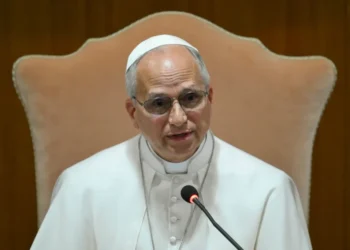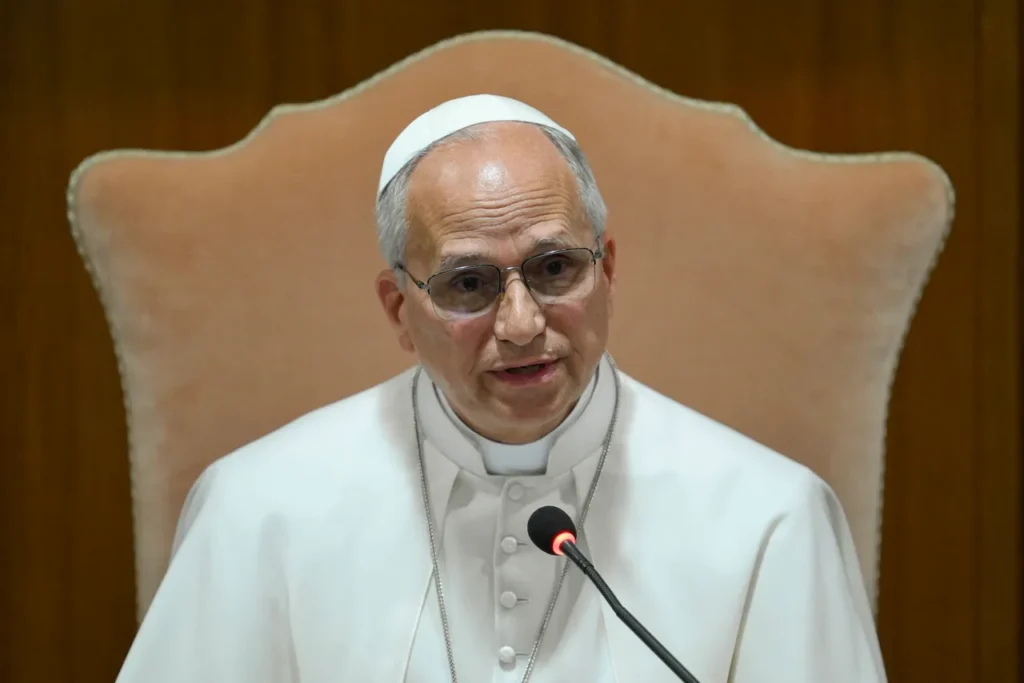
When Pope Leo XIV presented his first encyclical on artificial intelligence at the Vatican on Monday, he invited Christopher Olah, cofounder of Anthropic, to speak. The move signaled an unprecedented alliance between the Catholic church and Silicon Valley. But to understand how this partnership came about, we need to go back to Anthropic’s founding.
Why Anthropic?
Anthropic launched in 2021 after a group of OpenAI researchers, including Dario and Daniela Amodei, left to form a rival lab. They did so with a clear conviction: Artificial intelligence models were becoming too powerful to be developed exclusively according to the logic of competition and speed.
Since then, Anthropic has built its public image around the concept of AI safety. The company aims to build not just powerful models, but ones that are controllable and guided by ethical principles. This is where the concept of Constitutional AI comes from: the idea of training systems using a kind of constitution composed of principles and rules, instead of just manually correcting the most risky and dangerous responses.
How the Convergence With the Vatican Began
Olah’s presence at the Vatican was obviously not accidental, nor the result of a last-minute symbolic gesture. It was the outcome of a deliberate, long-term effort in which the Vatican has progressively sought to transform itself from a moral observer of technology into a direct interlocutor with the AI industry.
The first major step came in 2020 with the Rome Call for AI Ethics, an initiative promoted by the Pontifical Academy for Life together with Microsoft, IBM, and other international organizations. The goal was to establish a shared foundation of ethical principles for the development of AI, including transparency, inclusion, and accountability.
At the time, the Vatican appeared to be operating primarily in the realm of bioethics and moral questions. In the years that followed, however, the context changed dramatically. The rise of ChatGPT, the struggle for technological leadership between the United States and China, and the growing power of Big Tech gradually convinced the Holy See that the issue was no longer just about tech ethics, but about the very future of humanity.
In this sense, Anthropic has come to be seen by the Vatican as a particularly important interlocutor. Unlike other Silicon Valley companies that have built their reputations primarily around innovation and growth, Anthropic has made AI safety a core part of its identity.
In recent years, the Vatican has followed one specific strand of the technology debate with particular attention: the alignment of AI models.
Olah’s Role
This is where Christopher Olah comes in. Unlike the Amodei siblings, who are more exposed to the media, Olah represents the more theoretical and almost philosophical side of AI research. He is one of the world’s best-known researchers on the topic of model interpretability, or the effort to understand what really happens inside increasingly complex neural networks.
On his personal website, Christopher Olah describes himself as someone trying to “transform neural networks into algorithms understandable to human beings.” And it is difficult to imagine a figure more aligned with the core of Pope Leo XIV’s encyclical: a reflection centered on the risk of building technologies that become too powerful to be understood, controlled, or governed.
According to various journalistic sources, the contacts between circles close to the Holy See and Anthropic may have intensified right during the global summits on AI safety. The Vatican saw in Anthropic a company at least willing to publicly acknowledge that the problem of artificial intelligence cannot be solved by the technology industry alone.
This is a point emphasized both in the text of the encyclical and during its presentation. The document repeatedly insists on the idea that technology is not neutral, and that algorithms inevitably embody a particular worldview. Through its Constitutional AI project, Anthropic is attempting to do precisely this: explicitly introducing values, rules, and principles into the behavior of AI models.
In essence, the connection between the Vatican and Anthropic lies in a shared fear: that increasingly powerful systems could end up shaped solely by the economic, geopolitical, and competitive incentives driving the global AI race.
Reputation as Product
The story also has an industrial dimension, not just a spiritual one: For Anthropic, its relationship with the Vatican inevitably carries enormous reputational value. At a moment when artificial intelligence is becoming increasingly central to debates about labor, national security, surveillance, and military power, the image of an “ethical AI company” is a significant advantage.
Claude, Anthropic’s chatbot, was built precisely around the idea of trust with users. The model “responds” to an ethical constitution, the company’s public language continually revolves around responsibility and safety, and ethics itself becomes part of the product’s symbolic infrastructure.
“Magnificent” Humanity
The very title of the encyclical revolves around a specific tension: The human being is described as “magnificent,” yet at the same time capable of creating new forms of dehumanization. Seen from this perspective, artificial intelligence is not evil in itself. It is a mirror of the people who build it.
For this reason, the Vatican repeatedly warns about the risk of a new, “digital Babylon”: a society that reduces people, relationships, and even truth itself to data, performance, and efficiency.
In the text, Pope Leo XIV speaks explicitly about the concentration of technological power in the hands of a small number of transnational private actors. It is a critique that echoes many contemporary debates around AI governance: Who controls the models? Who decides the criteria by which they are trained? Who owns the infrastructure of the future?
During the presentation of the encyclical, Christopher Olah said something unusual for a tech executive: He openly acknowledged that even companies most attentive to ethics remain immersed in economic, geopolitical, and competitive incentives that can conflict with “doing the right thing.” In doing so, he publicly recognized that the problem of artificial intelligence cannot be left to the self-regulation of technology companies alone.
The “Hiroshima of the 21st Century”
In debates about AI, comparisons to the atomic bomb return again and again. The difference is that nuclear technology was controlled by states, whereas AI is being developed primarily within private companies. This is one of the central points of the encyclical: Today, “technological power takes on a new face, one that is predominantly private.”
And this is where a shared fear emerges—expressed in very different language both by the Vatican and by the parts of the AI world most focused on safety: that increasingly powerful systems, like those now being developed, could end up guided by distorted human incentives.
From this perspective, the “Hiroshima of the 21st century” might not be a single catastrophic event, but rather a slow process of social automation in which human beings begin delegating to machines the ways they think, choose, inform themselves, and relate to one another. In other words, the risk is that Magnifica humanitas could transform into something terribilis.
The post Why the Vatican Invited Anthropic to the Pope’s AI Encyclical Presentation appeared first on Wired.