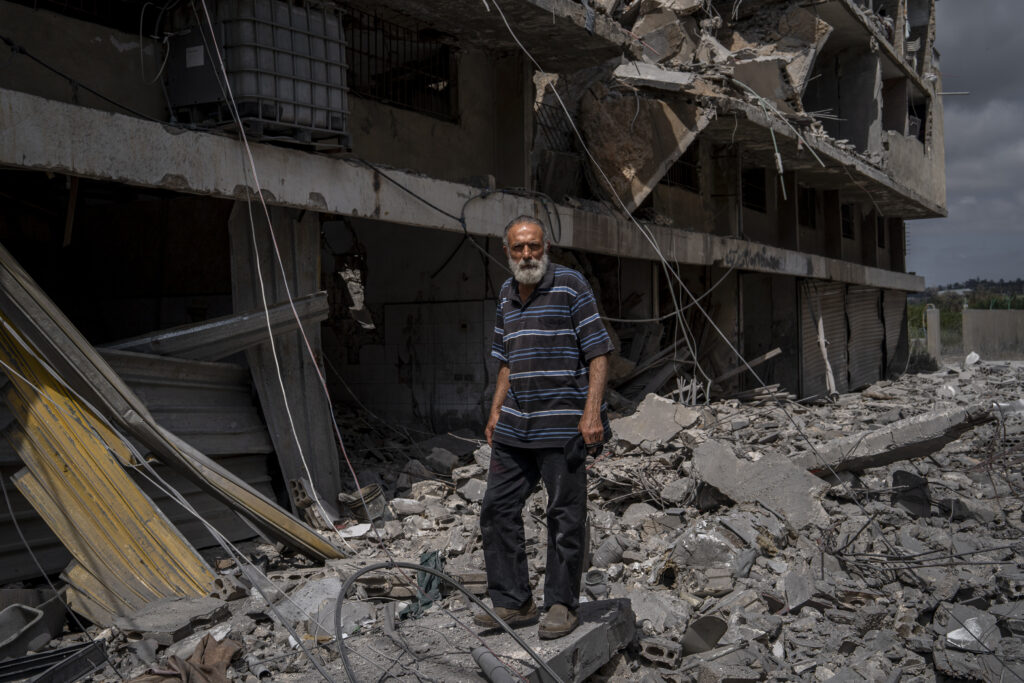
Fighting between Israel and Hezbollah intensified Tuesday as Iran threatened to retaliate after U.S. strikes overnight. The fragile ceasefires in both conflicts have come under increasing strain.
Israel is “deepening its operation” in Lebanon, Prime Minister Benjamin Netanyahu said, as the Israel Defense Forces pushed beyond the “yellow line” established in a U.S.-brokered ceasefire last month.
“The IDF is operating with large forces on the ground and seizing dominant terrain,” Israeli Prime Minister Benjamin Netanyahu said at a security cabinet meeting Tuesday.
Israel’s military is operating in a “targeted manner beyond the Forward Defense Line in Lebanon” to remove “direct threats … in accordance with the directives of the political echelon,” said an Israeli military official, speaking on the condition of anonymity to discuss sensitive details.
Despite the ceasefire, Israel and Hezbollah have continued to trade attacks. More than 700 people have been killed in Lebanon since the ceasefire went into effect in mid-April, Lebanese health officials said. At least 10 Israeli soldiers have been killed in southern Lebanon in the same period.
Rare talks between Israel and Lebanon, facilitated by the United States, led to an initial ceasefire that has been extended twice, most recently in mid-May talks that included larger delegations.
On Monday night, the U.S. military said it launched “self-defense” strikes in southern Iran, on targets including missile launch sites and Iranian boats attempting to set mines. Navy Capt. Tim Hawkins, a military spokesman, said the military used “restraint during the ongoing ceasefire” while continuing to “defend our forces.”
Iran’s Foreign Ministry condemned the attacks, which it called a “blatant violation” of the ceasefire, and said it would “leave no act of hostility unanswered.”
Iran and the United States are negotiating a memorandum of understanding to reopen the Strait of Hormuz and extend the ceasefire while they work toward a more substantial accord. Both sides over the weekend signaled progress, but U.S. officials said no deal had been reached.
U.S. officials later said the extension could last 60 days, while the Strait of Hormuz — the narrow waterway through which some 20 percent of the world’s oil supply passed before the conflict — is demined and reopened.
President Donald Trump on Sunday also urged several majority-Muslim countries to join the Abraham Accords, a set of treaties aimed at normalizing relations with Israel, as part of the ceasefire deal. However, analysts say countries’ acceptance of that stipulation is unlikely.
On Sunday, Secretary of State Marco Rubio had predicted there would be an imminent announcement on a deal to reopen the strait, but no such details were released.
Analysts say that even if a deal is reached to open the strait, it will take time for the waterway to see its prewar status quo levels of transit. More than 20,000 seafarers on over 1,000 vessels remain stranded in the Gulf, with only a trickleof the prewar roughly 130 daily transits passing through.
In discussions about a deal, U.S. government officials sometimes seem to “keep forgetting that getting to a deal is only the start of the process to recover from this,” said Andrew Leber, a nonresident fellow at the Middle East program of the Carnegie Endowment for International Peace, a Washington-based think tank.
“Everything takes an inordinate amount of time,” he said, adding that parameters of a deal involve opening the Strait of Hormuz starting after one month. “Then demining still needs to happen, and even once it begins to open, ships will be going out at a slow pace.”
Leber said that there would be a backlog of ships trying to get through, that the ships that are waiting will be moving slower than usual with skeleton crews and that some ships that rerouted may have changed their routes altogether.
“Since the likelihood of future flare-ups seems high, some shippers may decide they are fine paying a premium for a safe route,” he said.
There would be multiple steps in the reopening process, with the first and main one being that operators once again feel safe, said Mark Finley, a fellow in energy and global oil at Rice University in Texas.
For traffic to open to a much wider flow of traffic, “Tankers and their insurers more broadly have to be confident that they are not going to be attacked,” Finley said.
Even if or when there is an agreement to reopen the strait, he said, it would take time to get such a massive logistical operation back up to speed. Some production facilities in the Gulf that have been slowed or damaged would need to restart production. Tankers would need to arrange trips into the Gulf before they could head back out again with oil.
“Every day flows are reduced through the strait, the oil market is in a hole,” Finley said. “And that hole gets deeper every day.”
Westfall reported from Washington. El Chamaa and Haidamous reported from Beirut and Soroka from Tel Aviv. Rachel Chason, Evan Halper and Susannah George in Washington contributed to this report.
The post Lebanon ceasefire falters as Trump pushes for Iran deal appeared first on Washington Post.