In this edition, we explain how the warnings about jet fuel shortages could affect emissions from air travel. But, first let’s get caught up:
So, what happened to the worst-case climate scenario? Last week, an international team of researchers published a major revision of the emissions scenarios used to study global warming. Here’s why the worst-case scenario got revised down.
The U.S. seeks to give weapons-grade plutonium to start-ups for fuel: The Trump administration is moving forward with a plan to provide plutonium from dismantled nuclear warheads to companies that want to convert the dangerous material into fuel for nuclear power plants. It would be the first time the U.S. government has made weapons-grade plutonium available to private companies. The plan has generated debate and some unease among nonproliferation experts, Brad Plumer reports.
Twenty years after “An Inconvenient Truth,” Al Gore is still giving a climate slide show: The Oscar-winning documentary was built around Gore’s grim presentation on the effects of climate change. Chico Harlan reports that Gore still gives the road show on climate change, but the tone and details have changed to suit the times.
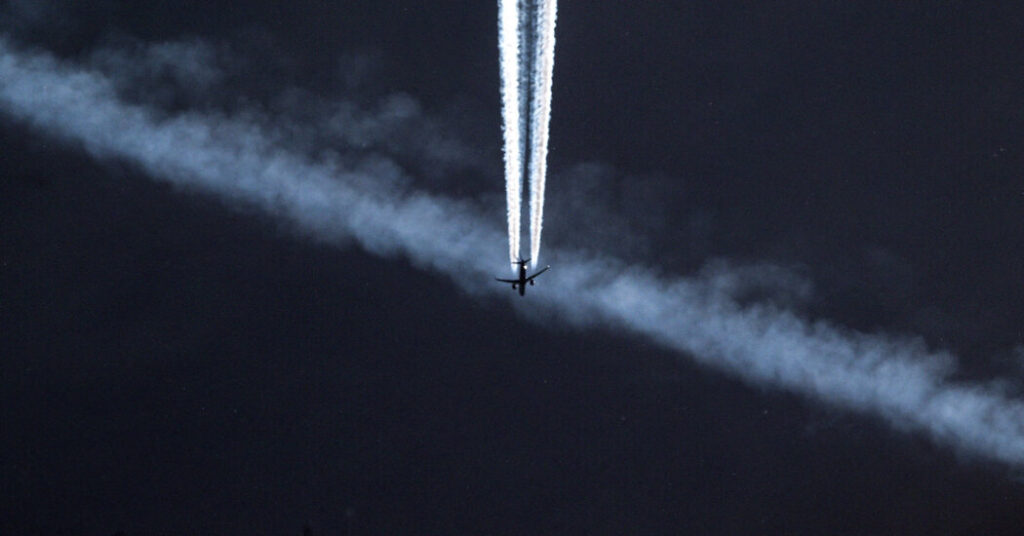
When will emissions from air travel start to fall?
Some of the most dire early predictions about the effects of the Iran war warned of severe disruptions to the global aviation industry. Experts feared a prolonged conflict would lead to jet fuel shortages, summer flight cancellations and soaring ticket prices.
The closure of the Strait of Hormuz, a key channel for oil and gas, has pushed some to wonder whether the conflict will have any effect on overall greenhouse emissions from air travel, which makes up about 2.5 percent of global carbon dioxide emissions. Scarce jet fuel could mean fewer flights or bigger investments in lower-carbon alternatives, like sustainable aviation fuel.
But so far global air travel hasn’t been hit as hard as many feared.
Yes, airlines have raised prices, imposed fuel surcharges and canceled some flights in response to the disruption. But widespread shortages have not materialized, and executives from Ryanair and easyJet said last week that they were not concerned in the short term.
So, what happened?
Oil exporters like the U.S. and West Africa stepped up production, and some refineries have made more jet fuel and less gasoline. Some would-be ticket buyers have sat on the sidelines as prices inched upward.
In the U.S., travelers have been willing to buy pricier tickets: United Airlines has raised prices by 15 to 20 percent since the start of the conflict, but expects to fly three million more passengers this summer than last.
This balance may be fragile, analysts say.
If the Strait of Hormuz doesn’t reopen by mid-June, one estimate from Rystad Energy, a research firm, suggests total jet fuel demand could actually fall this year as airlines cut flights.
Fewer flights, higher prices
Surging jet fuel prices have hit one corner of the industry particularly hard: Budget carriers that operate short-haul flights. Shorter flights use more fuel relative to total distance traveled because takeoff requires so much energy.
In the U.S., the budget airline Spirit pointed to rising jet fuel prices as one reason for its collapse in early May. And in Southeast Asia, where low-cost carriers like AirAsia have seen huge growth in the last 25 years, fuel-related price increases have taken a big bite out of travel demand.
Budget airlines have cut about 20 percent of flights compared with pre-crisis levels, which equates to around four million fewer passengers per month, wrote Brendan Sobie, an airline analyst based in Singapore.
“It’s a very price-sensitive market,” Sobie said in an interview. “So when you increase fares, not everyone can afford to fly.”
What happened to sustainable aviation fuel?
Airlines have long promised they’ll invest in sustainable aviation fuel, or SAF, which can be made from used cooking oil, corn ethanol, or other agricultural and waste products.
So, as fuel prices soar, why aren’t they rushing to fill their tanks with SAF?
There’s still not enough sustainable aviation fuel being produced to make a real dent in jet fuel demand. United Airlines says it’s the biggest SAF buyer in the United States, and the 28 million gallons of fuel made from used cooking oil it burned last year made up less than 1 percent of its total fuel consumption.
But the rise in jet fuel prices has narrowed the price gap between conventional jet fuel and SAF, said Lauren Riley, the chief sustainability officer at United Airlines. In recent weeks, she said, conversations about alternative fuels have been less about cutting emissions and more about making sure there’s enough fuel to go around — a first in her tenure.
“We’re beginning to appreciate in a manner that we didn’t appreciate before that the supply chain to produce SAF is completely decoupled from the fossil supply chain,” Riley said. “And so that presents an opportunity for us to just diversify our fuel sources.”
Sustainable aviation fuel has a long way to go, and critics have pointed out that some of these alternatives may not be all that environmentally friendly. The Biden administration set a goal of producing three billion gallons of SAF per year by 2030, about 10 percent of fuel demand. But a recent industry projection estimated that growth for cleaner-burning SAF will actually slow in 2026.
Invasive species
How ‘sentinel gardens’ help spot dangerous bugs abroad
Sentinel gardens, scattered around the world, are plots of foreign trees that researchers closely monitor to figure out what local bugs and diseases can damage them. The goal is to learn as much as possible about these potential threats before they cross the ocean and become a problem at home.
Thousands of nonnative insects and plant diseases have found their way to the United States, often hitchhiking in on imported goods. As warming temperatures make it possible for species to survive in new places and global trade continues to expand, the spread of invasive species is expected to grow.
Many of these outsiders prove harmless, but some go on to ravage citrus groves, soybean fields and forests.
It takes just one to cause a huge problem, one researcher said. — Sachi Kitajima Mulkey
Number of the day
Drought now covers 70 percent of the West
Widespread drought in the American West is forcing cities to restrict water use and farmers to abandon their fields, Jack Healy, Reis Thebault and Scott Dance report. It’s also, they write, “raising pressure on Western states and the Trump administration to avert an all-out collapse along the dwindling Colorado River.” One water management official in Colorado told The Times that water sources in the area are “just drying up.”
In their own words
“When I started, nobody had heard of the problem. Nobody was active. We started at zero. Well, look at us now. Everybody in the world knows about climate change. So is that progress? Let’s hope.”
That’s Rafe Pomerance, a prominent environmentalist, who died last week, looking back on his life of activism. He was 79.
In an obscure 1979 report, Trip Gabriel writes, Pomerance discovered that “burning coal heats the atmosphere, which roused him to play a Paul Revere-like role in warning the public and politicians about climate change.” Pomerance was key in introducing James Hansen, of NASA’s Goddard Institute in New York, to Washington policymakers. In June 1988, during a year of record global heat, Dr. Hansen testified to a Senate panel that global warming was a real and imminent danger.
one last thing
The oldest baobab tree in Madagascar is dying
Tsitakakantsa, one of the largest and oldest baobab trees in Madagascar, is dying, according to experts and local stewards.
Having survived centuries, it appears to have entered a final phase in which it will buckle, collapse and eventually disintegrate. It could take months, maybe longer. Eventually, only a patch of stained earth — like a shadow in the soil — will remain.
To the surrounding forest community, which has long revered Tsitakakantsa, its demise represents the loss of a spiritual anchor. To the wider world of scientists and nature lovers, it underscores the fragility of even the most enduring pillars of nature in the face of rapid environmental change. — Jonathan Wolfe
More climate news from around the web:
-
“When Tehran oil infrastructure caught fire in March following Israeli strikes, the blaze produced toxic fumes detectable across an area the size of Italy,” Bloomberg reports.
-
The Guardian published an investigation into BHP, the world’s biggest mining company. Leaked internal documents show that the company quietly “halted or delayed projects to cut vast amounts of emissions.”
Read past editions of the newsletter here.
If you’re enjoying what you’re reading, please consider recommending it to others. They can sign up here.
Follow The New York Times on Instagram, Threads, Facebook and TikTok at @nytimes.
Reach us at [email protected]. We read every message, and reply to many!
Claire Brown covers climate change for The Times and writes for the Climate Forward newsletter.
The post When Will Emissions From Air Travel Start to Fall? appeared first on New York Times.