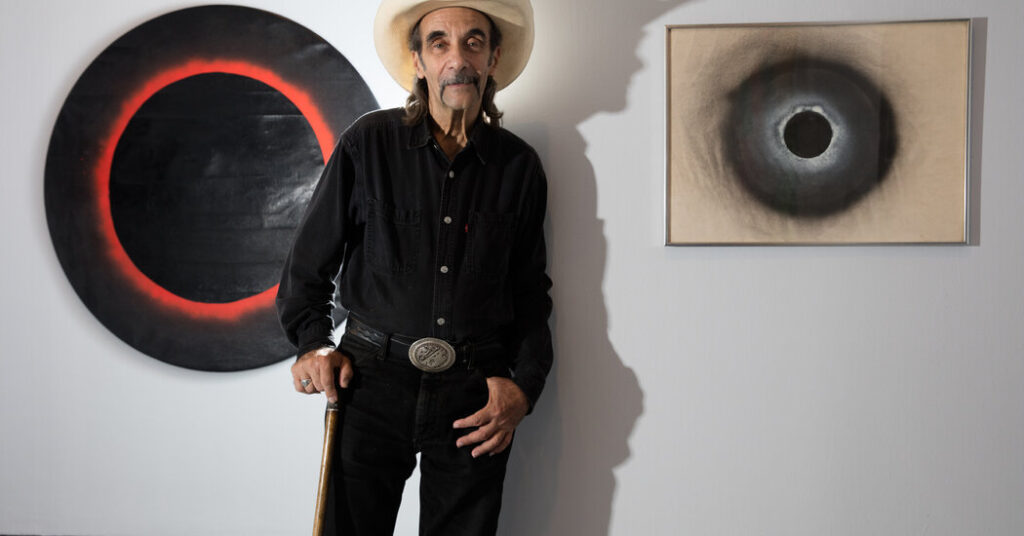
Ben Morea, an artist and chief provocateur of an anarchist group that rattled New York City in the 1960s, dumping garbage on the steps of Lincoln Center and booby-trapping the stairwell of a Columbia University building with furniture hung from the ceiling and rigged to drop, died on May 2 at his home in Gardner, Colo. He was 84.
Mr. Morea’s former wife, Joan Eagle, said he collapsed while walking on their property, about 60 miles from the New Mexico border. He moved to the region in 1969, living among Native American tribes and working as a lumberjack for nearly four decades before re-emerging in Manhattan as a flea market picker.
Barely 5 feet tall and as thin as a parking meter, Mr. Morea was an abstract painter who wanted to creatively destroy the gap between art and revolution. He published the militant magazine Black Mask and loosely led a band of radicals whose name began Up Against the Wall and ended with a profanity.
Based on the Lower East Side, the group of runaways, Ivy League dropouts, petty criminals and artists armed themselves with guns and switchblades, hosted community meals, provided assistance to Vietnam War draft dodgers, ran a free clothing store and tripped out on psychedelics.
As a counterculture figure, Mr. Morea was more pugnacious than Abbie Hoffman and Jerry Rubin, who engaged in whimsical acts like tossing money on the floor of the New York Stock Exchange and “levitating” the Pentagon. He admired the Black Panthers but thought they were too hierarchical.
And he had little regard for hippies, though he did travel to Boston in 1968 to help defend them against local vigilantes who were bullying them. The incident turned violent and resulted in his arrest on assault charges. (He was acquitted.)
“They were getting beaten,” Mr. Morea said in a 2019 interview with the online publication Ill Will. “And to us, it was like a challenge: ‘Oh, you’re going to beat up these kids. Long-haired, innocent kids, that probably never had a fight. Well, all right — beat us up.’”
Mr. Morea didn’t become as well known as other leaders of the counterculture movement. That was intentional. In choosing a name that mainstream publications couldn’t write, Up Against the Wall ensured that the media wouldn’t turn them into a spectacle.
“Ben wanted us to be the action faction, to be doing rather than talking about doing,” Osha Neumann, a member of the group who later became a civil rights lawyer, said in an interview. “He believed in the propaganda of the deed, not in the propaganda of the word, and he mobilized us in ways that were not traditionally political.”
In 1967, as Secretary of State Dean Rusk arrived at a banquet in New York, the group hurled eggs, rocks and bags of cow blood. Later that year, during an antiwar march on the Pentagon, they were among a group of protesters that broke into the building through an unguarded door and were forcibly removed by soldiers.
As mayhem on American streets increased in 1968, the group became more creative and audacious.
During a literary gathering at St. Mark’s Church in-the-Bowery, a member fired a blank round at the poet Kenneth Koch, whom the group deemed overly bourgeois, as he read from his work. Mr. Koch fainted, people in the audience screamed and the group flung leaflets from the balcony printed with “POETRY IS REVOLUTION” and a photo of the writer LeRoi Jones. (A line from the poetry of Jones, who later became Amiri Baraka, gave the group its name.)
When New York sanitation workers went on strike and piles of garbage grew mountainous, Up Against the Wall members collected bags of trash and headed for Lincoln Center, the arts complex that had displaced Black and Puerto Rican New Yorkers from a community known as San Juan Hill.
Depositing the garbage on the center’s steps, they handed out fliers that said, “WE PROPOSE A CULTURE EXCHANGE — GARBAGE FOR GARBAGE.”
Later in 1968, Up Against the Wall stormed the stage of the Fillmore East, the rock music venue, and demanded that its owner, the promoter Bill Graham, provide one night a week for free community use. At some point, Mr. Graham’s nose was bloodied.
Mr. Graham invited Mr. Morea to his office, opened his desk drawer and pulled out three bullets. “These were given to me by the Hells Angels because they wanted something from me,” Mr. Graham said, as Mr. Morea later recalled. “And now you want something from me.”
Mr. Morea replied, “Yes, the only difference is, if we give you three bullets, they’re not gonna be on your desk.”
Mr. Graham gave him Thursday nights.
“We were like the psychedelic mafia,” Mr. Morea said.
Mr. Morea was born on Oct. 8, 1941, in Washington, D.C., and grew up in the San Juan Hill neighborhood in Manhattan, where Lincoln Center was later built. His full name at birth and his father’s name could not be confirmed. His mother was Aida (Maglia) Waller, and his stepfather was Henry Waller.
As a teenager, he learned that his father’s surname was Morea and began using it. By then, he was hanging out in jazz clubs and using heroin.
In the late 1950s, he was arrested on charges of drug possession and sent to prison, where he took up abstract painting. In 1964 and 1965, his paintings appeared in group shows in Manhattan galleries alongside works by Ad Reinhardt, Louise Nevelson, Louise Bourgeois and Meredith Monk.
“They stand on their own as important objects in postwar art,” Matthew Higgs, the curator of White Columns gallery in Chelsea, told The New York Times in 2016 during the run of a show featuring Mr. Morea’s works. “They deserve to be in the permanent collection of the Whitney.”
Mr. Morea became disgusted by the rise of Pop Art, calling Andy Warhol “despicable,” and he later praised Valerie Solanas (a friend of Mr. Morea’s) after she shot Warhol in 1968.
Hanging out on the Lower East Side, he fell into a crowd of increasingly anarchist radicals. “We had an edge,” he said in “Full Circle: A Life in Rebellion” (2025), an oral history of his life. “We didn’t fit with the love generation. We weren’t flower children. Instead of peace and love, we proposed ‘armed love’ — I coined that phrase.”
The novelist Rachel Kushner depicted Up Against the Wall in “The Flamethrowers,” her 2013 novel about the frenetic arts scene in downtown New York during the 1970s.
“My interest in them was in their exuberance, their commitment and intensity, and also their capacity for humor,” Ms. Kushner said in an interview. “Ben didn’t want to be the leader of anything. He’s inspiring people, but without doing it by cult of personality.”
The police didn’t always see it that way.
In 1969, sensing the heat was getting a little too hot, Mr. Morea disappeared with his wife to a wild, mountainous part of Colorado. They traveled around by horseback with cowboys for five years — two city people living off the land, hunting for food and making their own clothing.
“It’s almost unimaginable,” Mr. Morea later said. “And I cannot tell you how or why, but I felt so comfortable.”
Eventually, they settled on land in Southern Colorado. Mr. Morea and his wife became active in the Native American community, taking care of dozens of children. He changed his name to Ben Eagle in 1980.
Around 2004, he reappeared in New York, wearing a cowboy hat. Now hobbled by a limp, and not nearly as menacing as in earlier days, Mr. Morea spoke to a group of young anarchists at 16 Beaver Group, an artists’ space in the financial district.
“Part of the reason I re-emerged to talk about what we did back in the 1960s is the fact that things have gotten so bad in the U.S.,” Mr. Morea said in an interview with libcom.org, a “libertarian communism” website. “It’s at a point where you can’t ignore it, it’s worse than ever. I figured that I’d start letting people know about our history and then go from there.”
Mr. Morea rented a loft and supported himself by buying and flipping high-end artwork, beaded purses and furniture that he discovered at flea markets.
“He had an extremely refined eye,” Michael Rips, the author of “The Golden Flea: A Story of Obsession and Collecting” (2020), said in an interview. “He was still a little worried that the authorities were after him, so this was the perfect way for him to make a living — in cash. And he was very good at it.”
In addition to his former wife, Mr. Morea is survived by a son, Jared Dean Yelloweagle; a brother, Allen Waller; a grandson; and a great-grandson.
Mr. Neumann recalled Mr. Morea fondly in his memoir of their days together on the streets.
“He had a way of cocking his head to one side and hitching himself up when preparing for a confrontation that might have seemed ridiculous in someone else,” Mr. Neumann wrote. “But Ben was not ridiculous. Ben’s strength lay in the fact that, in a non-trivial sense, he was true to his word.”
The post Ben Morea, Principal Provocateur of 1960s Anarchist Group, Dies at 84 appeared first on New York Times.